Original fiction
On this page
One More Stop Before Home
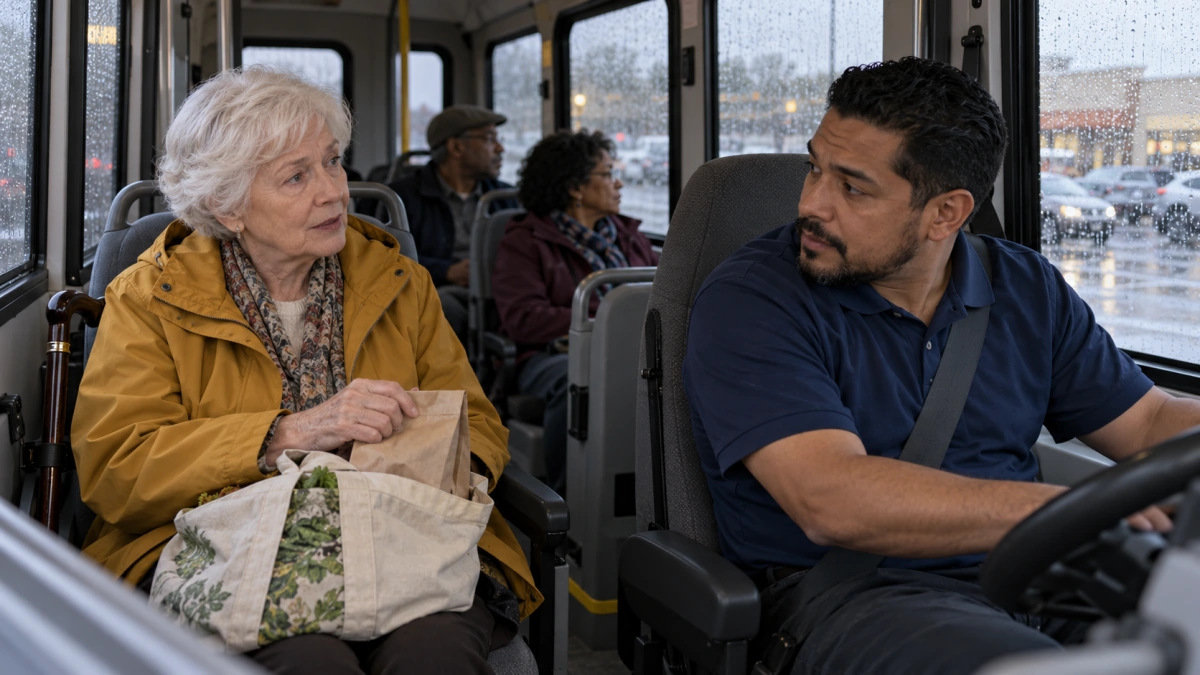
Irene Webb kept her paper bag as I closed the shuttle door.
Her grocery bags were zipped shut. Her cane was upright beside her knee. She had checked her receipt, tucked it into her wallet, and fastened every button on her ochre raincoat. There was nothing confused about the way she looked at me.
"We still have one stop," she said.
Behind her, Mr. Bell shifted the insulated bag containing his groceries. Across the aisle, Ruth pressed the button on her watch to check the time. I had three passengers left, a return sheet clipped beside the steering wheel, and a daughter who expected me at school at four.
"We're heading home now," I told Irene.
"After the cemetery."
The rain ticked against the windshield. We were parked outside the grocery store in Dayton, finishing the Tuesday shopping route. I was thirty-nine, a part-time community shuttle driver, and very good at noticing when a trip was about to become something that wasn't on my sheet.
Irene lifted a small paper bag off her lap. "I asked last week. I wrote it on the form."
"Did dispatch confirm it?"
"Nobody said no."
My name is Mateo Santos. There are things that sound easy until you're the person behind the wheel. One extra stop. Five little minutes. A road you've driven a hundred times.
Then Irene told me Tuesday would have been her wedding anniversary. Victor had died eighteen months earlier. She had brought a smooth stone from their garden, wrapped in a clean handkerchief.
I looked at the route again. No cemetery. No time set aside for a visit. No way to make the promise she thought we'd already made without breaking promises to people still sitting behind her.
"Let me call dispatch while we're parked," I said.
Irene nodded once. She didn't cry. Somehow that made the situation harder. Tears would have given me something familiar to respond to. Her composure left me with the actual question.
I called Devika Rao on the work phone. She answered over the sound of a drawer shutting. I could picture her burgundy cardigan and the black-and-gray braid she tucked over one shoulder when she studied the schedule.
"I have a passenger asking about an additional stop," I said. "It's not on the confirmed sheet."
I didn't announce the anniversary to the whole dispatch room. Irene could decide what she wanted to share. I handed her the phone after asking if she'd like to explain the request herself.
"This is Irene Webb," she said. "I left a form last Tuesday. Cemetery and home afterward."
She listened. Her thumb rubbed the folded top of the paper bag.
"I understand what the sheet says. I'm asking what happened to the form."
I had seen Irene nearly every Tuesday for months. She knew which seat gave her room to place her cane without blocking the aisle. She carried a shopping list folded into quarters and crossed things off with a small pencil. Once, when a new passenger couldn't find the seat belt buckle, she had pointed it out without making him feel foolish. None of that meant I knew what she had arranged with dispatch. Familiarity had made me assume we were all expecting the same ordinary afternoon.
Earlier, in the grocery store parking lot, she had asked whether the rain would stop. I had said probably. I'd thought she was worried about carrying her bags inside. Now I remembered the careful way she had checked the sky through the glass. There had been a whole second journey in her mind while I was counting riders and looking for carts left behind the shuttle.
Ruth looked out the window. Mr. Bell held his groceries more tightly. The shuttle heater clicked, and the windows began to mist at the corners. I turned the fan up a notch.
Irene handed the phone back. "She wants you."
Devika said she had found the request in a folder marked for follow-up. It hadn't been confirmed or transferred to a booked trip. She was sorry. There was no cemetery stop authorized on my route, and she couldn't add a visit while keeping the current return commitments.
"Any actual option this afternoon?" I asked.
She checked. I heard keys, a pause, then more keys. The other vehicle was committed to its scheduled riders. The later driver had no open supported slot. There was no hidden shuttle waiting for someone to ask the right way.
"Not today," she said. "Don't promise a time before I've checked next week."
I thanked her and ended the call. Irene watched my face, already knowing.
"We need to finish the booked returns," I said. "I'm sorry we didn't give you a clear answer earlier. We can't make the cemetery visit on this trip."
"It's along the way."
"The entrance is near one of our roads. A visit still needs its own time."
She looked down at the bag. "I wasn't planning to stay all day."
"I know."
"You don't know. You haven't asked me."
That was true. I had been responding to the shape of the problem instead of the woman describing it.
"How long had you hoped for?"
"Enough to walk to him and back without somebody watching a clock behind my head."
I let her finish. That was not five minutes, and both of us knew it.
Ruth cleared her throat. "I don't mind if we're a little late."
"I do," Mr. Bell said.
Ruth turned toward him, surprised by how sharply it came out. He lowered his eyes to the insulated bag.
"My building door is being repaired. My neighbor said she'd meet me before she leaves for work. I can't carry these up the side steps alone."
"You shouldn't have to explain," I told him. "Your return is booked. We'll keep it."
I said it to the whole vehicle, not only to Irene. Generosity was easy when you were offering someone else's stairs, someone else's cold groceries, someone else's child waiting at school.
Irene turned carefully in her seat. "I'm sorry, Mr. Bell. I didn't know about your door."
"You didn't need to," he said, less sharply now.
She faced front again. "Take me home."
There was no way to hear that without feeling I'd failed. But feeling it didn't give me permission to turn left where the route said right.
I checked that everyone was ready, checked the mirrors, and drove toward the first return. Rain gathered at the wiper's edge and swept away. At the light, Irene said Victor used to complain that the grocery store moved the bread every month.
"It does," Ruth said.
"I know. I kept defending them. I thought he just wanted an excuse to look at the pies."
Mr. Bell made a sound that might have been a laugh. The traffic light changed. Ordinary conversation returned, but not because the hurt had disappeared. It had simply made a little room for bread.
At Mr. Bell's building, his neighbor was waiting beneath a red umbrella. I parked at the approved entrance and helped with the bags according to our usual procedure. The side steps shone with rain. If we'd come later, he would have been standing there deciding whether he could manage them.
"Thank you," he said quietly.
I nodded, careful not to turn his safe arrival into evidence against Irene. These were people, not competing examples in a training booklet.
Ruth was next. Before getting out, she touched Irene's shoulder after asking with a small gesture. "I hope you get there," she said.
"So do I," Irene answered.
Her apartment building was the last stop. I offered the usual assistance with her groceries. She accepted the heavier bag and carried the small paper one herself. In the lobby, she set it on the mail table while she found her keys.
"I can request a call from Devika," I said. "Only if you want that. She can discuss a separate visit, not promise today."
Irene kept looking through the neat compartments of her purse. For a moment I thought she was going to ignore me. Then she took out her keys and held them flat on her palm.
"Yes. Tomorrow morning, if possible. Not tonight. My sister calls tonight, and she will make plans before I've finished the first sentence."
I smiled. "Tomorrow morning requested."
"Requested," she repeated. "Not confirmed."
"Right."
She gave me a look that was neither forgiveness nor accusation. It was the look of a person adjusting a piece of information she should have had sooner.
I brought the groceries to the agreed drop-off point, made sure she had them, and returned to the shuttle. The small bag was still on the mail table. I almost called her back, then saw her lift it herself. She had not forgotten it. She had set it down.
Before I pulled away, Irene came back to the lobby door. She didn't wave for me to stop. I was still parked, completing the return note. She waited until I saw her and opened the passenger door from the controls.
"I left a photograph in my bag," she said. "I was going to show it to you."
She held it up but stayed under the doorway's shelter. Two young people stood beside a car with an enormous hood. The woman had Irene's direct gaze. The man wore a suit that seemed slightly too large in the shoulders.
"That was the wedding?" I asked.
"Afterward. We changed before the meal because he spilled coffee down his shirt. That's his brother's jacket. Everybody thinks it's a wedding picture because we look so pleased. Really, we were laughing at the sleeves."
I looked long enough to see what she wanted me to see. Not a symbol of lost love, just a young man wearing somebody else's clothes and making a young woman laugh beside a car.
"He looks funny," I said.
"He was. Not all the time. Enough."
She lowered the photograph and put it back in her handbag. "I'll talk to Devika tomorrow."
"I'll pass on the time you asked for."
She went inside. I waited for the door to close, checked the mirrors, and continued to the depot. I had not taken her to the cemetery. Listening to a story about a jacket did not cancel that disappointment. But I was glad I hadn't driven off before she could show me the photograph.
At the depot I logged the unresolved request and the requested callback time. I included the missed confirmation, not just "passenger requested detour." The difference mattered. Irene hadn't sprung a whimsical excursion on us. We'd left a question unanswered until it became an expectation.
Devika came out of the office as I handed in the keys. Her braid had loosened near her neck.
"I found the original form," she said. "It was put aside because it needed clarification. Nobody called."
"She thought no answer meant yes."
"I can see why. The form says we'll contact you if there is a problem. It doesn't say a submitted request isn't a reservation."
I leaned against the counter, suddenly tired. "That doesn't make a route appear today."
"No. It makes an apology necessary. And a better answer tomorrow."
My personal phone vibrated. The school had sent the usual reminder about the after-school pickup location. My daughter, Lucia, was nine and practicing for a class performance she insisted was not a play, because there were songs but no costumes. I had promised to listen to her lines before dinner.
Devika glanced at the clock. "Go. You're finished here."
I wanted to ask whether Irene had called again. Instead I said goodbye and went to my car.
At school Lucia came out carrying a cardboard tree. Its leaves were made from green tissue paper. She refused to put it in the back seat until I moved an empty water bottle that might crush a branch.
"You look like your bus broke," she said.
"The shuttle is fine."
"Then why that face?"
I told her someone had been disappointed today. Not the person's name or private story. Just that I couldn't do something they wanted because I had other things I had promised to do.
"Like picking me up?"
"Yes. Like picking you up."
She considered this as I fitted the tree into the car. "You can be sad and still come."
Children sometimes say things that sound wise because they are speaking about a world small enough to see. I didn't make her sentence carry more than it needed to. I buckled her in and asked which branch was the important one.
At home we made eggs and toast. She rehearsed beside the refrigerator, using a wooden spoon as a microphone. I missed one cue because I was thinking about Irene's paper bag. Lucia stopped and stared at me.
"You said you would listen."
I put down the dish towel. "Start again. I'm here."
This time I was.
The next morning Devika told me she had spoken with Irene at the requested time. She had apologized for the missing confirmation and asked what a useful visit would require. Irene wanted time to walk at her own pace, a person nearby in case the path was slick, and a clear return time. She didn't want a group waiting by the gate.
There was an existing supported trip slot the following Tuesday. Not on the shopping loop, and not at a time that would affect Mr. Bell or anyone else's confirmed return. It was available because it was available, not because a stranger had donated a van after hearing a sad story.
"I've offered it," Devika said. "She's thinking about it."
"She hasn't said yes?"
"Not yet. A week later isn't the day she asked for."
I looked at the clipboard in my hand. I'd wanted the solution to feel clean. A confirmed future appointment, an apology, everything filed in its proper square. But a square on next week's calendar wasn't a replacement anniversary.
"Let me know what I need for the route," I said.
Devika nodded. She didn't ask me to call Irene personally or make sure Irene felt better. I was grateful for that, then faintly ashamed of being grateful. The shame passed more slowly than I liked.
On Thursday I saw Irene at the community center. I was dropping off a rider for a booked class. Irene stood near a table of donated books, wearing the same ochre coat, her cane balanced against her leg. She was arguing amiably with a woman about whether a jigsaw puzzle could be called complete if two missing pieces were drawn on cardboard.
I waited until she looked up before greeting her.
"Mr. Santos," she said. "I hear you're doing the supported route Tuesday."
"That's my scheduled shift."
"I accepted the visit. Devika sent the confirmation. I asked her to read the return time twice."
"That sounds sensible."
"It sounded annoying, actually. But she read it twice."
I laughed. She didn't seem to mind.
She wanted to show me the confirmation, not because she thought I'd disbelieve her, but because she wanted to know where the pickup instructions were. We stood by the table while she unfolded the paper. I pointed to the part that said her building's usual entrance and the separately booked return window.
"I don't need to buy groceries first?"
"No. This is a different trip."
She nodded. "I keep making it into the same trip in my head."
"The shopping route will still run."
"Without me. They'll find the bread without me."
The woman at the puzzle table called that nobody found the bread anymore. Irene smiled, then folded the paper along its existing creases.
"I was angry with you," she said.
"I figured."
"I'm not asking you to say it was all right. I'm telling you because pretending otherwise would make the next ride strange."
I appreciated that more than an apology. "I was sorry I couldn't make the day work."
"You kept saying we. I noticed. You didn't say dispatch lost it and leave me to be cross with somebody I couldn't see."
"You were riding our shuttle."
"Yes," she said. "I was."
The rider I had brought was ready to enter the class. I excused myself. Irene didn't keep me. She turned back to the puzzle debate, where someone had proposed calling the cardboard pieces an artistic improvement.
For the first time, I could picture next Tuesday as an ordinary trip with Irene in it, rather than a test I had already failed.
On Friday, Devika walked through the supported trip details with me. The cemetery visit had a scheduled arrival and enough time for a slow walk, within a defined service window. A trained companion already working the supported schedule would accompany Irene on the path. I would remain responsible for the vehicle and the booked transportation. If Irene wanted a shorter visit, we could return within the arrangement. If conditions made the path unsuitable, we'd discuss the safe options with her rather than deciding silently.
"No surprises that turn into promises," Devika said.
"That's going on a mug."
She looked over her glasses. "Only if the mug is already in the budget."
We both laughed, and then she showed me the revised wording for future requests. I wasn't approving a policy; she wanted to know whether a driver could explain it without sounding like a locked gate. Requests needed confirmation. If no confirmation came, the rider should call before travel day. The office also needed a way to mark unanswered requests so they didn't disappear in a folder.
"The second part is ours," she said. "We can't put all the work on the person waiting."
I thought of Irene's neat wallet, the form she had filled out, the way she had organized everything except an answer nobody sent her.
Over the weekend Lucia asked whether I could help paint a backdrop at school on Tuesday afternoon. I checked my shift before answering. The supported route ended in time, with room for the ordinary return and depot handoff. I could make it, but not an earlier volunteer setup.
"I can come at the time I pick you up," I said. "Not before."
She wanted me there earlier. Her friend Ada's father was coming for setup. She pressed her spoon into her cereal and asked why my work always had hours.
"Most work does."
"I know. I just don't like it today."
Neither did I, sometimes. I told her that. Then we worked out what I could actually do, which turned out to be painting a very large moon after pickup. She was disappointed for another few minutes before beginning to worry that I would make the moon look like a potato.
On Monday evening the forecast threatened rain. I checked the route information through the usual work channel, not by calling Irene from my personal number. The trip remained booked, and the companion would assess the path with her on arrival. If the weather changed the available choices, she'd hear those choices clearly.
I slept badly anyway. Not because the route was difficult. Because I wanted a simple ride to repair a complicated day, and that was a kind of promise too.
Before bed, I packed Lucia's lunch and found a note from her teacher asking for old shirts to protect the painters' clothes. I pulled one from the laundry basket, examined the frayed collar, and put it by my keys. There were smaller arrangements a day needed before it could work. A clean seat. A clear pickup point. An old shirt. None looked dramatic enough to count as care until they were missing.
Lucia called from her room to ask if the moon had to be white. I told her she should ask the person directing the performance. She said that was her teacher, but her teacher might say no to silver.
"Then you don't have a yes yet," I said.
There was a pause, followed by a theatrical sigh. "Fine. I'll ask."
I stood in the hall smiling at the closed door. I could have told her about the week's lesson, but she didn't need her paint question turned into a speech. In the morning she wrote SILVER MOON on a scrap of paper and put it in her backpack as a reminder. I admired the practical part without predicting the answer.
Tuesday arrived gray but dry. At the depot, the grocery shuttle was loading for its usual route. Mr. Bell stood by the entrance with his insulated bag. He waved me over.
"Door's fixed," he said, pointing toward his building as if it were visible through the wall. "They finally did it."
"Good."
He asked whether Irene was getting her visit. I said she had a booked trip today. I didn't give him the times or details. He nodded, satisfied with what was his to know.
"Tell her the bread moved again," he said.
"If she asks about shopping."
He smiled. "She'll ask."
The companion on the supported trip was a woman named Celia, whose green rain jacket had a stubborn zipper. She checked the trip sheet and the agreed assistance details with me. We had worked together before. She did not bring flowers or a camera. There was no reason to turn a passenger's visit into a story for anybody else.
At Irene's building, she was waiting inside the lobby, not out in the cold. Her cane rested by her knee. The small paper bag sat beside her handbag. She checked my face and then the vehicle, as if allowing herself to believe both had really arrived.
"Good morning," I said. "We're here for the confirmed cemetery visit."
"I have the paper," she said.
"So do we."
Celia introduced herself and asked how Irene wanted help boarding. Irene told her clearly. We followed her preference, secured what needed securing, and settled the bags where she could reach them. Nobody took the small paper one from her lap.
The drive was quieter than the shopping route. Without carts and bags and Ruth commenting on prices, the heater seemed loud. I asked whether the temperature was comfortable. Irene said yes, then asked if I minded talking.
"Not at all."
"Not about the visit. About anything else."
I told her my daughter had given me a moon to paint and had doubts about my ability to make it round. Irene considered this serious problem.
"Trace a plate."
"The moon is bigger than a plate."
"A serving tray, then. Your daughter is right to be concerned if you haven't thought of that."
Celia laughed. Irene leaned back, satisfied with her contribution.
At a red light she took out the folded confirmation and returned it to her purse without opening it. I saw the movement in the mirror. Then I looked back at the road. Some things didn't need to be discussed simply because I had noticed them.
The cemetery entrance appeared between two bare trees. I followed the agreed drive to the permitted stopping place. Celia stepped out first to look at the path, then returned to describe what she saw: damp pavement, a short section of uneven gravel, a bench farther along. Irene asked one question about the distance and chose to walk with Celia nearby.
"Would you like the bag carried?" Celia asked.
"No, thank you."
"All right."
Irene rose slowly, took her cane, and waited while the boarding equipment was ready. There was no hurry in the movement because the time for it had been included. That, more than anything, made this a different journey.
Before leaving the vehicle she looked back at me. "You don't have to come."
"I'll be here when you're ready for the booked return. Celia will stay nearby as we agreed."
She nodded. I didn't say take all the time you need. We had agreed time, useful time, and pretending it had no end would have made it less trustworthy.
I watched them reach the path, then did the ordinary vehicle checks. I straightened the trip sheet. A school bus passed on the road beyond the fence. Somewhere a maintenance cart hummed. The world continued doing its work while Irene walked toward the place she had wanted to reach a week before.
She stopped once, and Celia stopped with her. Then they went on.
I couldn't see Victor's grave from where I was parked. I was glad. The visit didn't require an audience. Later Irene would tell me what she wanted me to know, or she wouldn't. Both possibilities were part of bringing her here with dignity.
A gust lifted a few dry leaves against the fence. I watched one catch on a low branch, shake loose, and continue across the drive. Waiting was part of the work, but it felt different when it had been allowed for. I wasn't stealing minutes from another passenger's return. I didn't have to choose between watching a clock and resenting the person who needed time.
I thought about Mr. Bell's wet steps, and about Lucia holding her cardboard tree above the empty bottle in my back seat. Their needs had not become smaller because Irene's loss was large. Her loss had not become smaller because the route had ended. I could hold those facts together without finding a sentence that made them painless.
When they returned, her paper bag was folded flat. She was tired, but not in trouble. Celia asked whether she wanted the bench before boarding. Irene said she would rather sit in the shuttle. We made that possible without a discussion about what she ought to feel.
Back in her seat, she put her cane in its place and looked through the window for a while.
"The stone stayed where I put it," she said at last. "Ridiculous thing to report."
"Not ridiculous."
"It came from our garden. He kept moving it when he mowed. I kept putting it back beside the steps. I thought he'd appreciate having the last word about where it belonged."
She smiled without looking at us. Celia checked that she was comfortable. I confirmed we were ready to begin the booked return and pulled away when everyone was settled.
At the first light, Irene opened her handbag and took out a peppermint in a striped wrapper. She held it for a moment before peeling the ends apart.
"We always had one on the way home," she said. "From anything. Groceries, visiting friends, a trip to the hardware store that somehow lasted two hours. Victor said it cleared the road dust. Even when we'd only gone six blocks."
The wrapper crackled. She put the mint in her mouth and folded the paper into a little square. The gesture was tidy, almost brisk.
"I didn't do it last Tuesday," she said.
I kept my eyes on the road. "You can today."
"Yes," she said. "Today."
We passed a grocery store. Irene asked whether Mr. Bell had found his bread. I told her the door at his building had been fixed and that, according to him, the bread had moved again. She shook her head with a force that made Celia laugh.
At her building, we completed the return as arranged. Irene accepted help with the heavier outer door, kept her own bag, and checked the lobby clock without flinching at it.
"Next time," she said, "I'll ask for the confirmation before I pack."
"And we'll make sure the request gets an answer," I said.
She pointed one finger at me, not quite a warning. "Both parts."
"Both parts."
She thanked Celia by name. Then she thanked me and went toward the elevator. I didn't ask if she felt better. She had reached Victor, left the stone, and come home. That was what we had promised, and it was enough to have kept it.
At the depot I handed in the completed sheet. Devika asked whether the return had gone as booked. I said yes. She smiled, made her note, and turned to another ringing line. There were other people waiting for answers.
I washed my hands, changed out of my navy polo, and drove to school. Lucia was waiting with a brush and a paper plate full of white paint. Someone had already drawn a broad circle on the backdrop.
"We traced a tray," she announced.
"Excellent planning."
She nodded solemnly, as if the whole sky now depended on that tray.
"No silver?" I asked.
"She said white shows up better from the back row."
"Did you ask?"
"Yes. I also asked if we could put silver on the edge. She said we could try a little bit after the white dries."
She sounded pleased with an answer that wasn't the answer she'd first wanted. I pulled the old shirt over my clothes and crouched beside her. The room smelled of paint and the sweet dust from an open box of cookies. Other parents were cutting stars from cardboard. Nobody asked where I had been before I arrived. My promised work was here, and I was here to do it.
Lucia showed me how to keep the brush from leaving thick ridges. She had learned that morning and enjoyed being the expert. I followed her instructions. When I made a drip, she handed me a rag instead of taking the brush away.
I thought of the small paper bag, now empty, and the sound of a peppermint wrapper in a quiet shuttle. Not everything sad had been fixed. Irene would have other Tuesdays, and I would have shifts when the answer to an extra request was still no. But this Tuesday contained a kept appointment, a completed return, and a child telling me to watch the edge. It was not a small day merely because none of it would make a headline. For once, I didn't need it to be anything more.
She handed me the brush. The moon was still slightly crooked. We painted it together anyway, with enough time to let the first coat dry.
Read next
The Obituary with My Phone Number
The Name on the Cake Boxes
The Bicycle Under the Stairs
The Landlord’s Son Told My Neighbor to Leave Her Shop by Friday—Then She Handed Me a Receipt Older Than He Was
Reading notes
A shuttle driver balances a grieving passenger’s wish with promises already made to other riders and his daughter.
This is an original work of fiction. Characters and events are fictional. Explore public-domain books at Project Gutenberg or browse more stories on ReadStoryvia.