Original fiction
On this page
The Bicycle Under the Stairs
The blue bicycle caught Celia Moss by the grocery bag before anyone admitted it was in the way.
Amira Hassan heard glass strike the apartment hall tiles and turned from the mailboxes. A jar of peaches rolled beneath the radiator. Celia stood behind her walker, one hand shaking against its rubber grip, while the bicycle's brake lever held the torn handle of her bag.
Gus Mercer came out of the basement carrying a coffee cup. At sixty-seven, he still wore the tan work jacket he had worn fixing Richmond buses, although retirement had softened its shoulders. His gray curls were damp from the rain.
"I can tuck that farther back," he said.
"You tucked it back yesterday," Celia answered.
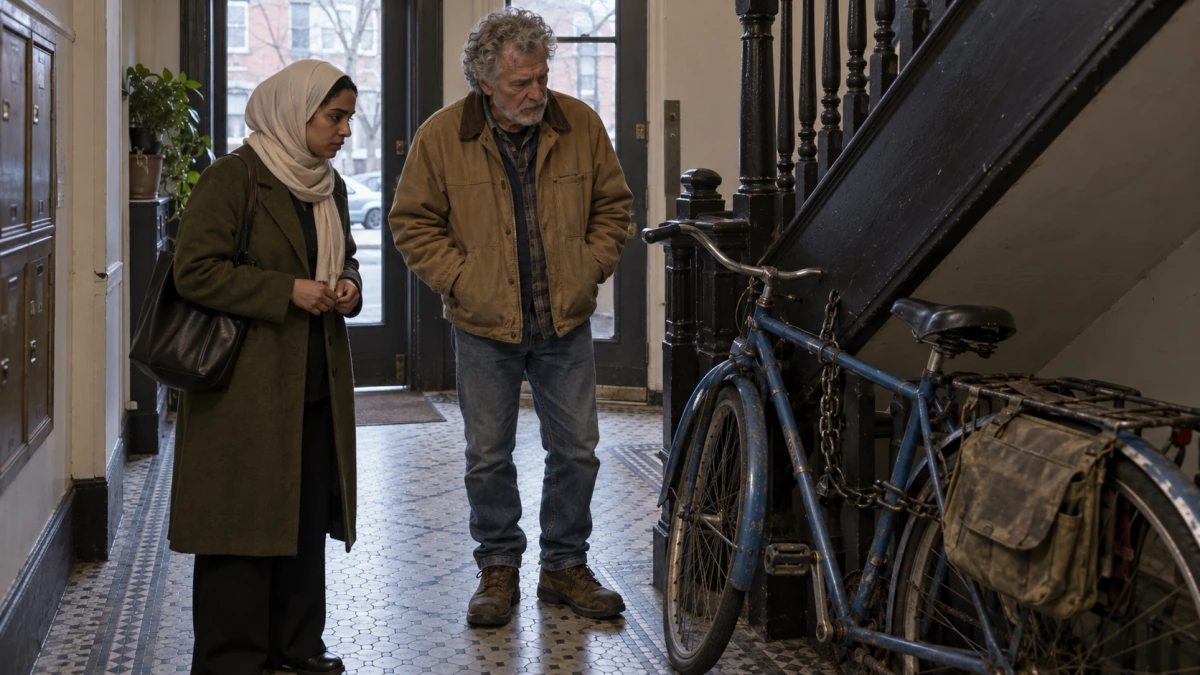
Amira set down her own bag. Her olive coat brushed the wheel as she reached for the peaches. Beneath the stairs, the bicycle was chained to a railing, its battered tool pannier bulging into the passage. She had walked around it for months without considering what walking around meant for somebody who could not turn sideways.
"It needs to come out," she said.
Gus looked at her as though she had slapped his cup away.
From the upstairs landing, a young man called, "That's the bike he uses to get to work on ours."
Another door opened. Someone mentioned a stroller. Someone else said Gus had saved her two weeks of bus fares. Celia remained in the middle of the hall with peaches dripping through a split paper sack.
Amira pulled a dish towel from her shopping bag and wrapped the broken jar.
"He can be helping people," she said, looking up at the gathered neighbors, "and this can still be blocking Celia."
Gus put his coffee on the bottom stair.
"Then help me unchain it," he said. "But don't tell me there's somewhere else until you've actually found somewhere."
The chain had rusted around the clasp. Gus turned his key twice, pressed his lips together, and asked Amira to hold the front wheel steady. The bicycle was heavier than she expected. A metal toolbox filled one side of the pannier; the other held a pump, folded rags, and a paper bag spotted with grease.
"Not through the broken glass," Celia said.
Amira stopped. She had been so eager to clear the obstruction that she was about to push a tire through the mess and trail it across the floor. Gus lifted the wheel instead. Together they carried the bicycle outside, leaving the hallway empty except for Celia, her groceries, and an ugly little pool of syrup.
No one applauded. That made the moment easier to bear.
They left the bicycle beside the front steps while Amira swept. Gus fetched a cardboard box for Celia's remaining groceries. He offered to replace the peaches. Celia accepted without telling him not to worry about it. She had paid for them, and she had wanted them.
"The large jar," she said. "Packed in juice."
He nodded and wrote it on his palm.
By the time the floor was dry, the upstairs audience had retreated. Only Luis Ortega remained. He was twenty-six, worked morning shifts at a grocery warehouse, and wore the exhausted expression of someone doing sums he disliked.
"My back brake," he told Gus. "You said this evening."
Gus stared through the glass entrance door at his bicycle.
"I did."
Amira wanted to promise an immediate solution. Instead she asked where Gus could put the bicycle tonight.
"My kitchen, if I move the chairs."
"Will you still be able to get around?"
He gave her a hard look, then a reluctant, almost amused one.
"You ask everybody that?"
"Apparently I started late."
They took it through the rear entrance and into his first-floor apartment. He removed the pannier before bringing it past the stove. The kitchen smelled of instant coffee and orange peel. One chair carried folded towels. Another faced a radio that was turned low enough to sound like rain.
There was space for the bicycle, but not for the bicycle and the life he ordinarily lived around it. Amira could see that without pretending the hallway was the answer.
Gus leaned it beside a bare wall. A pale rectangle showed where something larger had once hung.
"My wife's calendar," he said, noticing her glance. "She liked the pictures better than the dates."
Amira did not ask how long his wife had been gone. She asked whether he wanted help carrying the toolbox somewhere else.
"Not today."
She left him with that small choice intact.
In her apartment upstairs, Amira unwrapped the groceries she had forgotten to refrigerate. She was thirty-one and worked at a dental practice, where she spent her days making appointments fit around jobs that did not offer paid time off. She knew what a repair bill could do to someone's week. She also knew the look Celia had worn while everybody discussed whether her inconvenience was worth somebody else's savings.
Amira had worn a version of it at twelve, when a teacher suggested that removing her headscarf would make the class photograph simpler. The circumstances were different. The familiar part was being treated as the awkward detail in somebody else's convenient arrangement.
She texted the building manager, Dana Price: The bicycle is out of the shared passage now. Can we discuss an authorized place for a limited repair setup? Please don't promise anyone we have one yet.
Dana answered after dinner. She could visit Thursday. Nothing could be stored in the hall in the meantime.
Amira sent back a photograph of the cleared floor, without Celia in it.
Later, a knock interrupted the rice she was burning. Luis stood outside with a bent brake cable in his hand.
"You got what you wanted," he said.
It was an accusation too tired to arrive loudly.
Amira switched off the stove.
"Celia got through the door. That's what happened."
"He told me to go to a shop. I don't have shop money."
"Did he say he wouldn't fix it, or that he couldn't tonight?"
Luis looked at the cable. "Does it matter if I need it tomorrow?"
It mattered, but she understood why that distinction sounded like something a person with a working car would say. She did not have a car. She had a functioning bicycle downstairs in the courtyard and a bus route that added forty minutes to her commute when it rained.
"I'll help you look at the buses," she said. "I can't offer his work for him."
Luis nearly left. Then he came in, sat at the table, and helped scrape the rice into a smaller saucepan. The warehouse route required a transfer. The earliest connection was unreliable, but a coworker could collect him from the second stop. Luis called the coworker himself.
Before leaving, he said, "I'm not against Celia."
"Then tell her that sometime when she isn't asking to pass."
Thursday brought a cold bright morning and Dana in a raincoat over her work clothes. She walked the entrance, looked beneath the stairs, and asked Gus whether any tools remained there. He showed her the empty corner with the stiff courtesy of a man displaying a wound.
"I'm not inspecting your usefulness," Dana said. "I'm looking at the space."
That helped, though not enough to make him smile.
Amira had invited Celia, who arrived with her walker and a reusable grocery bag. At fifty-nine, Celia had cropped silver hair and a direct way of speaking that some neighbors called sharp when they disliked the content. She worked part-time from home, editing medical transcripts. She was not retired, helpless, or available for a meeting simply because someone chose an afternoon.
"I have until one," she told Dana.
They examined the rear laundry room first. It had a wide patch of floor beside a disused folding table. Amira felt hope rise before Dana opened the electrical panel and explained that access to it had to remain available. Wet laundry, bike grease, and an essential working area made the idea unsuitable anyway.
Gus said nothing. His silence made Amira want to argue, but a room was not safe merely because it looked more promising than a kitchen.
The basement storage area was worse. Narrow stairs led to an uneven floor, and Dana would not authorize carrying customers' bicycles through it. Celia waited above while the others looked. When Amira returned, she found her studying a strip of afternoon light at the rear door.
"You don't have to come to every corner," Amira said.
"I know. I want you to notice when I can't."
Outside, behind the building, stood a small brick service shed with a stiff door and a cracked window. It held two empty paint cans, a broken rake, and a stack of replacement floor tiles. The landlord had been planning to sort it for months, Dana said. Nobody currently rented it.
Gus ran a finger along the doorjamb.
"Damp," he said.
"Yes. And I can't hand you the key today. I need the owner's permission, and we need to see whether the door and window can be repaired."
"No rent I can't afford disguised as an opportunity."
Dana nodded. "We can ask about a short trial with no storage fee. It might be refused."
Celia looked at the uneven paving outside the shed. "And nobody waits across the back path."
"Agreed," Amira said.
Gus looked from one woman to the other. "You two have a talent for finding the next problem."
"Before somebody falls into it," Celia replied.
For the first time that morning, he laughed.
The laugh did not survive the building's group chat that evening. Somebody posted that Gus had been thrown out of his workshop. Someone answered that selfish tenants were destroying the last good thing in the building. There had never been a workshop beneath the stairs, but the word made the story easier to mourn.
Amira typed several angry sentences, deleted them, and wrote that the shared passage was clear after a neighbor's grocery bag had caught on the bicycle. She named no injured party because Celia had not asked to become an example. She added that possible alternatives were being explored with management and that no arrangement was yet approved.
A tenant called Eric replied with a photograph of Gus repairing a child's bicycle the previous summer. The child's face was visible. Amira asked him privately to remove it rather than turn the picture into ammunition.
He responded, You're missing the point.
She answered, So is the photo.
By bedtime, it was gone, though the argument remained.
On Friday she found a bag outside her apartment containing a new jar of peaches. A note said For Celia. Gus's handwriting slanted so far forward it seemed to be moving faster than the words. Amira took the bag downstairs without becoming its messenger. She knocked on his door and told him Celia lived two doors past his.
"I know where she lives."
"Then she should hear you."
He looked irritated. A minute later, he picked up the peaches.
Amira heard the brief conversation from the stairwell. Gus apologized for the bicycle catching the bag. Celia thanked him for replacing the jar and said she had hated needing a crowd's permission to be upset.
"I didn't ask them to defend me," he said.
"You didn't ask them to stop, either."
The silence afterward was long enough that Amira moved upstairs. That part did not belong to her.
Saturday morning, Gus appeared at her door holding a bicycle wheel with no tire.
"I'm not asking you to fix it," he said. "I'd like you to see something."
He spread three receipts on her kitchen table. A tube, a brake cable, a package of patches. Small purchases, paid on different days. He had circled none of the totals. Amira asked before picking them up.
"You pay for the parts?"
"Sometimes they pay me back."
"And sometimes?"
He shrugged.
The wheel belonged to Mrs. Alvarez's grandson. The cable was Luis's. The patches were mostly everybody's. Gus had started fixing neighbors' bicycles after his wife died because people knocked if they saw him working. Eventually they knocked whether he was working or not.
"The blue one was hers," he said.
Amira looked at the wheel leaning against her chair.
"Not this. The one downstairs. She rode it to the library. I lowered the saddle, changed the bars. Easier on her wrists."
He spoke about the work rather than his grief. She let him.
"When somebody says get rid of it," he continued, "I hear something they probably didn't mean."
"You don't have to get rid of it. You do have to keep it somewhere that doesn't catch people."
"I know that now."
"I think you knew it before."
His face tightened. Amira regretted the sharpness, not the truth.
"Maybe," he said. "Knowing and doing aren't the same thing."
He put the receipts into his pocket. She asked what he wanted the repairs to become if the shed worked out. Not what the neighbors needed. What he wanted.
He considered the question while she made coffee.
"A thing I do on Saturday. Not a doorbell with a wrench attached."
That sentence gave them more to work with than every promise in the group chat.
The owner agreed to consider four Saturdays after Dana arranged the window repair and cleared the shed's stored materials. Permission was conditional, not a permanent tenancy or a promise of a public business. Dana would specify what could be kept there, how keys were handled, and when the arrangement would be reviewed. Gus asked to read the terms before anyone announced anything.
While they waited, he repaired Luis's brake outside in daylight, with Luis holding the bicycle and buying his own cable. They worked on an open patch off the walking route. Gus finished in twenty minutes and spent another ten making Luis adjust it himself.
"If it slips on your way home, you should know what you're looking at."
Luis offered ten dollars. Gus took it, then looked surprised at his own hand.
"For your time," Luis said. "The cable's already paid."
Later he told Celia that he was sorry about the argument in the hall. She asked him whether his brake worked. He said yes. She said that was good, and neither of them tried to make the exchange larger than it was.
The shed needed a stout shelf, weatherproof bins, and a work surface. Amira suggested contributions only after Gus agreed that he wanted them. She refused Eric's plan to post a photograph and call it Saving Gus. Gus refused a used sofa, three bent wheels, and a lawn mower somebody generously offered to donate.
"I'm not opening a museum of things people don't want," he said.
They made a short list of actual needs. A neighbor lent a folding work stand. Another contributed two lidded bins. Celia offered a shelf she had been trying to rehome, but asked for help moving it because she was not pretending generosity made furniture weightless.
Gus measured the shelf before accepting. It fit.
Amira spent an evening carrying its pieces across the courtyard with Luis. Celia directed them from her kitchen, where she had laid the screws in a saucer. On the refrigerator was a photograph of her beside a red touring bicycle, a younger version of her silver hair tied back with a scarf.
"You rode?" Luis asked.
"I still own legs," she said, then softened. "Not much now. I miss the speed."
Gus, standing in the doorway, glanced at the photograph without offering a cure. Instead he asked which route she had taken along the river. They disagreed about a hill for nearly five minutes. Amira realized it was the first conversation she had heard between them that did not involve an apology or an obstruction.
Before the opening, Amira took a walk with Celia to the corner store. Celia had asked for company, not an escort, and corrected Amira when she automatically reached for the bag on her walker. They stopped beneath an awning while a delivery truck reversed into the alley.
"I liked him before all this," Celia said. "I still like him. People keep making that the question."
Amira watched the truck's blinking lights. "You don't have to prove it to me."
"I'm not proving. I'm telling you. He brought soup when I first came home from the hospital. Terrible soup. All the noodles had surrendered."
The memory made her smile, and Amira smiled with her.
Celia explained that she had mentioned the bicycle twice before the broken jar. Once Gus had moved its handlebar inward. The other time he had said he would find a better chain. Neither response answered what she had actually asked. Afterward she had begun using the rear door, even when it meant crossing wet paving.
"I didn't want a feud in my own building," she said.
Amira thought of the months she had squeezed past the bicycle without noticing Celia's altered route. She apologized for that, specifically. Celia accepted the apology and pointed toward the store, where the delivery truck was finally pulling away.
Inside, they argued companionably about which pears would ripen first. Celia bought two hard green ones because she wanted them for Thursday, not because she failed to understand fruit. On the walk home, Amira let the silence settle without turning their outing into another meeting about Gus.
That evening, Gus called Luis to return an old adjustable wrench he had borrowed from the warehouse worker's father. Luis came down with a photograph on his phone: his father holding a bicycle outside their old house, one foot on a pedal, smiling at whoever stood behind the camera.
"He'd say you should charge," Luis told him.
"Your father said everybody should charge everybody. Then he'd fix my radio and refuse money."
"He liked being the exception."
Gus laughed. The father had died before Luis moved into the building, and neither man had realized until recently that Gus had known him through a bus route years earlier. There was comfort in the connection, but also a trap. Luis had begun asking Gus for the kind of immediate help he once expected from his father. Gus had liked being needed enough to overlook it.
"I was rude to Amira," Luis said.
"I was rude to Celia."
They stood with the wrench between them, two men discovering that grief did not make their bad manners mysterious.
Luis asked whether he could help assemble the work stand. Gus said yes, provided they finished before his television program started. They finished with seven minutes to spare. Luis went upstairs with the wrench, and Gus closed his door without listening for the next knock.
The trial began on a Saturday with a low sky and the smell of wet brick. Gus wore his tan jacket. Amira came down in her olive coat and cream headscarf, carrying a thermos she had offered to share, not a clipboard she had volunteered to manage. She had made that distinction aloud the previous night.
The shed door opened smoothly now. Dana had checked the space and the rear route with them before granting access. A small work surface stood inside, with bins beneath it and the borrowed stand folded at the back. Nothing extended into the walking path. Customers would bring bicycles only at agreed times and take them away that day; there was no unattended queue of broken frames.
The first visitor was Eric, pushing a mountain bike with a flat rear tire.
"Figured you'd have me first after all my campaigning," he said.
Gus looked at the tire, then at his watch.
"Your time's eleven. Luis is coming at ten."
Eric laughed as though this were a joke, then stopped when Gus did not join him.
"I was on your side."
"You can be on my side at eleven."
Amira took a careful sip of coffee. There were moments when helping meant not smoothing over the useful discomfort.
Luis arrived with his mother's bicycle. Gus asked what she wanted done, what they had agreed to spend, and whether Luis had checked with her about the saddle height. Luis called her. She wanted the basket tightened, not the seat lowered. It was a tiny correction, and Amira liked that it happened before anybody touched a wrench.
At eleven, Eric returned. His tube needed replacing. Gus named the cost of the tube and asked whether Eric wanted to buy it himself or reimburse the receipt. Eric said he thought donated supplies covered that.
"The bins were donated. Air's still free. Tubes aren't."
"For people who can't afford it?"
"You can afford your tube, Eric."
The words landed without cruelty. Eric took out his wallet.
By noon, Gus had repaired two bicycles and turned away a third whose damaged fork needed a shop's attention. The owner, a college student, looked disappointed. Gus showed him the damage without suggesting that a clever adjustment could make it safe. He offered to help describe the problem when the student called a shop, but did not promise a cheap outcome.
Amira watched his shoulders loosen after the student left. Refusing a repair had cost him something; pretending he could do everything would have cost more.
That afternoon, she went to work an extra shift. When she returned, four bicycles stood outside the shed, blocking most of the rear path. Someone had read the cheerful group-chat message about the trial and assumed drop-offs were welcome. One had a note asking for brakes, tires, and a tune-up before Monday.
Celia waited at the rear entrance. She did not look surprised. That was worse than anger.
"I was going to call Dana," she said.
"You should. I'll call Gus."
Amira did not drag the bicycles somewhere else and conceal the problem. Dana needed to know the arrangement had already failed one of its conditions. Gus came outside wearing slippers and a cardigan, looking smaller without the work jacket.
"I told them appointments," he said.
"Not everyone hears a sentence that costs them convenience," Celia replied.
By phone, Dana authorized moving the bicycles onto the unused paved bay beside the shed immediately. Amira and Gus cleared the route before Celia passed safely. Dana notified owners where their unlocked bicycles stood; nobody impounded them. All four collected them that evening and heard the no-drop-off rule.
Gus canceled the next Saturday while they reconsidered. He made the decision before Amira could offer to supervise arrivals.
"You'll spend your whole weekend guarding my door," he told her. "Then there'll be two people trapped by my hobby."
For the first time, she heard him call it a hobby rather than a duty. She did not argue with the canceled morning.
They met with Dana on Tuesday. Celia joined for the first fifteen minutes and left for work exactly when she had said she would. They agreed on one appointment at a time, no public invitation beyond residents, and a clear instruction that bicycles remained with their owners until Gus accepted the work. Any repeated blockage would end the trial. Dana would review it after the four scheduled Saturdays, including the canceled one, rather than quietly extending the experiment forever.
"I'm not asking Celia to test whether we mean it," Gus said.
Amira looked at him. He looked down at his hands.
The following week, Amira's own bicycle began clicking under pressure. She heard it on the bridge and walked the last three blocks to work. By evening, rain had soaked the cuffs of her pants. She wanted nothing more than to knock on Gus's door and let her involvement count as an exception.
She stood outside his apartment longer than she liked admitting.
Then she went upstairs and sent a message asking whether he had a Saturday appointment available. He answered that he was full but could look the following week. A shop near her office inspected it sooner and found a worn part Gus would not have stocked anyway. The repair consumed money she had hoped to spend visiting her sister.
On Friday, Gus asked whether she had sorted it out.
"Yes. Expensively."
"You could've asked."
"I did ask. You were full."
He held her gaze, then nodded. "Thank you."
She laughed once, without much humor. "You're welcome. I'm still annoyed about the money."
"Both can happen."
The second open morning passed quietly. The third brought sunshine and Mrs. Alvarez carrying cookies in a container she wanted back. Gus finished her grandson's wheel, accepted payment for the tube, and declined a request to collect another bicycle from across town. He did not invent a medical appointment or a family obligation. He said he did not collect bicycles.
Afterward he sat outside the shed on a folding chair, eating a cookie with grease still beneath one fingernail. Celia came through the courtyard with her walker. He moved his chair before she had to ask. She stopped beside him anyway.
"You ever finish your own?" she asked.
He glanced toward the blue bicycle inside.
"Runs fine."
"That wasn't the question."
He looked at the lowered saddle, the curved handlebars, the rear rack where his wife had tied library books with a red strap. He had kept it ready for somebody who would never ride it again, and stopped riding it himself except on errands made necessary by other people's needs.
"Maybe tomorrow," he said.
Later that same Saturday, Dana returned for the review. She did not gather grateful customers to vote on Celia's comfort. She checked the path, asked about the unattended bicycles, and listened while Gus explained the revised arrangement. The canceled morning stayed on the record. So did the successful ones.
The owner agreed to a further limited period, subject to the same space restrictions and another review. Gus asked for a week off before beginning it. Dana wrote that down without asking him to justify the holiday. There would be no repair appointments that week, even if nobody went anywhere.
After Dana left, Eric arrived carrying the borrowed work stand's missing strap. He had found it in his garage and looked embarrassed that he had praised his own generosity while failing to bring the whole thing.
"No speech?" Gus asked.
"I thought I'd try just returning it."
Gus accepted the strap. Eric helped him fold the stand, then asked whether he would show him how to patch a tube another morning. It was a request, not an appointment disguised as praise. Gus said he would think about it.
Amira watched from the laundry doorway with a basket against her hip. The arrangement still depended on ordinary people remembering what they had agreed. There was no guarantee that it would last. Yet the blue bicycle had a dry place, Celia had a clear route, and Gus could close the shed without leaving a piece of himself trapped outside it.
He locked the door, tested the handle, and put the key in his pocket. Then he asked Amira whether she knew if the riverside path was open after last week's rain. She did. She had ridden it that morning.
"Good," he said. "I might try it."
That night, Amira called her sister instead of scrolling through the building chat. She described the repair bill and the postponed visit, then admitted that she had wanted special treatment from the man she had encouraged to refuse everyone else.
Her sister laughed kindly. "Did you ask for it?"
"No. I stood outside his door thinking very generous thoughts about myself."
"That sounds exhausting."
It had been. They made a cheaper plan for the visit, involving a bus ticket bought early and dinner cooked at home. Nothing about the bicycle had improved Amira's finances. She was relieved to say that without feeling disloyal to the project.
Downstairs, Gus cleaned his pannier at the kitchen table. He put the tools into their shed bin, shook crumbs from an old cloth, and found a library receipt tucked into a seam. His wife's name had faded almost completely. He placed it in a drawer rather than returning it to the bag.
Then he adjusted the saddle, checking the bolt twice out of habit. He had spent years setting things to suit another person's reach. His own knees would need more room tomorrow. The change did not erase her hands from the handlebars. It simply made the bicycle fit the person who was going to ride it now. He washed his hands, ate his supper, and left the dishes until morning without apologizing to an empty kitchen.
Sunday morning, Amira found him in the front hall holding a helmet. The blue bicycle waited outside, not chained beneath the stairs. He had raised the saddle. A narrow red strap still crossed the rack.
"River?" he asked.
She had laundry to do. For once, she let the laundry wait.
They rode slowly, past damp sidewalks and early dog walkers, until the city opened toward the water. Gus stopped at a bench where the path widened. He took two oranges from his pannier and handed her one. No tools rattled when he set the bag down.
Amira peeled hers in a single uneven spiral. Gus watched the current, then told her that his wife had always carried more books than the rack was meant to hold. Once, a dictionary had fallen out beside a bus stop, and three strangers had argued about who should chase it.
He laughed before the story ended. Amira had never heard that laugh from the stairwell.
When they returned, Celia was leaving with a grocery bag hooked securely over her walker. The hall was clear from the entrance to the mailboxes. Gus held the outer door while Amira carried her bicycle through, and Celia passed between them without stopping or turning sideways.
Outside, she checked the sky and continued toward the corner store. Gus watched until she reached the sidewalk, then wheeled the blue bicycle toward its proper place. This time, no one had to ask him to move.
Read next
The Books in the Dumpster
The Porch Light at Number Seventeen
The Locked Rooftop
The Landlord’s Son Told My Neighbor to Leave Her Shop by Friday—Then She Handed Me a Receipt Older Than He Was
Reading notes
A blocked apartment passage tests how neighbors can respect both a mechanic’s help and another resident’s access.
This is an original work of fiction. Characters and events are fictional. Explore public-domain books at Project Gutenberg or browse more stories on ReadStoryvia.