Original fiction
On this page
The Name on the Cake Boxes
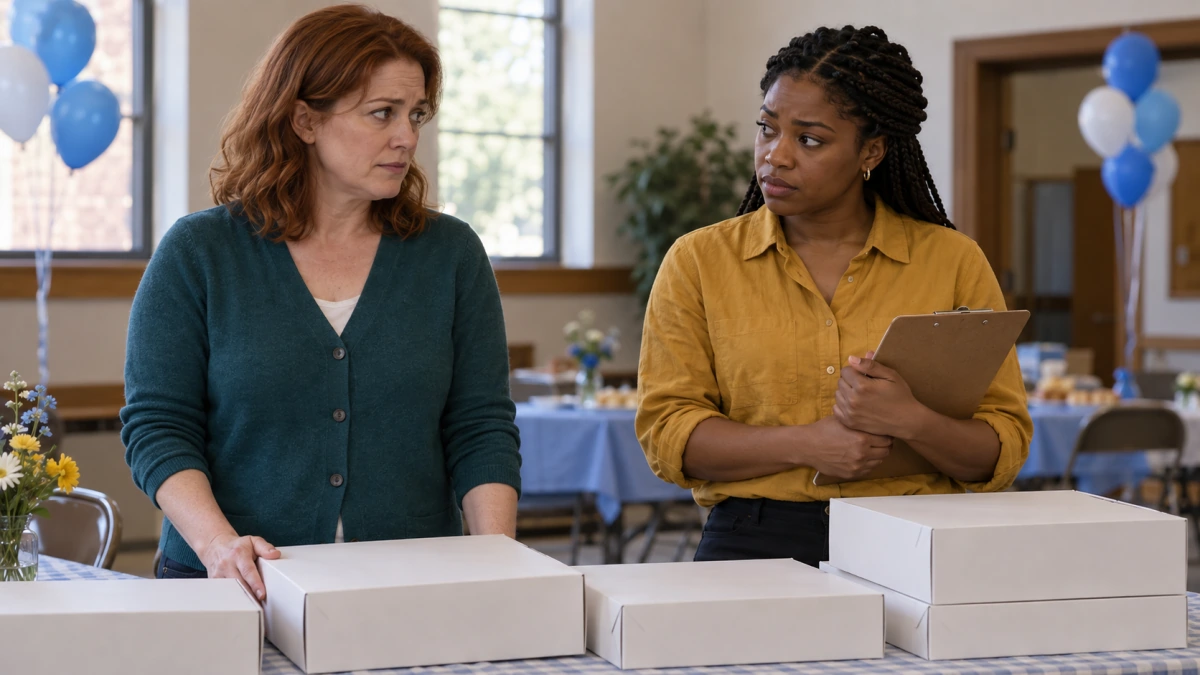
Bethany Wells was cutting the first cake when Zoe Fletcher asked why her name was on the announcement.
Not the cake boxes. Those were plain white, stacked on a folding table beneath the community center's basketball scoreboard. The name was in the fundraiser post everyone had been sharing since breakfast: Homemade cakes by Bethany Wells.
Bethany looked at the phone Zoe held above her plain clipboard. In the screen's reflection, her auburn hair seemed redder than usual, her teal cardigan almost gray.
"I didn't write that," she said.
"I know. I asked Martin to change it. He said you were fine with it."
Across the Milwaukee gym, Martin was arranging raffle baskets. Bethany had told him she was coordinating the cakes. She had also seen the draft announcement yesterday and postponed correcting it because the real explanation was difficult.
Now someone behind Zoe said, "Maybe ask her where the recipes came from."
The speaker was a volunteer named Paula. She had found a handwritten recipe card beside the cash envelope and decided that Zoe, who had brought neither cakes nor recipes, was selling somebody else's work under a false name. By noon, the story had grown a missing donation.
Zoe's braided hair shifted as she turned. Her mustard shirt had a streak of flour from helping plate slices.
"You need to say what you're accusing me of," she said.
Bethany set down the knife. She knew who had baked the cakes. She knew why that woman had asked not to be named. She also knew that silence was beginning to look like agreement with a lie.
Her phone buzzed inside her pocket. A message from the baker read: Please tell me you haven't put my name anywhere.
Bethany wiped her hands before answering. For the first time that morning, she stopped trying to make the problem disappear politely.
"Zoe didn't bake these cakes or supply their recipes," Bethany said. "She's helping us serve them. If you're saying money is missing, tell Martin and me exactly what you saw."
Paula glanced toward the raffle table, as though the accusation had arrived from somewhere over there and she was only delivering it.
"There was an envelope. Then it wasn't where it had been."
"An envelope moving isn't proof that Zoe took anything."
Zoe looked at Bethany, not grateful, just watchful. It was a fair expression. Bethany had spent the morning accepting compliments for cakes she had not made. Her new interest in precision deserved examination.
"I want Martin here," Zoe said. "And I don't want to keep taking cash while people whisper."
Bethany agreed. They paused sales at their table without abandoning the food. Darlene, the designated food lead, stayed with the covered cakes and the ingredient binder. She had already checked the delivery against the center's event requirements, including ingredient information and the products that needed cold storage. Baker privacy did not mean anybody had to guess what they were eating.
Martin came over with a roll of raffle tickets around his wrist. He was fifty-eight, a volunteer organizer who could coax folding tables out of almost anybody but dreaded a conversation that made the room go quiet.
"Can this wait until after the lunch rush?" he asked.
"No," Zoe said.
She put her clipboard on the table and folded her hands so no one could mistake a movement for hiding something.
Bethany saw that and felt ashamed. Zoe should not have needed to choreograph her hands.
Martin led them to a side room whose door remained open. Darlene asked another volunteer to cover the front of the table while she fetched the sales materials. Paula came too. Bethany wanted to send her away, then understood that letting an accusation float free while excluding its source would accomplish nothing.
On the side-room table lay two cash envelopes, a receipt pad, a card-reader report, and a cardboard box full of forks. One envelope contained the starting change; the other held sales cash transferred before the table became crowded. Martin had told a runner to make that transfer and had not informed Zoe.
The supposedly missing envelope was in the locked cash tin where Martin had placed it himself. He fetched it, red-faced, and opened it with Zoe watching.
"Then there isn't any missing money," Paula said quickly.
"We haven't reconciled it yet," Zoe replied. "You don't get to make the next assumption just because the first one was wrong."
Bethany almost smiled. She did not. This was not a pleasing scene of someone finally standing up for herself. Zoe had wanted to spend a Saturday helping pay for neighborhood music classes. Instead she was supervising the correction of a rumor about her honesty.
Martin counted with Darlene, separating the original change from sales revenue. They checked the numbered sales slips, the card report, and the envelopes against the cake portions sold. The totals matched. No cash was missing. A donor's check for the general fundraiser belonged in a separate deposit list, not in cake sales; Darlene made sure nobody used it to conceal a discrepancy that did not exist.
Zoe asked them to write down what they had verified, who had counted, and that she had not moved the envelope. Martin did so on the back of a blank event sheet. She photographed it for herself.
Paula shifted toward the door.
"We're not finished with the recipes," Zoe said.
The recipe card was an old photocopy with handwritten notes, tucked into the ingredient binder after Bethany had checked a frosting detail with the baker. It had no donor's name on it. Paula had seen it near Zoe's clipboard when the binder was briefly set down beside the cash tin. From those neighboring objects she had constructed a theft.
"A card sitting beside my work isn't my claim to have written it," Zoe said. "I never said these were my cakes."
"You said you knew baking."
"I know how to keep a serving knife out of an allergen-free order. That doesn't mean I stole a recipe."
Darlene gently corrected the phrase. They were not claiming an allergen-free preparation area; they were using separate utensils and providing accurate ingredient information, with the shared setting explained to guests. Zoe nodded, accepting the correction without letting it displace the accusation.
Bethany said, "The recipe card came from me. Zoe wasn't involved in getting the cakes here."
Martin looked relieved. "Then let's just tell everyone whose they are."
"We can tell them who they aren't," Bethany said. "I need permission for anything else."
He glanced at her cardigan, as if she had brought another hidden problem in one of its pockets.
"It's cake, Beth."
She looked at Zoe's tightly folded hands.
"It's already more than cake."
She went into the empty coatroom and called Naomi Chen. At fifty-two, Naomi had straight dark hair streaked with silver and a way of listening that made Bethany choose her words more carefully. They had met at an evening ceramics class, where Naomi had once spent half an hour rescuing Bethany's collapsed bowl without calling it a lesson.
Naomi answered after the fourth ring.
"Where are you?" she asked.
"At the center. Alone in the coatroom. I haven't named you. But I let a wrong announcement stand, and now somebody else is being accused. I need to explain what happened."
Bethany told her everything, including the draft she had seen the day before. She did not blame Martin's enthusiasm or pretend there had been no chance to act sooner.
Naomi listened until the account was finished.
The delivery had happened before the event opened. Bethany had collected the cakes without a helper, using the plain boxes Naomi supplied. Each cake had its ingredient information prepared separately for Darlene. Naomi had checked that the event could accept them before buying supplies, and had declined a custard filling because keeping it properly chilled through transport and service would complicate the morning.
"I can make something good that doesn't need heroic handling," she had said.
Bethany remembered laughing at that. She also remembered Naomi setting one small condition after another in a calm voice, like placing dishes where they would not fall. No kitchen photograph. No tagged thank-you. No account of why she preferred privacy. Bethany had agreed to all of it while thinking mostly about fitting the boxes into her car.
At the center, Martin had praised the smell and asked whether Bethany had been up all night. She had answered that everything was ready, which was not an answer to what he meant. Later, when he mentioned the announcement, she had waved him toward the raffle baskets and said they could sort it out after setup.
There had been no single moment in which she decided to steal credit. There had been several small moments in which telling the truth would have interrupted someone thanking her. That was worse to describe, because it offered no dramatic mistake she could promise never to repeat.
"You liked them thanking you," she said.
Bethany sat on a low bench between empty hangers.
"Yes. I also wanted to avoid a conversation. Both are true."
The admission felt smaller and uglier than a noble explanation about protecting a friend. It was also the first useful thing she had offered Naomi that morning.
Naomi had left a controlling partner two years earlier. He still searched public community posts and contacted people whose names appeared alongside hers. She had not asked Bethany to devise a universal safety plan. She had asked her not to make this particular activity searchable under her name, not to photograph her kitchen, and not to identify her as the source of these cakes. Those were the conditions under which she had agreed to bake.
She loved baking. She did not want every pleasure to require an explanation of what had happened to her.
"Has someone posted a picture of the recipe?" Naomi asked.
Bethany checked with Darlene by text. The answer came quickly: no picture taken by their team, binder now closed in the side room. Bethany relayed exactly that, not a promise about every phone in the building.
"I can correct my name without naming you," she said. "But they need accurate credit, not just a denial. Martin filled the blank with the coordinator's name. If we leave it blank again, he'll do it again."
"What do you want it to say?"
"Cakes donated by a volunteer baker who has requested privacy. Coordinated by Bethany Wells. No identifying description, no story about why. Would that be acceptable?"
Naomi asked her to remove the second sentence. Bethany did not need a credit line for carrying boxes while the person who had baked could not have one.
"You're right," Bethany said.
"I didn't say you did nothing. I said I don't want your name in that sentence."
Bethany understood the difference and repeated the proposed wording with only the neutral baker credit. Naomi agreed to it for the announcement and a short spoken correction. She did not agree to interviews, photographs, a public thank-you directed at her, or a dramatic account of an anonymous survivor's generosity.
"Don't make the reason a riddle people can solve," she said.
Bethany promised only what she could control: her own words, the correction she would request, and the information she would not share. Martin would have to confirm his part himself.
Before hanging up, she asked if Naomi wanted the remaining cakes withdrawn from sale. The question cost Bethany something; it would create work, disappointment, and explanations. Naomi said no. The cakes were meant to help the classes. She wanted the agreed boundaries honored, not the afternoon destroyed on her behalf.
"And the young woman?" Naomi asked.
"Zoe. The cash matched. The recipe accusation was invented from where a card happened to be sitting."
"Then say that. My name isn't evidence she stole something."
Bethany stayed on the bench after the call, staring at a mitten someone had lost last winter. For months she had treated Naomi's privacy as a secret only she could manage. That had made her feel trusted, even important. Now she could see the mistake in that feeling. Trust was not permission to improvise a better story.
When she returned, Martin was attempting an apology to Zoe that began, "You know how people get."
Zoe interrupted. "I know how Paula got. I know what you did with the envelope. Please use names for things you actually know."
Bethany gave Martin the approved attribution and asked him to edit the online announcement immediately. He said changing it might draw attention. She told him the wrong version had already drawn attention to the wrong person.
He opened the post. In front of them, he removed the line naming Bethany as the baker, replaced it with the consented neutral credit, and added a correction that the original attribution had been mistaken. Bethany checked the displayed version, not merely the text in his editing window.
The center's staff member who managed its own page made the same correction there. Martin sent a short factual message to volunteers who had received the original announcement. They could not reach every forwarded screenshot, and Bethany said so when Zoe asked. They could at least stop distributing the error themselves.
Paula wanted the correction to say there had been a misunderstanding.
"That makes it sound like I spoke unclearly," Zoe said. "I didn't."
Bethany turned to Paula. "You accused Zoe of taking recipes and donations. Neither claim was supported. The accounts match. The recipe came through me, and Zoe never claimed authorship. You need to correct what you told people."
"Everyone will think I'm a terrible person."
Zoe picked up her clipboard. "I've been thinking about what everyone thinks of me for an hour."
Paula's face changed. Not into instant understanding, but into the uncomfortable beginning of recognizing that another person had been paying for her certainty.
They went back to the gym together. Martin paused the raffle microphone and said the cake attribution had been wrong. A volunteer baker who had requested privacy had donated the cakes. Bethany had coordinated delivery, not baked them. The cash had been reconciled, nothing was missing, and Zoe had not taken recipes or money.
He did not mention Naomi's circumstances. He did not invite guesses. He thanked Darlene for overseeing food service and returned the microphone to its stand.
Paula spoke to the volunteers she had approached, with Bethany nearby but not speaking for her. Some had already repeated the rumor. Martin asked them to correct it wherever they had shared it. One woman looked at Zoe and offered a sympathetic smile without apologizing. Zoe did not supply a smile to make the moment easier.
The fundraiser continued. Children practiced trumpet scales in a side room; a kettle clicked off; somebody won a basket containing three kinds of mustard. Ordinary things persisted around the damage, which was almost insulting and also a relief.
Bethany returned to the cake table. Darlene had kept everything covered, the chilled items where they belonged, and the ingredient information available. A guest asked about walnuts. Darlene checked the relevant cake record and explained the shared preparation setting, rather than guessing from the color of a frosting or the anonymity of a donor.
Zoe remained beside the table but did not pick up the serving knife.
"I can cover your shift," Bethany said.
"I haven't decided if I'm leaving."
"Okay."
"Don't decide for me because you feel bad."
Bethany nodded. She had spent years translating discomfort into chores. Bring a casserole, take a shift, smooth the seating plan. Those were useful acts until she used them to avoid hearing somebody say she had let them down.
Zoe asked for ten minutes outside. Bethany covered the table because that was what Zoe requested, not because it erased anything.
Through the glass doors, Bethany could see her standing near a bicycle rack with her phone against her ear. She looked away. Zoe was entitled to a conversation that did not become another thing Bethany interpreted from a distance.
At the table, a man complimented the cake and said Bethany must share her recipe. She answered that she had not baked it and repeated the approved attribution. He looked mildly disappointed, then asked which plate had the ginger cake. The truth had not stopped him buying a slice. Bethany found the smallness of that discovery humiliating.
She had imagined the correction would require exposing everything or explaining nothing. In fact, most people wanted to know what they were eating, what it cost, and where their money went. Those were questions the volunteers could answer. The baker's private life supplied none of the necessary information.
Darlene asked her to fetch fresh serving utensils. Bethany brought them, checked which cake each belonged with, and listened instead of using the errand to tell Darlene how awful she felt. For the next ten minutes she did work that could be evaluated without reference to her intentions.
When Zoe returned, she chose to help at the music sign-up desk instead. Her sister's son was playing a clarinet later, and she wanted to be there when he finished. Bethany carried her clipboard over without announcing that Zoe had been generously reassigned.
From the desk, Zoe could see the gym but no longer had to stand beside the boxes that had become a case against her.
Her nephew arrived carrying his clarinet case like something easily startled. He wanted to know whether she would hear his whole piece or just the end. Zoe checked the program, found his slot, and said she would hear the whole thing.
Bethany was close enough to hear him ask why she had stopped selling cake. Zoe said she wanted a change of job. She did not owe the boy a lesson about accusations before his performance. He accepted the answer and asked her to hold his winter hat.
The hat remained on Zoe's clipboard during the recital. Bethany noticed it whenever she looked across the room: a little green wool thing beside names of children hoping to join classes. Zoe's Saturday was not defined entirely by what had happened at the cake table. Bethany needed to remember that without pretending the damage had therefore disappeared.
Near the end of the afternoon, a local neighborhood blogger approached Bethany. He had heard the microphone correction and thought an anonymous donor would make a good human-interest story. Was the baker elderly? Was she struggling? Could he photograph Bethany holding a cake and say she was the donor's friend?
"No," Bethany said.
He smiled as though she were negotiating a fee.
"I don't need the actual name. Just a few details."
"The approved credit is the whole public description. Ingredients are available from our food lead. The person isn't a story we're offering."
He asked Martin instead. Martin looked toward her, remembered the open editing window and Zoe's folded hands, and gave the same answer. The blogger photographed the raffle baskets after checking with their donors. No mysterious baker feature appeared that evening.
Bethany wanted to tell Naomi immediately, as if resisting one request could earn back the morning. She waited until the event ended, then sent a concise update: wording corrected on both pages; spoken correction made; Zoe cleared on both claims; no identifying details shared by Bethany or the organizers. She added that older screenshots might still exist.
Naomi replied, Thank you for telling me exactly what you know.
There was no heart, no reassurance that everything was fine. Bethany read the sentence twice and accepted its limits.
Cleaning took longer than anyone expected. Paula wiped tables silently until she reached Bethany's corner. She said she had been worried about the fundraiser because her brother's children depended on the subsidized classes. Bethany understood that worry. She did not let it become an explanation that swallowed Zoe's name.
"You can care about the classes and still owe her a real apology."
"I apologized in front of people."
"You corrected the record. That's necessary. It's not quite the same thing."
Paula set the cloth down. "Will you tell me what to say?"
Bethany shook her head. "Not if you're asking for words that guarantee she'll forgive you."
Across the gym, Zoe was listening to her nephew explain why one clarinet note had squeaked. She bent her head toward him with complete attention. Paula watched, then returned to wiping the table. For once she did not cross the room and require someone else to make her feel better immediately.
The cake sales proceeds went into the event's normal reconciliation, separate from the general donations and starting change. Martin and Darlene signed off on the records. Bethany asked for the volunteer procedures to include clear handoffs for cash, a named food lead, and consented public credit before announcements were posted. She did not suggest keeping a secret list of donors' personal histories.
Martin rubbed his eyes. "I thought coordinator meant baker."
"You could have asked."
"You saw the draft."
"I did. I should have corrected it then. Your assumption and my silence both mattered."
He looked relieved at not being assigned all the blame. Bethany hoped he also heard that she was not taking all of it.
At home, she hung the teal cardigan over a chair and found a spot of frosting near the cuff. Her husband, Daniel, asked how the fundraiser had gone. She said the cakes sold well and she had behaved badly before lunch.
He waited while she explained. She described the wrong credit and the accusation without naming the baker or giving the reason for privacy. Daniel did not need that information to understand her mistake.
"What made you leave the announcement alone?" he asked.
She could have said she was busy. She had been busy. She could have said Naomi had asked for discretion. That was true too, but neither answered the question.
"People kept saying I was wonderful. I wanted one part of the day to be easy."
Daniel took two plates from the cupboard. "Was it?"
"Not for anyone else."
They ate leftover soup, and Bethany resisted the urge to turn dinner into a trial in which he would declare her either a good person or a fraud. The correction was work she would have to keep doing, not a verdict he could provide.
On Monday she emailed Zoe. She kept it short: she was sorry she had failed to correct the attribution earlier, sorry she had hesitated while Zoe became the target, and available to confirm the facts if the rumor resurfaced. She did not ask Zoe to reassure her or volunteer again. She included the corrected event link and offered a copy of the verified accounting note, which Zoe already had photographed.
Zoe answered that evening. She appreciated the correction. She did not want to be the example used in future volunteer training, named or unnamed, without being asked first. She would decide later whether to return to the fundraiser committee.
Bethany replied that she understood and would honor both requests.
Then she wrote Naomi a different message. She apologized for allowing her own name to replace Naomi's labor, explained the revised procedure, and asked what Naomi wanted done with the recipe photocopy. Naomi requested that it be returned with her empty containers. The event's necessary ingredient records could remain with the food lead according to the center's usual practice; her handwritten working copy did not need to circulate.
They arranged a time for Bethany to bring the containers to Naomi's home. Bethany did not bring flowers or an elaborate gift that would force gratitude into the room. She washed the containers, checked that the lids matched, and packed the recipe separately so it would not be discarded with a paper towel.
Naomi opened the door wearing a navy sweater. Her silver-streaked hair was tied loosely at the back. Flour dusted one wrist, and the apartment smelled of ginger. The domestic familiarity made Bethany's eyes sting. She had nearly made this quiet place a location strangers could look for, not by malice but by deciding that a little public credit could wait.
"Come in," Naomi said. "But I'm not ready to tell you it's all right."
"You don't have to."
They put the containers away. Naomi checked the recipe card, smiled at an old stain in the margin, and slipped it into a battered folder.
"That recipe was my aunt's base," she said. "I changed the ginger. I didn't invent cake."
"Paula invented a theft from practically nothing."
"People enjoy a shape they recognize. A thief. A saint. An anonymous woman with a tragic reason to bake. Saves them looking closely."
Bethany sat at the kitchen table. "I liked being the saint."
Naomi gave her a level look, then slid a small plate toward her. On it was a lopsided slice from a cake that had never been intended for the fundraiser.
"This one sank," Naomi said. "You can say you ate it. You can't say you rescued it."
Bethany laughed, startled by the possibility of humor that did not cancel the hurt.
They ate slowly. Naomi said she did not know whether she would bake for another public event. She might, if the conditions were clear and someone else handled coordination. She might prefer to make one cake for a friend and keep the rest of her Saturday. Bethany said either choice made sense, then stopped before making an offer to arrange the next event herself.
Naomi turned the plate a little, studying its chipped blue edge. Her aunt had owned a set like it. She remembered birthday parties where adults argued over cake portions while children ate frosting with their fingers. Baking carried those rooms forward for her. It was not merely a service she could provide because she was good at it.
Bethany asked whether the aunt had taught her the ginger adjustment. Naomi shook her head. That part was hers, discovered during a winter when she wanted something warmer than vanilla. She could talk about that winter without explaining her former partner, and Bethany let her.
They discussed the cake's sunken middle, the way the edges had set too soon, and whether Naomi's oven ran hotter than its dial suggested. Bethany contributed nothing expert. She listened and ate the last crumbs. For several minutes, her friend's life contained a failed cake rather than a risk Bethany needed to manage. Naomi seemed to rest inside that conversation, and Bethany was relieved not to interrupt.
After a while Naomi asked about the music classes. Bethany told her that Zoe's nephew had played his clarinet and bowed so deeply his music nearly fell off the stand. She did not describe Zoe as grateful. She described the song.
The following Thursday, Paula sent Zoe a message copying Bethany and Martin. She said she had accused Zoe without evidence, repeated claims to other volunteers, and allowed a moved envelope and a recipe card to become a story about her character. She listed the people she had contacted with a correction and offered to address further repetitions herself.
Zoe replied to Paula alone. Bethany never learned the words, and did not ask.
Before the next meeting, Martin called Bethany to ask whether the anonymous baker might donate again. Bethany told him he could put out a general request with the new credit question. She would not approach her friend as if the previous donation had created an obligation.
He started to mention how popular the ginger cake had been, then stopped himself. Popularity was information, not consent. He could thank the donor through Bethany for the gift already made, using the agreed words, without turning gratitude into a request.
At the center's next planning meeting, there were fewer cakes to discuss and more ordinary tasks: a broken music stand, a room booking, chairs for a recital. Zoe came because she wanted to help plan the recital, not because the committee had earned unrestricted access to her time. She chose the sign-up desk again and declined cash handling.
Martin accepted without an argument about moving forward. Bethany noticed, and was glad he had learned not to put that phrase in somebody else's mouth.
When food donations came up, the new form asked what public credit the donor approved. It did not require a personal story to justify a blank name. Ingredient handling and event suitability remained separate questions for the food lead. Martin read the form aloud, asked whether anyone saw a problem, and waited through the silence long enough for an answer.
Zoe suggested adding a place to record who would collect empty containers. Everyone laughed because half the center's cupboards were full of unmatched lids. It was a useful laugh, not one demanded from her to prove the incident had become harmless.
Bethany did not sign Naomi up for anything. She took responsibility for washing serving trays, a task that involved hot water and no borrowed applause.
On the way out, Zoe stopped beside her car.
"I saw the blogger's post," she said.
Bethany's stomach tightened. "Was something wrong?"
"No. Just baskets."
They stood for a moment in the cold parking lot. Bethany could smell somebody burning leaves beyond the houses across the street.
"Good," she said.
Zoe nodded. "It was good."
That was all she offered. Bethany did not reach for more.
A month later, Naomi invited her over to help make a birthday cake for a neighbor. No fundraiser, no announcement, no promise of a photograph. Bethany arrived with oranges Naomi had asked her to buy. She put them on the counter and washed her hands.
Naomi handed her a bowl and told her to separate eggs. Bethany broke the first yolk. Naomi took another bowl from the shelf without making a speech about second chances. Outside, a bus hissed at the stop. Inside, the mixer began its steady low hum, and the two women got on with making something neither of them needed to explain to a roomful of strangers.
Read next
The Bicycle Under the Stairs
The Books in the Dumpster
The Porch Light at Number Seventeen
The Landlord’s Son Told My Neighbor to Leave Her Shop by Friday—Then She Handed Me a Receipt Older Than He Was
Reading notes
A fundraiser’s cake announcement forces a volunteer to correct false credit without exposing a private baker.
This is an original work of fiction. Characters and events are fictional. Explore public-domain books at Project Gutenberg or browse more stories on ReadStoryvia.