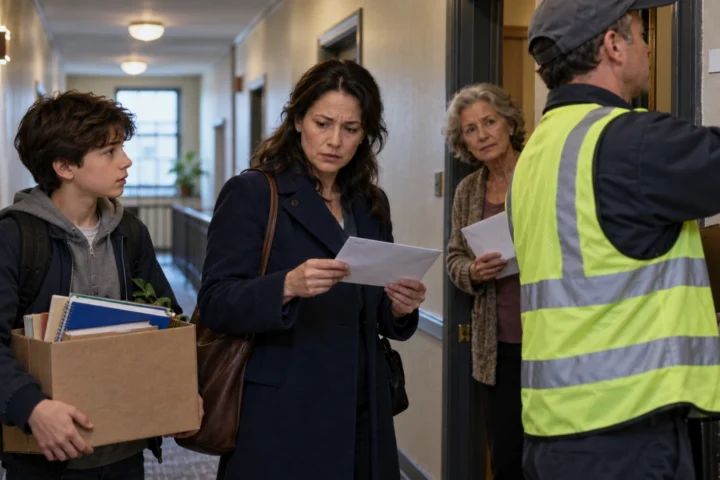
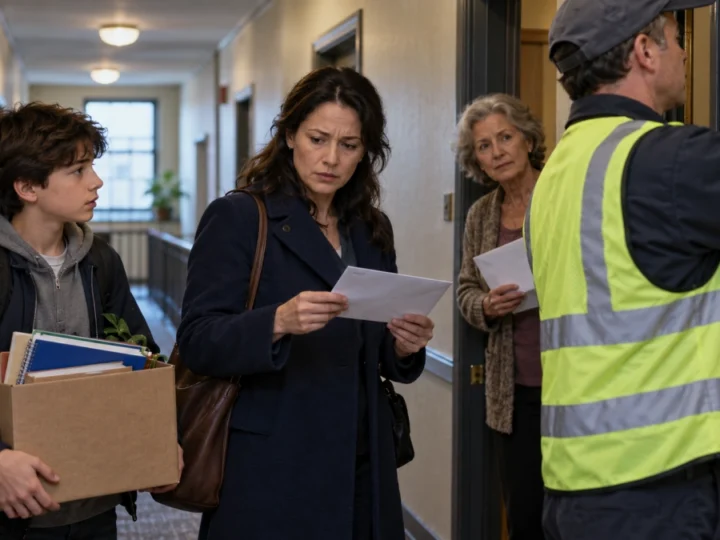
On Monday morning, a man in a reflective vest stuck a label reading 4C on my apartment doorframe. My son, Mateo, thought the building was changing its numbers. The man said he was marking units “ready for delivery” to the new owners. I had never agreed to move.
An envelope from management lay under my door: four thousand dollars if I gave up the apartment in twenty one days. It called the offer voluntary. I looked at the boxes of books Mateo had stacked for a school presentation, then at my night shift schedule. Three weeks was not enough time to find a two bedroom apartment in his school area, save a new deposit, and take days off to move.
Ruth from 4A heard us in the hall. She had received an envelope too, but hers offered twelve thousand dollars and two months. Her apartment was the same size as mine. Both our leases ran into spring.
I went downstairs to ask why the letters were so different. The property manager said every offer was calculated individually and I should sign before mine expired. I asked about the label on my door. She called it a survey crew mistake, then pushed a paper across the counter. “This only confirms you received the notice,” she said.
Under the signature box, in smaller type, the paper said I agreed to terminate my lease and hand over the empty apartment on the twenty eighth. I put down the pen. My phone buzzed with an automated email from the company: “Pre-delivery inspection scheduled.” The inspection was set for Friday.
Mateo stood beside me with a box of books in his arms. “Did you say yes?” he asked. Behind the counter, the manager watched me over her monitor, waiting for me to pick up the pen again.
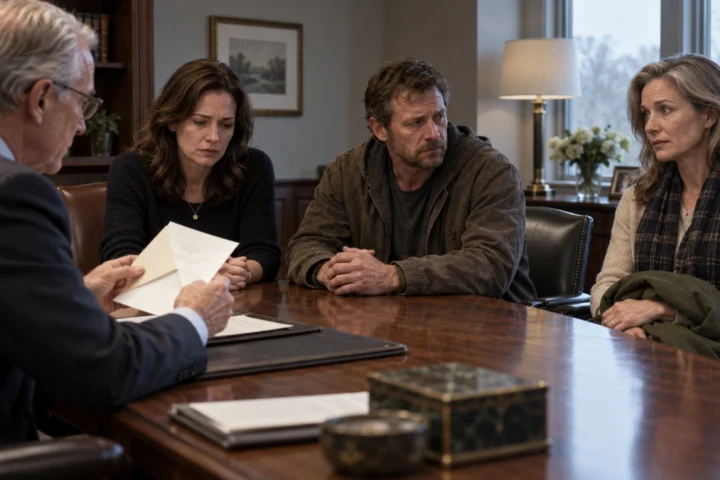
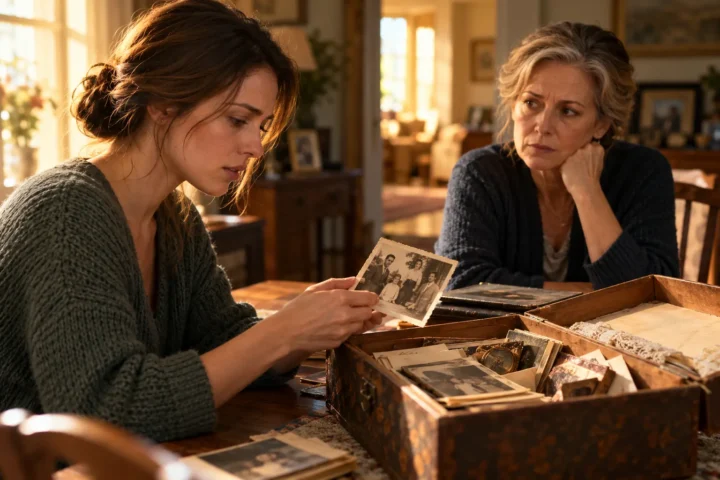
The attorney had barely said “half the house” when my brother laughed. It was the kind of laugh that comes out when there is nothing safe to say. I had spent the last eighteen months sleeping in a folding chair beside our mother’s bed. Dan came by between repairs at his auto shop. Yet half the house on Alder Street was going to a woman neither of us had ever met.
She sat at the far end of the table, a green coat folded across her knees. She didn’t smile when she heard her name. She watched the envelope in the attorney’s hands as though it might contain one more thing she was afraid to learn.
“There’s a mistake,” Dan said. “My mother didn’t know her.”
Mr. Harris took off his glasses. “June Whitcomb signed this will in front of two witnesses after meeting with me alone. She left one quarter of her estate to Daniel, one quarter to Claire, and one half to Maya Ortiz.”
I was about to say that a stranger was not getting a key to Mom’s house. Then Harris opened the letter she had instructed him to read with the will. Its first line made me grip the edge of the table.
“Maya is my first daughter.”
Dan looked at me. I looked at Maya. She had Mom’s gray eyes, but matching eyes could not explain a lifetime of silence. Maya said she had found Mom eleven months earlier through adoption records and a DNA match. She had asked Mom to tell us.
“She promised she’d do it at Christmas,” Maya said. “I waited in my car outside for almost an hour. Then she texted that it wasn’t the right time.”
That Christmas, Mom had sat between Dan and me, opened gifts, and eaten the waffles I made. She had said we must keep the house in the family. Now the woman left waiting in the cold was family too, and each of us held a piece of that promise.
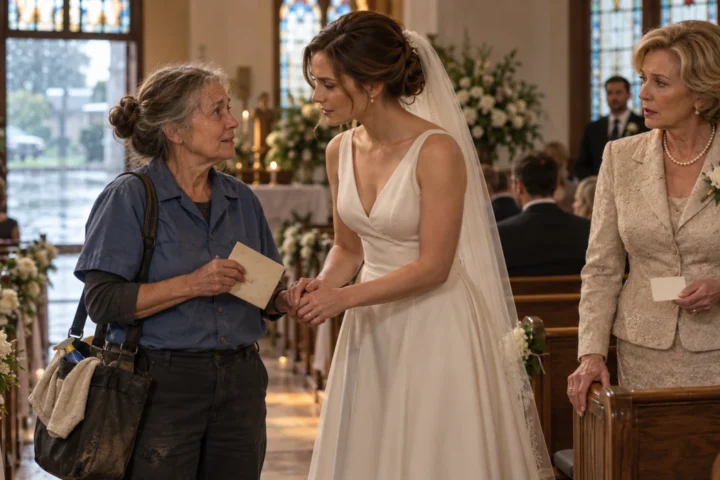
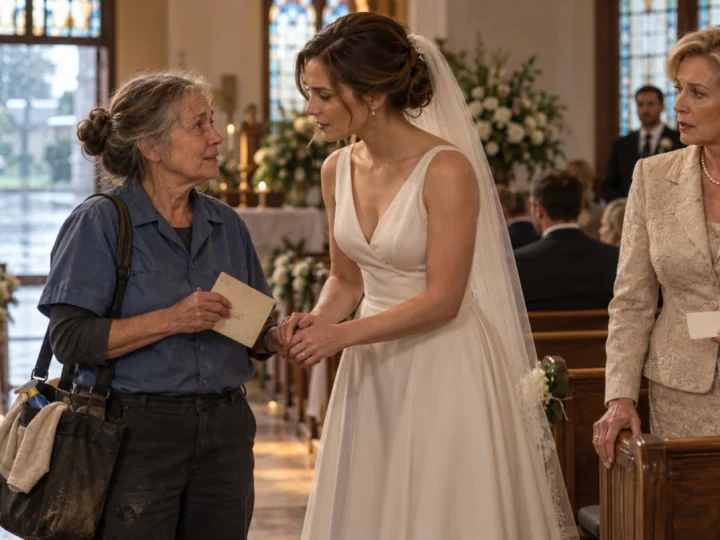
The groom's mother lifted the place card from the front row and pressed it into the hand of a woman wearing a cleaning uniform.
“These seats are for family. Staff use the back entrance.”
I saw it through the door of the bridal room. The organist was still rehearsing. The woman looked down at her blue work shirt, then at the shoes the rain had soaked, and reached for her canvas bag.
Twelve years earlier, those hands had braided my hair before a school audition. She disappeared that afternoon. I was told she had stolen money and run away. I was told to stop waiting for someone who had never really loved me.
That morning, a message arrived: “It's Ruth. I received your invitation.” I pulled a chair close to the aisle. I didn't know what I should call her anymore. I knew she needed a seat.
I stepped out, catching my dress on the hinge. Daniel turned toward me.
“Claire?”
I reached Ruth before she reached the door.
“If she leaves, I leave.”
Daniel's mother looked from me to Ruth. For a moment, her irritation became something else. Recognition.
Ruth took a faded envelope from her bag.
“I didn't come to ruin your wedding,” she said. “But I won't accept money to disappear again.”
Daniel put a hand on the chair. “Mom, do you know her?”
His mother didn't answer. She watched the envelope as Ruth let go of my hand and laid it where the place card had been.
Eight minutes before the wedding, Emily received an unsigned card.
It held only two sentences:
“Ask Daniel about the $1.8 million he owes. He’ll tell you it’s been paid off.”
Emily called her fiancé.
“Do you owe $1.8 million?”
Daniel paused. “Who told you that?”
“Just answer me.”
“It’s from the old company,” he said. “I paid it off.”
Emily looked at the card again. Whoever had sent it knew exactly what he would say.
“Daniel, who paid it?”
A door closed on his end of the call. Daniel lowered his voice.
“Emily, who’s with you?”
“Rachel. And your mother.”
“Don’t ask my mother. I’m coming up.”
He hung up.
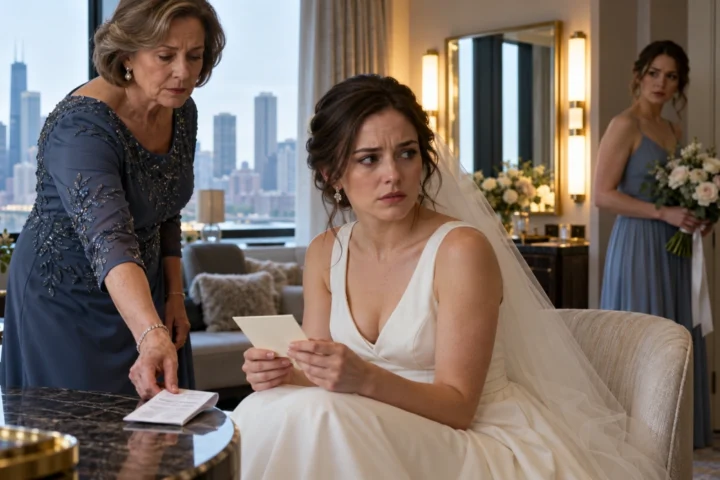
Emily looked around the bridal suite. Rachel, the best friend who had urged her to postpone the wedding, stood by the door holding the bouquet. Margaret, Daniel’s mother, was quietly straightening the veil on the dressing table.
“Someone says Daniel owes $1.8 million,” Emily said.
Rachel lowered the flowers. Margaret did not turn around.
“Did you know?” Emily asked her.
Margaret set the veil down. “Have you spoken to Daniel?”
“He says it’s paid off.”
Margaret met Emily’s eyes in the mirror. “Then you asked him the same question I’ve been asking for eleven months.”
Emily’s phone lit up.
Daniel: Don’t make any decisions before I get there.
Downstairs, the musicians began the song Emily had chosen for her walk down the aisle. Margaret reached into her purse, took out a folded sheet of paper and placed it in front of Emily.
It was a receipt for a $16,200 payment made at 9:14 that morning. The sender’s name was Margaret Reed.
“That’s the eleventh payment I’ve made for him,” she said.
Emily stared at the amount. Eleven payments like that were more than Margaret had ever claimed to have in savings. Where had the money come from?
Running footsteps stopped outside. Daniel knocked hard.
“Mom,” he called through the door, “you promised you’d let me tell her myself.”
Margaret looked at Emily before she answered.
“I’ve been waiting eleven months for you to do that.”