My name appeared in the bottom corner of the presentation, beside the words “Data reviewed by.” On the title slide, beneath Neighborhood Delivery Plan, was my boss's name: Owen Price. I had proposed the route plan, tested it with six stores, and sent Owen the results. But the missing credit was not what made my hands go cold.
Slide four said, “28% fewer late deliveries.” The correct figure was 8%. During two days when the warehouse scanners failed, dispatchers recorded twenty late deliveries in a paper log. The automated report ignored all twenty. I had attached photographs of the log, marked the problem in the spreadsheet, and warned Owen not to use 28% in front of the client.
Owen walked into the conference room and set his coffee beside the projector. “This is final,” he said. “Maple & Main will be here in ten minutes.” The eighteen-store bookstore chain was considering moving its replenishment deliveries to our company. If its managers believed our presentation, they might cut receiving staff on the days we promised to arrive on time.
I pointed to slide four. Owen glanced at it. “It's twenty deliveries. The direction is still right.”
“Those twenty deliveries are the difference between eight and twenty-eight percent.”
He lowered his voice. “Don't ruin the pitch over a footnote. I'll tell them the pilot numbers are still being reviewed.”
I opened the email I had sent on Monday. It contained the complete spreadsheet, Tessa's signature from dispatch, and an unmistakable warning. Owen had replied, “Seen.” I asked if he would fix the slide now. He opened his laptop and changed just one word in the heading: “Projected 28% reduction.”
Greetings sounded in the hall. Marisol Vega, Maple & Main's operations director, approached with two store managers. Owen closed his laptop, handed me the clicker, and smiled as if we had settled everything.
“Leah can answer the data questions,” he told them. “She checked the numbers for my plan.”
At 6:30 every morning, three knocks sounded through my bedroom ceiling. I had usually been asleep for four hours after my late shift. My daughter, Molly, would burrow deeper under her blanket while I stared at the plaster and counted. Ever since we had moved into apartment 2B, the knocks had come at exactly the same time. Sometimes two softer knocks answered them, and then the building went quiet.
I emailed the property manager three times. Dale said the sound came from 3B, where Harold Whitaker, a retired man who lived alone, had an apartment. Dale promised to remind him that quiet hours lasted until seven. When nothing changed, I filed a formal noise complaint. I did not want Harold fined. I wanted forty-five more minutes of sleep before I got Molly to school and returned to work.
Yesterday afternoon, I saw a warning notice beneath Harold's door. I was on the third floor returning a scarf Molly had dropped. Harold stood beside the notice, reading it twice. I walked past without admitting I was the person who had complained.
This morning, 6:30 came without the three knocks. I lay still, waiting to feel relieved. Instead, two sharp taps traveled along the heating pipe. They came again, faster. Footsteps shuffled in the hall, followed by pounding on my door.
Beatrice Bell from 3C stood outside in her robe, clutching an old phone. “Harold isn't answering,” she said. “I sent my signal twice. He has never missed a morning without telling me.”
My clock read 6:34. Beatrice pointed toward the spot on my ceiling where I had wanted the noise to disappear. “Do you have Dale's number? I can't get into Harold's place. The lobby intercom is still broken.”
Molly appeared behind me, barefoot on the cold floor. For the first time, I understood that the three knocks were meant for someone other than the woman trying to sleep below. Now they had stopped, and the three of us had to decide what to do before waiting became its own decision.
The woman holding the real estate sign asked Nathan Vale to move his tomatoes before she photographed the yard.
He had just lowered a seedling into the bed beside Ruth Bell's kitchen window. Dirt darkened the knees of his only decent jeans. Behind him, the garden gate stood open, exactly as Ruth had always left it.
“These aren't mine to move,” he said.
Claire Bell looked at the flat of plants by his feet. “But you're planting them.”
Ruth had been dead for nineteen days. Her daughter had driven down from Toledo with a borrowed trailer, three empty coffee cups, and the belief that clearing a house meant dealing with things inside it.
Nathan had moved into the upstairs apartment next door after his divorce. For most of last summer, Ruth's garden had been the only place where he could spend an evening without hearing his refrigerator switch on.
“She told me to keep it going,” he said.
Claire set the sign against the fence. “She told me she wanted less work.”
Before either could answer, Alma Ruiz appeared at the alley entrance carrying a blue bucket. She stopped when she saw the new tomato plants.
“That's where the marigolds go,” Alma said. “We put them there for Luis every June.”
Across the fence, a boy's voice called, “Did you move my beans?”
Nathan looked down. A row of little sticks lay beside his trowel. He had mistaken them for winter debris.
Claire shut her eyes for a moment. Then she opened the gate wider, not as an invitation but to make room for everyone who seemed to have a claim on her mother's backyard.
“Nobody plants anything else,” she said. “Not until somebody tells me what my mother promised.”
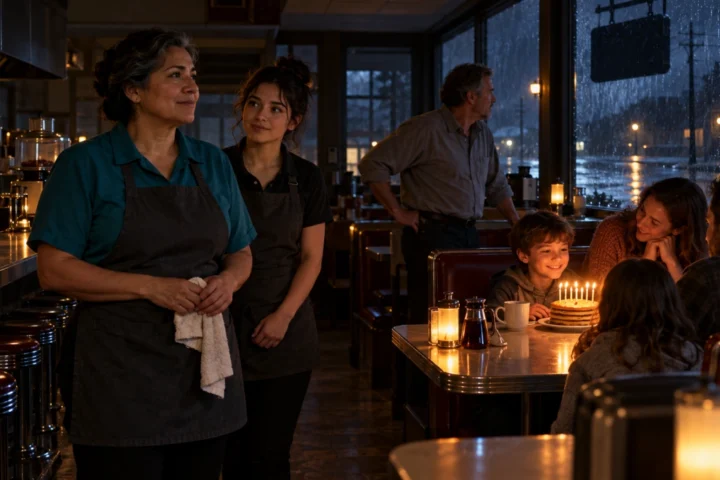
The lights went out while Rosa Medina was showing her replacement where the diner kept its birthday candles.
Across the counter, a little boy inhaled to blow out the seven flames on his pancakes. The exhaust hood stopped. The pie case went dark. Somewhere behind Rosa, a plate shattered.
"Nobody move yet," she said.
She had worked at Cedar Street Diner in Dayton for nineteen years. She knew which stools wobbled, which regulars needed help standing, and how long the emergency lights would last. What she did not know was why the woman she was training had been offered her entire schedule.
That morning, owner Dean Porter had said, "It's coverage, Rosa. You're moving into management. We talked about this."
They had talked about it for three years.
Now the new server, Tessa Ward, stood beside the register with a birthday candle illuminating her frightened face. Through the front windows, rain crossed the parking lot sideways. A dead traffic signal swung above the intersection.
Rosa turned off the coffee warmer and called to Luis in the kitchen. He was already shutting down the cooking line.
"Keep the refrigerator doors closed," she told him. "I'll check the tables."
Dean emerged from his office holding his phone above his head, searching for reception.
"We can still do cash," he said. "Rosa knows how to keep us running."
Tessa looked at her. "He told me you'd be leaving the floor on Monday."
Monday was four days away. Rosa had no new contract, no new pay rate, and no management schedule. At home, her sixteen-year-old son had two tickets to his school concert beneath a magnet on their refrigerator.
Dean moved toward the locked front door.
"Don't turn that sign," he said. "People need somewhere to go."
Rosa put her hand over the switch for the OPEN sign, although it was already dark.
"Then we decide what we're actually offering them," she said.
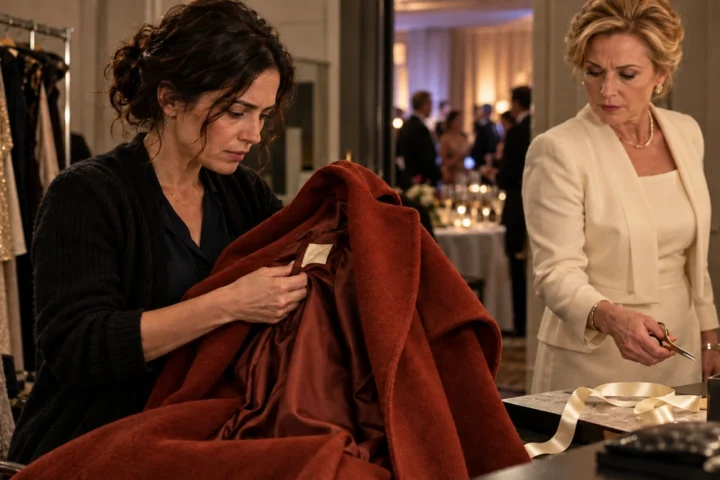
The woman holding Mara Ellis's coat had already cut one stitch from the label when Mara reached across the table and closed the scissors.
"That isn't the washing tag," Mara said.
"I know." Claire Benton kept her voice low. Beyond the dressing room door, volunteers were setting out wineglasses for the Harbor House auction. "We need the lining clean for photographs."
On the hanger beside them waited a cream ribbon printed with the name Bellwether Atelier. Mara had never worked there. She had spent six evenings making this coat at her kitchen table in Cleveland, moving her daughter's homework whenever she needed room for the sleeves.
"Did they design anything?"
"They're lending us their reputation."
The coat was rust red, with a deep inside pocket positioned for a hand that couldn't easily reach across a chest. Mara had developed that pocket for her mother after shoulder surgery. The auction card described the garment as an exclusive Bellwether creation. Under estimated value, somebody had typed twenty-four hundred dollars.
Mara had donated her labor because Harbor House had given her daughter, June, a free place in its summer art program. She had paid a hundred and eighty-six dollars for wool and lining. At home, the refrigerator held a renewal notice for June's bus pass and a gas bill she had turned facedown.
Claire put the scissors down.
"There's private work afterward. Six coats for the committee. Six hundred each. Materials supplied. But they want discretion. No maker tags, no photographs, no discussing clients."
Thirty-six hundred dollars. Mara could hear the radiator knocking in her apartment even here.
"And if I leave my name in this one?"
Claire looked toward the door, where the auctioneer had begun testing his microphone.
"Then I can't promise either opportunity survives."
Mara slid her hand inside the coat and found the loose thread beneath her name.
My husband announced my retirement between the crab cakes and the roast chicken, using a sentence I had never said aloud.
"I want a life that doesn't happen in the spaces my job leaves behind."
Around our anniversary table, eight people lifted their glasses. Martin stood beside me with his reading glasses folded into his shirt pocket. He looked nervous and handsome, the way he had looked twenty-six years earlier when he asked whether I wanted to share an apartment.
Only now he was telling our friends that I was leaving the library.
I was fifty-two. I managed adult programs at a Pittsburgh branch library. I had not given notice, applied for retirement, or agreed to quit. That sentence lived in an unsent email addressed to nobody, written after a particularly exhausting Tuesday.
"No more being the dependable one for strangers," Martin continued. "It's finally Nora's turn."
Another sentence. Same draft.
Our daughter, Wren, put down her glass. Across the table, Martin's sister Beth pressed her hands together, touched by a sacrifice she thought she understood.
Martin set a blue envelope beside my plate. Inside was a printed itinerary for a month driving through New England in September. September was when my branch launched the evening literacy program I had spent a year building.
"I already told people not to expect you back," he said softly, mistaking my stillness for happiness.
The restaurant smelled of browned butter. A server waited behind him with a cake bearing two crooked candles.
I looked at the envelope, then at the man who knew how I took my coffee and apparently believed he knew how I should spend the rest of my life.
"Which people, Martin?"
He lowered his glass.
"And before you answer that," I said, "tell me how you read my email."