Original fiction
On this page
The Meeting on the Third Floor
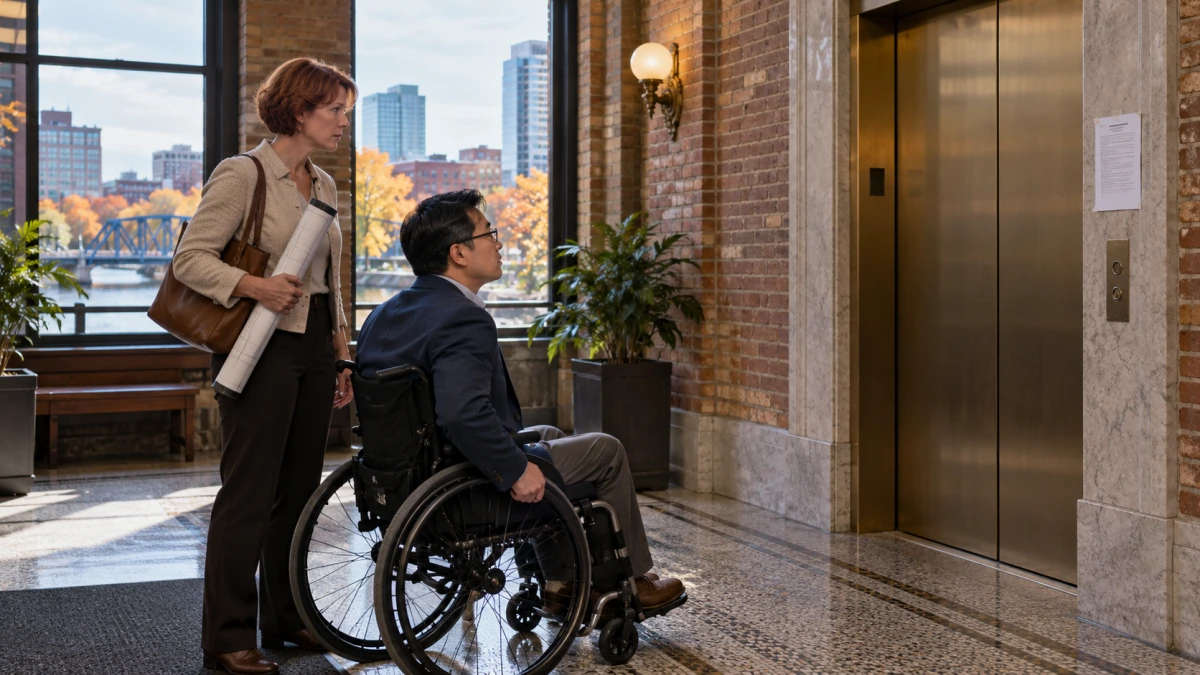
The elevator doors stayed closed while Beth Rowe explained that Miles Chen could still be part of the presentation from the bottom of the stairs.
“I'll put you on speaker,” she said. “You know I know the drawings.”
Miles looked from the small service notice to the presentation tube under her arm. Inside were the market forecourt plans he had spent three weeks revising. His name was on the drainage study. His measurements determined whether delivery trucks could turn without blocking the pedestrian route.
He had arrived twenty minutes early. Now there were twelve minutes before the Thursday pitch, and the meeting was three floors above him in an older Grand Rapids commercial building with one broken elevator.
“Where would I put the drawings?” he asked.
Beth glanced toward the narrow space beside the stairwell. She had not thought that far.
A building employee offered to find two strong people. Miles said no before the man finished. He would not be carried upstairs, and nobody would improvise a lifting arrangement with his wheelchair. The employee apologized and went to answer the desk phone.
Beth lowered her voice. “We can't lose this meeting.”
“Then we need a place where I can do it.”
His phone lit up with a message from Omar Velez, the client coordinating the proposal review. Were they in the building?
Miles typed yes, then paused. Beth was already reaching for the tube as though taking the drawings upstairs might save the morning.
He held it against his wheel.
“Don't take the work up without me,” he said.
Then he called Omar, not to ask permission to exist in the meeting, but to explain why the meeting needed to move.
Omar answered with the briskness of someone watching a clock. Miles could hear chairs moving in the background. He described the elevator, the room assignment, and the time remaining. He did not begin with an apology.
“Is there a room on your floor?” Omar asked.
“There may be. We haven't confirmed one.”
“Find out. I'll check what the reviewers can move.”
It was not a rescue. Omar had five proposals to hear and a committee with different lunch obligations. Miles appreciated that he had treated the problem as something to arrange rather than something to admire Miles for enduring.
Beth looked at the phone when the call ended. “You could have let me explain.”
“I can explain why I can't reach a room.”
She flushed. He was sorry about the flush and not sorry about the sentence. Those feelings could coexist. He had worked with Beth for four years. She knew how he took coffee, which software shortcuts he hated, and why the blue pencil was never available for lending. Somehow she still imagined participation could mean his voice floating out of her phone while everyone else looked at one another.
The building employee returned. His name badge said Alan. He explained that the elevator contractor had been called that morning, but there was no repair time. Miles asked about ground-floor meeting rooms, entrances, and restrooms. Alan mentioned a training room beyond a glass door. It belonged to a bookkeeping office and might be occupied.
“Can you ask whoever controls it?” Miles said.
Beth began searching nearby hotels on her phone. The first had a room but needed advance payment. The second had a public lobby, which was not a suitable place to discuss an active bid. Miles did not want to present beside strangers checking out. He asked her to keep the hotel option open while Alan checked the training room.
They moved away from the stairwell so people could pass. A woman carrying a tray of bagels smiled at Miles with the bright concern he dreaded. She said it was awful, then asked Beth whether she wanted the bagels taken upstairs. Beth said no, thank you. For once, she did not explain anything on his behalf.
Miles opened the drawing file on his laptop and checked the battery. He had charged it overnight, downloaded a local copy, and packed an adapter. Those preparations had nothing to do with the broken elevator. He resented that they might now be described as evidence of extraordinary determination rather than ordinary professional preparation.
Omar called again. Two reviewers could join by video from upstairs. He could come down if a room became available. They had twenty minutes before the next presentation team, not the thirty originally allocated. If the arrangements took too long, they would have to consider rescheduling, and the decision deadline remained Tuesday.
“I need to see the room before agreeing,” Miles said. “And test whether I can share the drawings and hear questions.”
“Fair. Call me in five minutes.”
Beth glanced at her watch. “We're spending our time on this instead of the work.”
“This is what makes the work possible.”
She looked ready to answer, then put her phone away. “What do you need me to do?”
“Find out whether we can use their screen. Then check the link with the reviewers.”
Giving her a concrete task steadied them both. Miles did not want to punish Beth by refusing help. He wanted help that answered the actual problem, not help that removed him from it.
Alan came back with a woman from the bookkeeping office. The training room was free until noon. They could use it if the tables were returned afterward. There was a level route through the glass door, enough turning space once an unused chair was moved, and a restroom down the same hallway. Miles checked the route himself. Alan held the door after asking whether that would help.
Inside, there were six tables in a loose rectangle, a wall screen, and a webcam on a rolling stand. The screen cable did not fit Miles's laptop, but his adapter did. Beth tested the audio with Omar's assistant upstairs. The first attempt echoed badly. She muted the room computer's speaker, chose one microphone, and asked the assistant to repeat a sentence. This time the sound was clear.
Miles positioned himself where the camera could see him and the printed site plan. He could reach the table without twisting, see the screen, and move away from the desk if necessary. These were not luxuries. Without them, he would spend the pitch solving his own position instead of solving the client's drainage problem.
Omar arrived carrying his notebook. He was fifty-one, with salt-and-pepper hair and a dark blue shirt. He introduced the two remote reviewers by name: Ruth handled operations, and Calvin worked on the budget. He asked Miles whether this arrangement worked.
“Yes, with the drawings shared from my laptop and questions directed to whoever has the relevant work,” Miles said. “I need to know who is speaking if I can't see them.”
Omar relayed that upstairs. He did not call Miles brave. He asked where they should start.
Beth set the tube on the table and pulled out the plans. Her hands were still moving too quickly. Miles asked her to open with the project aims, then pass to him for the circulation and drainage explanation. It was their original division, shortened rather than erased. She nodded and wrote the revised minutes on a scrap of paper.
The pitch began eleven minutes late. Beth described the neighborhood market's wish for a welcoming forecourt without reducing the deliveries that kept the shops operating. She was good at this, clear and unsentimental. Miles remembered why he liked working with her even while he was angry with her. The two facts did not cancel each other.
When she passed to him, he brought up the turn analysis. The delivery van could enter without crossing the main pedestrian path if a proposed planter shifted closer to the east boundary. He showed the turning envelope, then the existing drainage slope. Moving the planter without adjusting the surface would direct water toward a low doorway during heavy rain.
Ruth interrupted from upstairs. Could they keep the larger planter and alter the delivery hours instead?
Beth started to answer, then stopped and looked at Miles.
He asked Ruth which deliveries could actually move. The dairy supplier arrived before the market opened, but the produce truck sometimes came after eleven. A diagram could not change a supplier's route. Miles proposed a narrower planting bed and a removable section reserved for occasional larger deliveries, subject to a maintenance check before final design.
Calvin asked what it would cost. Miles named the allowance in their estimate, then explained that an underground survey might change it. Their number was not a guarantee. Beth added the separate fee for that survey. Omar underlined something in his notebook.
With six minutes left, they had not shown the seating views. Beth wanted to rush through them. Miles chose one view that demonstrated the pedestrian route and left the others in the submitted packet. The choice cost them some visual charm but preserved time for questions. It was a professional tradeoff, not evidence that the room problem had ceased to matter.
Calvin said another team had priced similar work lower. Beth described their extra coordination visits. Ruth asked about experience on a site with shops remaining open during construction. They had related projects but fewer directly comparable market jobs than they wanted. Miles answered with one small loading-area study instead of stretching a larger plaza renovation into something it had not been.
Omar ended on time. The room would be restored, the packet was complete, and the committee would contact them after reviewing all proposals. He did not promise that their difficulties would earn special consideration. Miles did not ask for any.
When the call disconnected, Beth dropped into a chair.
“We lost ten minutes,” she said.
“We lost more before that.”
“I know.”
He rolled the drawing into its tube. His fingers were cold despite the warm room. During the pitch he had been able to work. Now the morning returned in pieces: the lifting offer, the stairs, Beth's hand reaching for his plans. He wanted lunch and silence. He also knew that silence would let the office call this a minor inconvenience they had heroically solved.
They thanked the bookkeeping staff and returned the tables to their positions. Miles could manage the papers; Beth moved the spare chair. Neither made a ceremony of dividing the tasks. Outside, rain had begun, thin and unpleasant. Beth held the door with her shoulder and asked whether he wanted her to bring the car closer. He said yes. Asking made the difference between useful help and another assumption.
In the car, she started apologizing before fastening her seat belt.
“I was thinking about the deadline.”
“So was I.”
“I thought I could get the material in front of them and then bring you in for questions.”
“You would have been deciding when I got to enter my own presentation.”
She rested both hands on the wheel. “That sounds terrible.”
“It was a terrible plan. You aren't required to be a terrible person for the plan to be terrible.”
The distinction seemed to hurt more than a simple accusation. Beth had expected either reassurance or a fight. Miles could offer neither while hungry and depleted. He asked her to drive back, and they spent the next several minutes discussing traffic because traffic required no emotional generosity.
At the office, their principal, Gwen Ellis, asked whether it had gone well. Beth opened her mouth, then looked at Miles.
“We presented,” he said. “We need to discuss what happened before the presentation, after I've eaten.”
Gwen agreed to meet at three. She had a contractor call first. Miles appreciated the delay because it meant he did not have to explain access while still recovering from the effort of obtaining it. He ate the lunch he had packed, answered a colleague's question about a drawing layer, and spent twenty minutes on an unrelated curb detail. Familiar work restored some scale to the day.
At three, he took his notes into Gwen's office. Beth had written a timeline too. They agreed on the basic facts: the venue invitation had listed a third-floor room; nobody had confirmed the elevator's operating status that morning; no alternative room had been reserved; Miles had not been included in planning a contingency. The elevator breakdown was not under their control. The absence of a plan was.
Gwen asked why Miles had not called ahead himself. Beth looked down.
Miles answered carefully. “I checked the invitation and the building information. It listed an elevator. I shouldn't be the only person responsible for whether our team can reach a meeting.”
“I wasn't saying you were.”
“You just asked me before asking who booked it.”
Gwen leaned back. She had built the firm through years of personally solving everything, and she sometimes confused ownership with remembering every small detail. Miles waited rather than filling the space with reassurance.
Beth said she had accepted the room assignment and never asked about an alternative. She had assumed the elevator would work because it usually did. Once it failed, she focused on keeping the pitch alive instead of keeping Miles in it. She did not say that she meant well. Miles had already known that, and it had not been enough.
They agreed to record the incident without turning it into a story about overcoming adversity. Miles asked that no photograph or social post be made about the relocated pitch. Gwen looked surprised; she had not planned one. He said he was glad, but wanted the point clear before somebody suggested celebrating the team's resilience. Their process had failed a colleague. That was a reason to change the process, not to advertise a heartwarming morning.
The first draft of a new checklist was terrible. Gwen proposed a box labeled “special needs,” with Miles responsible for completing it. He crossed out the label on the shared screen. Access information belonged with location, timing, equipment, and attendance, not in a private exception attached to one person's name.
Beth offered to own the booking check for the next three client meetings while the office developed a permanent process. She would confirm the route, room, working facilities, and a usable fallback with the host; ask each participant what they needed to take part; and tell the team what remained unverified. A calendar owner would carry the task after that. Miles would review the first version, not become its lifelong unpaid auditor.
Gwen worried that confirming every detail would take too long. Miles pointed to the hours they had just spent improvising. Nobody had been paid extra for those. They agreed to test the process for a month and revisit its workload. It was less satisfying than instant certainty, but more likely to survive a busy week.
That evening Miles stopped at a grocery store on the way home. The accessible checkout lane was occupied by stacked promotional boxes. A clerk moved them when he asked. It took less than a minute. He almost laughed at the contrast: the solution was simple, but he still had to be the person who noticed, requested, and waited. He bought noodles, mushrooms, and the expensive oranges he had talked himself out of the week before.
At home, his older sister Vivian called. She lived in Lansing and taught middle school. He told her the outline of the day while chopping mushrooms at his lower counter. She asked whether he wanted sympathy or help making an angry spreadsheet.
“Dinner would be better.”
“I can offer neither from here, but I can stay on the phone.”
He put her on speaker and listened to a story about a classroom printer that ate permission slips. She did not compare it to the elevator. She merely gave him somewhere else to rest his attention. By the time the noodles were cooked, he had stopped clenching his jaw.
Friday morning, the committee asked for clarification about their cost allowance. Beth and Miles prepared a concise answer, separating construction assumptions from design fees. They did not mention the elevator in the clarification. The bid still had to stand on its work. Miles checked the turning diagram again because he refused to let exhaustion from Thursday become an error on Friday.
At lunch, Beth asked whether they could talk somewhere other than Gwen's office. Miles suggested the small courtyard behind the studio. The rain had stopped, and two metal chairs were drying in the sun. Beth brought coffee without assuming he wanted his usual; she texted first and got the order right.
“I keep replaying what I said by the stairs,” she told him.
“I keep replaying it too.”
She winced. “I wanted to tell you I was panicking, but that's an explanation, not much of an apology.”
“It's useful if you understand what you reached for when you panicked.”
She looked at the cup in her hands. “Your work without you.”
He nodded.
Beth had once fought a client who wanted to remove Miles's name from a credited drawing set because he was a technician rather than an architect. She had insisted that credit follow the work. Yesterday she had nearly separated him from the work herself. He mentioned that, not to catch her in hypocrisy, but because he wanted her to connect two principles she had been treating as unrelated.
“I thought I was protecting the project,” she said.
“I was part of the project before we got to the door.”
She apologized without asking him to say they were fine. Then she asked what he wanted her to do if they encountered another failure despite planning. He said she should ask him what options worked, describe real constraints, and avoid making promises to others before they agreed. Sometimes they might use video. Sometimes they might reschedule. The answer depended on the actual meeting, not on a permanent rule that he would always accept less.
Their coffee cooled. Beth asked about a drainage model they needed to finish, and Miles answered. Returning to work was not proof the conversation had solved everything. It was evidence that he still had work he wanted to do with her, provided the terms changed.
Over the weekend he visited a neighborhood hardware store to replace a loose caster on a household cart. The owner, Tessa Morgan, recognized him from a public design workshop. She asked whether he still worked on site layouts. Rain had been collecting beside her loading entrance, and a supplier wanted to start using a larger van.
Miles did not inspect the site for free while holding a bag of screws. He said the firm could scope a paid study, and asked whether she wanted him to send a short proposal. Tessa did. She also told him not to promise a beautiful plaza because she needed somewhere dry to unload paint. He liked her immediately.
On Monday, Gwen approved preparing the small proposal. The fee would be modest, and the assignment would not replace the market bid if they lost it. Miles would lead the study, with Beth reviewing the client communication and a senior colleague checking the drainage assumptions. He asked for the role to be stated that way in the proposal. Gwen made the change without turning it into a promotion ceremony.
The committee's decision arrived Tuesday afternoon. They had selected another firm. Their price was lower, their experience with occupied market sites was stronger, and the committee had more confidence in their delivery plan. Omar's note also mentioned concerns about preparation on Thursday. Miles read the wording twice. It would have been easy to make the elevator the whole explanation. It would have been equally easy to pretend it had nothing to do with anything.
Gwen called a brief review. Beth said the room failure had reduced their presentation time and affected their start. Miles agreed, then pointed to the comparable project experience they lacked and the higher fee. They could address preparation without inventing a certainty that an unbroken elevator would have won them the work.
“I don't want to be the reason people say we lost,” he said. “I also don't want the access failure erased because there were other reasons.”
Gwen wrote both sentences in the review notes. For once, writing something down felt less like collecting a defense and more like preserving a useful distinction.
Omar agreed to a short feedback call the following morning. He explained the committee's priorities, including keeping shops open through construction and controlling survey costs. Miles asked a question about the turning diagram. Omar said the reasoning had been clear, though another team had more evidence from a nearly identical site. It was specific enough to use and disappointing enough to believe.
Before ending, Miles asked that future invitations include a contact for room access and a verified alternative if equipment failed. Omar said his office had already asked the venue for a clearer booking procedure. He did not promise a flawless world. He promised a named contact and a fallback room for the meetings he coordinated. Miles thanked him and ended the call before gratitude could grow into a debt.
Losing the bid changed the office's mood. Gwen postponed buying new display boards. A colleague worried aloud about winter workload. Miles felt that worry too. He had rent, repairs, and no appetite for a lesson in moral victory at the expense of actual income. The smaller hardware study mattered because it was paid work, not because it redeemed every failure of the previous week.
Beth kept the next meeting's access confirmation on the project calendar. When the host replied only that the building was accessible, she asked for the actual entrance and room route. The host sent a photograph of a side doorway with a step. Beth did not forward it to Miles with a helpless question mark. She asked the host to identify the level entrance and confirm that it would be unlocked during the appointment.
When she did ask Miles to review the arrangements, she included the response, the remaining unknowns, and two workable options. He chose the earlier time because a delivery would block the side passage later. It took three messages and ten minutes, a small cost compared with Thursday's improvisation. The work was visible on the calendar, not hidden inside Miles's private preparation.
He did not trust every new arrangement immediately. At the next client visit he arrived early and checked the route himself. Beth did not tell him he should relax because she had handled it. She walked with him, then returned to collecting the plans they would need. Trust, he thought, might look less like a dramatic apology than somebody tolerating a check without taking it personally.
Tessa accepted the hardware study the following Thursday. The scope covered drainage observations, a loading layout, and a short recommendation report. It did not include construction documents or a guarantee about underground conditions. Miles arranged a site visit when the loading area would be clear and asked who needed to attend. Tessa said the morning driver should be there, because he knew where the van actually stopped.
At the visit, the driver showed them the worn patch where his rear wheel always landed. Miles compared it with the existing survey and asked Tessa about water after heavy rain. Beth took photographs where he directed. He could make observations from the level pavement; no one needed to invent a dangerous route to prove he was committed to fieldwork. A colleague would measure a recessed corner later with the appropriate equipment.
The driver asked whether moving the bins would solve the whole problem. Miles said it might improve the turning space but would not change the slope. He explained the difference using two pencils on the plan. Tessa asked what could be done first within her budget. It was a real design question with a real constraint, and Miles felt the familiar pleasure of narrowing a problem without pretending it had disappeared.
Back at the studio, he found a draft internal note about the new booking procedure. The first sentence called the third-floor incident a valuable reminder of the team's resilience. He changed it to say that a venue failure and missing contingency planning had prevented a scheduled participant from reaching the assigned room. Then he sent it to Gwen with the practical steps below. She accepted the wording.
That afternoon Beth left the revised hardware plan on his desk for review. There was a sticky note beside the loading arrow: “Your call on this turn; I think the wider option earns its space.” She had an opinion and had left the decision with the person responsible. Miles read it twice, then drew a smaller correction that improved both options.
He was still annoyed when he remembered the stairwell. He expected he might remain annoyed for a long time. The point was not to turn memory into forgiveness on schedule. The point was to stop repeating the conditions that had made the memory possible. Beth was doing some of that work. So was Gwen. He could notice without declaring the job finished.
On Friday, Tessa called to confirm their review meeting. She suggested a café nearby because her office was full of paint samples. Miles asked about the entrance, room, and noise. Before he finished, she said they could also meet at the studio if that made sharing the drawings easier. He chose the studio, where the screen and table were already suitable. There was no contest over who would be accommodating whom. They chose the place that worked for the work.
Before the review, he spent an hour making the recommendation shorter. The first draft contained every observation because he was still tempted to prove how much work he had done. Tessa did not need proof of effort in the form of twelve crowded pages. She needed to see which tasks were urgent, which depended on a survey, and which could wait until she had a construction budget. Miles moved the supporting measurements to an attachment and kept the main comparison readable.
Beth reviewed the shorter version. She questioned a sentence about the loading window, and he realized he had carried an assumption from the market project into the hardware study. Tessa's deliveries were less frequent. He corrected it and thanked Beth. Being treated as the responsible designer included having his assumptions challenged. He did not want a fragile arrangement in which everyone was so afraid of excluding him that they stopped disagreeing with his work.
They argued for several minutes about whether the wider turning area justified losing one storage bay. Beth wanted to keep both options equally prominent. Miles thought the report should recommend one while explaining the tradeoff. They called the driver for the missing detail about the longest van. His answer settled neither preference by magic, but it gave them a sound basis for choosing. Miles kept the wider option and added a note about relocating seasonal stock. Beth signed off after checking the revised allowance.
At the weekly office meeting, Gwen asked how the booking trial was going. Another project owner said one host would only confirm arrangements by phone. Beth suggested adding a dated call note rather than abandoning the check because there was no email. Miles agreed. The process needed to record what was known, not demand a particular kind of reply regardless of circumstances. A useful plan could accommodate imperfect information while still assigning someone to follow it up.
A junior colleague asked whether the checklist should include remote participants too. Miles said yes: a person who could enter the building but could not hear a question on video was not meaningfully included either. They added a short audio and screen-sharing test where those tools were needed. Nobody turned it into a sweeping declaration that every problem had the same solution. The checklist became a little more specific, and the meeting moved on to invoices.
Later, Vivian asked how he felt about the lost bid. He said he was disappointed about the money and satisfied with the turning analysis. She laughed softly and said those sounded like separate answers. He told her they were. He had spent too much of the week being offered a single story that could explain everything: equipment failure, personal courage, poor luck, or a better competitor. The truth had several parts, and he wanted enough room to keep them separate.
Before leaving that evening, he found the scrap of paper on which Beth had divided their shortened pitch. His section was still there, with a rushed arrow pointing from her introduction to his diagrams. He put it in the project file with the feedback notes. It was not a souvenir of triumph. It was a record of a morning when an inadequate arrangement had been rejected and a workable one had been made under pressure. Next time, he wanted pressure spent on the design rather than on whether the designer could join the room.
He added the meeting to the calendar and assigned the confirmation task to the project owner. Then he opened the cost comparison he would need to explain. Across the room, Beth was arguing with a supplier about a late sample, entirely absorbed in a problem that had nothing to do with his wheelchair.
He could not know whether the new habits would survive the next rush of deadlines. A month of testing was still only a month. But responsibility now had names beside it, and the unanswered questions appeared where the whole team could see them. He would not have to remember every door alone. That change was small enough to sound administrative and large enough to affect how much of his day remained available for the work he had actually trained to do.
Miles looked at the two loading options, moved one line, and saved the drawing under his own name. The next meeting was on the calendar. This time, getting into it was part of the plan, not something he would have to negotiate after arriving.
Read next

The Voice on the Empty Desk

The Name Behind the Trophy
A Visitor Badge on My First Day
The Hotel Manager Accused Me of Stealing Wedding Linen—Then I Asked Her to Read the Orange Tag
Reading notes
A designer faces a broken elevator and a colleague willing to present his work without him.
This is an original work of fiction. Characters and events are fictional. Explore public-domain books at Project Gutenberg or browse more stories on ReadStoryvia.