Original fiction
On this page
The Voice on the Empty Desk
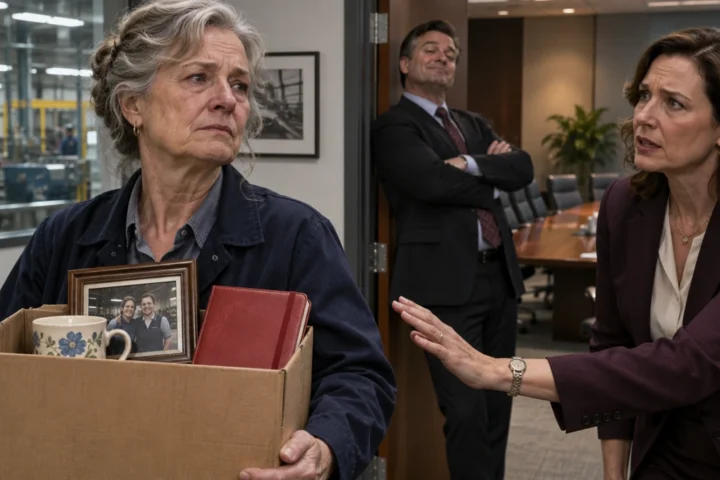
Farah Haddad was returning her headset when she heard herself offer to help a customer from the desk where she no longer worked.
Her cardboard box held a laptop, a charging cable, and the blue ceramic mug she had accidentally packed with company equipment. The mug was hers. Everything else had a yellow inventory sticker. After twelve years at the Columbus office, the distinction seemed almost funny.
Then the speaker said, in her voice, “Let's take this one step at a time.”
Farah stopped beside the empty desk. The little upward catch on “time” was hers too, a habit she had spent years trying to soften in recordings. Nobody was sitting behind the monitor.
Scott Avery came through the doorway carrying the equipment receipt. His pale gray shirt had a coffee stain near the pocket. He saw her looking at the speaker and stopped walking.
“That's the new assistant,” he said.
“I can hear that.”
Across the aisle, Priya Nair lowered her headset. Farah recognized the expression on her former coworker's face: the careful stillness people wore when they were being asked, without words, not to become witnesses.
Scott explained that the vendor had used the training library. Farah had recorded those examples herself. He had understood that the old recording permission covered the new system.
The assistant spoke again, describing a refund policy Farah had never read aloud.
She set the box down slowly. Her position had been eliminated on Friday. It was Tuesday morning, and apparently part of her had been given a new position without being asked.
“Turn that off while we talk,” she said.
Scott reached toward the speaker, then hesitated.
“I mean my voice,” Farah said. “Not just this speaker.”
Scott lowered the demonstration volume anyway. In the resulting quiet, a printer on the other side of the room sounded absurdly industrious. Farah could see the rectangle of clean carpet where her old cabinet had stood. Someone had already moved the cabinet to shipping. She had approved that herself on Friday, when being helpful still seemed a way to leave without embarrassment.
“Let's use my office,” Scott said.
She picked up the box. “First sign the receipt.”
He looked hurt, which made her unexpectedly angry. She had not accused him of stealing the laptop. She simply wanted a piece of paper confirming that she had returned it. He signed on the counter, and she checked the serial number against the photograph she had taken at home. Ordinary precautions felt theatrical now, although they would not have yesterday.
Priya caught her beside the supply closet. “I didn't know until Monday.”
“You don't have to explain in the hallway.”
“I want you to know that.”
Farah nodded. Priya's navy cardigan had a loose thread at the cuff. During training, Farah used to tell new hires to hold a pen instead of picking at their clothes while a customer shouted. Priya was twisting that thread around her finger. Farah wanted to tell her to stop, then realized she was no longer responsible for how anyone here handled difficult calls.
Scott's office still contained the small plant Farah had watered during his surgery. She sat facing it rather than the framed sales certificate. He opened the vendor dashboard and turned the screen toward her, as if visibility could stand in for an explanation.
“I thought it was a better version of the recordings,” he said. “Not a different use.”
“A recording repeats something I chose to say. That thing just made me explain a policy I haven't seen.”
“It isn't making decisions.”
“That's not the only thing I'm asking about.”
He shut his mouth. She appreciated that much.
She asked what files had been supplied, who had approved the upload, and whether customers were told she no longer worked there. Scott knew the folder name. He did not know the specific files or what the vendor retained. He said there was a disclosure that callers were speaking to an automated assistant. Farah asked whether the disclosure said whose voice it was. He admitted it did not.
“I need the source records and the permission you relied on,” she said. “And I want this voice suspended while you establish what happened.”
“The queues are already bad.”
She looked at him until he glanced away.
“That's a staffing problem, Scott. I don't say that to be cruel.”
Outside his window, a delivery driver dragged a hand truck over the cracked pavement. Farah had explained those cracks to customers awaiting replacement shipments, making a joke about the warehouse's adventurous geography. She wondered how many of her jokes had gone into the folder.
Scott promised to send a request to operations that morning. Farah wrote the date in the notebook she had brought for unemployment appointments. She did not secretly record him. She read her notes back and asked him to correct anything inaccurate. When he said the system had gone live Monday afternoon, she added that. When he called the upload a misunderstanding, she wrote “Scott describes assumption about permission,” which was less comforting and more precise.
In the parking lot, she put the equipment receipt inside the notebook. Her mug rattled in the empty box. For a moment she could not remember why she had brought it upstairs instead of leaving it in the car. That small mistake upset her more than she expected. She had rehearsed a dignified exit all weekend and had managed it until she heard herself continuing without her.
Her sister Salma called while she was sitting behind the steering wheel. Farah let it ring twice before answering. Salma wanted to know whether the return was finished and whether she had eaten. Farah told her about the speaker. There was a long silence, followed by an offer to drive over and complain in person.
“Please don't,” Farah said. “I need one thing today that doesn't get bigger.”
They met for lentil soup at Salma's apartment instead. Salma was a school secretary, not a person with spare money or a powerful friend to call. She could offer soup and a kitchen table cleared of permission slips. Farah found that more useful than outrage. She described the refund sentence, trying to imitate the imitation, then stopped because both women were listening too closely.
“Do you think they planned the layoff around it?” Salma asked.
“I don't know. The account loss was real. Three of us lost positions.”
“You don't have to defend them.”
“I'm defending what I know.”
She had spent twelve years teaching employees not to fill gaps with guesses. She could hardly abandon that now because a guess might make her anger easier to explain. The severance paperwork described a reduced training department. The automated project had existed for months. Those facts could sit beside each other without becoming proof of a secret plot.
That afternoon she opened her job applications. A regional supply cooperative wanted a trainer for a six-week contract, with a possible extension dependent on seasonal volume. The posting asked for a short sample lesson. Farah had planned to reuse a recording from her portfolio. Instead she closed the file and started an outline about helping a customer identify a damaged part without blaming the warehouse.
For twenty minutes she could not write a natural sentence. Every reassuring phrase sounded like something the assistant might be saying. She changed “I'd be happy to help” to “Show me what arrived,” then changed it back. Finally she stood up, washed the soup container, and explained the lesson aloud to the dish towel. Her own voice, unamplified in her kitchen, sounded tired and entirely ordinary.
Scott's email arrived at five. Operations had asked the vendor to pause the custom voice. He attached a recording release from seven years earlier. It authorized the company to record Farah's training demonstrations and use them in internal instructional materials. Below that were broad words about editing and distribution. There was no clear description of generating new speech for customer calls.
Farah read it three times. She was not going to declare what a court would decide. She did not need that certainty to say the document did not describe the use she had understood. She replied in those terms and asked for confirmation when the pause actually happened, not only when it had been requested. Then she returned to the sample lesson.
The next morning Priya sent a text asking whether they could walk at lunch. Farah almost refused. Friendship with someone still inside the office suddenly seemed like a second unpaid job. But she remembered the loose thread and agreed to meet at a small park two blocks away.
Priya brought a sandwich wrapped in foil and did not eat it. She explained that the assistant was routing confused callers to her team. People repeated a problem to the machine, then repeated it to her, angrier each time. One customer had said, “Put Farah on. She knows me.” Priya had said Farah was not available, because she had not known how much she was allowed to disclose.
Farah stopped walking.
“You can say I no longer work there.”
“I know. I should have.”
“I'm not asking you to become my spokesperson.”
“I don't know where the line is anymore.”
That was the first sentence anyone from the office had said that sounded as confused as the situation actually was. Farah sat on a damp bench. Priya remained standing, her sandwich hanging from one hand.
They had become friends slowly. Priya was twenty-nine, and Farah had initially mistaken her quietness for a lack of confidence. During a difficult training exercise, Priya had pointed out that the prescribed script promised delivery dates the warehouse could not guarantee. Farah had revised the exercise. After that, Priya brought her problems rather than agreeable answers.
“You don't owe me reports,” Farah said. “And don't take screenshots of customer accounts for me. I want the company to answer for its own records.”
Priya sat down. “I wasn't going to.”
“Good. I needed to say it before somebody tried to help that way.”
They ate, watching a maintenance worker collect wet leaves. Priya asked about the cooperative application, and for a few minutes Farah could be a person looking for work rather than a problem someone was carrying back to the office. She described her lesson. Priya suggested using a real box instead of slides. Farah wrote the idea on the foil before remembering she had a notebook.
At home, the box became the lesson's center. She packed it with a mismatched hinge and a harmless dented bracket from her junk drawer. Her nephew Daniel filmed a practice version on her phone after dinner. He was seventeen and more interested in getting the framing right than discussing the voice incident. When she stumbled, he told her to start at the previous sentence, not the beginning. It was excellent advice for more than filming.
She submitted a written outline with a private sample link and a note that the recording was for evaluation only. Adding the note made her feel demanding. Leaving it out would have made her feel worse. She sent it before she could turn a reasonable boundary into an apology.
On Thursday, Scott called to say the voice had been disabled in the live assistant. Farah asked him to confirm it in writing. He did, attaching a screenshot of a status field. It was a beginning, not the provenance she had requested. She thanked him for the specific action and asked for the file list and vendor retention explanation again.
“I have to be honest,” he said. “Operations thinks we're overreacting to a feature.”
“Then describe the feature accurately.”
“I'm trying.”
“Try without calling my objection an overreaction.”
He was quiet. She could hear office sounds through the phone, including a laugh she recognized but could not place. Once she would have asked who was celebrating. Now she waited.
Scott said he had approved sending the training folder. A vendor representative had described voice customization as an optional enhancement. He had checked a box because he assumed the existing release covered it. Farah wrote down his explanation. There was no dramatic hacker, no stolen password, just a hurried decision made by someone who thought permission for one thing would stretch around another.
“I should have asked,” he said.
“Yes.”
She did not rush to make that easier for him. In their old working relationship, she would have softened the silence with a joke. This silence belonged to him.
Friday brought an interview invitation from the cooperative and a bill for her car insurance. The combination was almost comically fair. Hope did not stop automatic payments. She calculated how long severance would cover rent, groceries, and the insurance, then cut two subscriptions and postponed replacing the tires until the mechanic's recommended limit, not beyond it. She refused to turn budgeting into a punishment for being unemployed.
At the grocery store, a former trainee named Denise recognized her near the apples. Denise now supervised a small returns team elsewhere. She asked whether Farah still worked at the old company. Farah answered plainly. Denise said she had heard the new assistant on a supplier call and thought Farah had become its spokesperson.
Farah held the bag of apples open longer than necessary.
“No,” she said. “That wasn't a role I agreed to.”
Denise's smile disappeared. “I'm sorry. I didn't mean anything.”
“You didn't do anything wrong.”
They discussed Denise's new job. Farah asked a genuine question about her training workload, and Denise relaxed. Before leaving, Denise offered to share a public opening if one appeared. Farah accepted, without turning the encounter into a campaign. In the car she added the incident to her notes without inventing harm beyond what had happened: a person had reasonably thought she still represented the company.
The interview was scheduled for Monday. Over the weekend she practiced with the box until Salma told her the hinge deserved its own paycheck. They laughed so hard that Farah had to start the timer again. It was the first time all week she had forgotten to listen for evidence of herself in every ordinary sentence.
Monday's interview took place in a cooperative warehouse meeting room smelling faintly of cardboard and coffee. The hiring manager, Elena Brooks, was direct about the contract. Six weeks, a fixed weekly rate, no promise of permanent work. Two trainers had left before the busy season. They needed someone who could teach unfamiliar staff without pretending the inventory system was simple.
Farah laid the damaged bracket on the table and asked Elena to play an annoyed customer. Elena enjoyed this more than expected. She interrupted, gave incomplete information, and insisted the bracket looked fine until someone tried to install it. Farah asked for the shipment label, named the next step, and explained what she could not promise. They finished within the allotted ten minutes.
“You don't sound like a script,” Elena said.
Farah took a breath before answering. “I teach people how to use one without hiding behind it.”
Elena asked about the employment gap. There had barely been a gap, but Farah heard the fear inside the question anyway. She explained the position elimination. Then Elena asked for a reference from Scott. Farah agreed and felt her stomach tighten. Her request about the synthetic voice was unresolved. She had to trust the same manager to describe her work fairly while she was challenging his decision.
Outside, she called him before she could postpone it.
“They may contact you,” she said. “I need to know whether you can give an accurate reference.”
“Of course.”
“About my training work. Not about whether you like how I'm handling this.”
He sounded stung again, but this time he did not make her manage it. “Those are separate things. I can keep them separate.”
She hoped that was true. She also sent him a brief list of projects and dates, so neither nostalgia nor tension would replace specifics. The list included reducing repeat onboarding sessions, revising the delivery script, and mentoring Priya. Reading it back, Farah realized she had been competent before a machine made competence sound replaceable.
Tuesday afternoon, operations joined Scott on a video call. The operations director, Jean Mercer, had the exhausted courtesy of someone who wanted an issue closed before dinner. Farah had asked for the agenda and received it. That small improvement let her prepare rather than spend the call discovering what she was supposed to answer.
Jean said the custom voice remained disabled. The assistant was running with a licensed generic voice supplied under the vendor's standard offering. Calls still transferred to employees when needed. Farah said she had no objection to that arrangement. Jean seemed surprised enough to make Farah wonder what description of her concern had circulated internally.
“I am not asking you to stop every automated tool,” Farah said. “I am asking you not to generate new statements in a recognizable version of my voice without a clear agreement. And not to let people think I'm still speaking for you.”
Jean nodded and wrote something down.
The file inventory contained forty-three recordings, including demonstration calls and pronunciation exercises. Farah recognized the names. One was a rehearsal she had asked the training team to keep because it showed how a trainer recovered from a mistake. She felt a private grief at seeing that imperfect, trusting moment reduced to an item in a transfer log.
The vendor had confirmed the source files were used to create a custom voice profile. The company could disable access to that profile immediately, and had done so. Deleting the active profile was a separate request. Archived backups followed a retention schedule, and the vendor could not promise that every historical copy would vanish at once. Jean did not yet have the final schedule in writing.
“Then don't tell me it's all deleted,” Farah said.
“We won't.”
Farah requested the written schedule, confirmation that the profile would not be restored or reused, and a record of who had approved the original upload. She also asked the company to preserve its decision records while pursuing deletion of the voice assets. Scott looked puzzled until she explained the difference between keeping evidence of what happened and keeping a usable voice model.
There were no raised voices. Somehow that made the meeting more tiring. Every distinction required attention. Farah wanted to say that a human being should not need to become an inventory specialist to stop speaking after being laid off. Instead she took a sip of water and asked when they would respond.
Jean committed to Friday for the remaining documentation or a dated explanation of what was still pending. Farah repeated that date, then ended the call on time. She went outside without her phone and walked around the block. A neighbor was trying to persuade a large dog to abandon a very small stick. For several minutes, Farah's mind had room for nothing more complicated than the dog's stubborn delight.
That evening Priya called, upset. Scott had asked her to help rewrite the transfer script, and a teammate had said Farah's complaint was why everyone was behind. Priya had argued back. Now she was worried the argument would be reported as insubordination.
Farah listened, then said something Priya did not expect.
“You can disagree without making me your whole case.”
“They were blaming you.”
“The queue was already behind. You know that. Say what the work requires.”
Priya was silent for a moment. “A clear handoff, enough staff, and somebody actually checking the promises the assistant makes.”
“That sounds like your expertise.”
They talked through a practical note Priya could send her supervisor about repeated customer explanations and missing order details. Farah would not write it for her. Priya needed ownership of the problem she was paid to solve, not a speech borrowed from someone who had left. Before hanging up, Priya said she had eaten her lunch standing up three days in a row. Farah told her the park bench was still available even if they never discussed the office again.
Wednesday passed without a job offer. On Thursday, Elena asked whether Farah could start the following week if the reference check was completed. Farah wanted to say yes before Elena finished. Instead she asked for the schedule, payment terms, and expectations about recording training sessions. Her hand shook after she sent the questions. Needing work made every boundary feel as though it might be mistaken for a reason not to hire her.
Elena answered that afternoon. They sometimes recorded sessions for absent employees. They could specify internal playback, an access period, and a separate discussion before any new use. She did not make a grand speech about respect. She put the terms in a revised contract and asked Farah to mark anything unclear. That practical response did more to steady Farah than reassurance would have.
Scott's reference reached Elena the same day. Farah did not receive its contents, and she resisted asking Priya to find out. Scott sent a simple message saying he had discussed her curriculum work and reliability. She thanked him. An accurate reference was not forgiveness, but it was an obligation met, and she could recognize it without surrendering the other issue.
Friday's documentation arrived with two unresolved items plainly labeled. The active custom profile was scheduled for deletion after the vendor completed its internal verification. Backups would expire under the stated retention period; the vendor had not offered independent confirmation of universal erasure. The company committed not to restore, distribute, or generate further audio from the profile and to notify Farah when the active deletion was confirmed. Its record of the approval would remain in the administrative file.
Farah read everything at Salma's table. Her sister watched without interrupting, which took visible effort.
“Is it enough?” Salma finally asked.
“It's not everything I wanted.”
“That wasn't my question.”
Farah closed the laptop. The voice was no longer being used. The source and mistaken assumption were documented. The limits were stated rather than covered with a cheerful claim that everything had disappeared. She could keep pursuing every uncertainty, or set a specific follow-up and return some hours to her own life. Neither choice would make the original decision acceptable.
“It's enough to stop spending every morning on it,” she said. “Not enough to pretend it didn't happen.”
She placed the follow-up date on her calendar. Then she signed the cooperative contract, after changing one sentence so that future uses required a separate agreement rather than an undefined notification. Elena accepted the change. Farah's relief came in pieces, not a triumphant rush: a start date, a clear scope, the ability to buy groceries without recalculating each item. Six weeks was not security forever. It was work she had chosen under terms she understood.
On her first morning, she wore the rust blazer because it had useful pockets, not because she intended to reclaim anything symbolic. The warehouse receptionist gave her a visitor badge while someone corrected the temporary staff list. Farah waited without interpreting the delay as an omen. When Elena came down, she carried two boxes, one for the lesson and one full of chipped sample parts.
The first group was skeptical. A man named Warren had trained three temporary crews already and did not want another exercise involving imaginary customers. Farah asked him for the most common mistake people made on real calls. He said they promised replacements before checking whether the part was in stock. She wrote that on the board and changed the exercise around it.
Halfway through, a trainee asked whether they could record the demonstration on a phone. Farah said not that session. They would receive a scheduled internal recording later, under the agreed arrangements. She did not explain her old employer or make the room responsible for her history. The trainee nodded and took notes. A boundary, she discovered, could sometimes be an ordinary sentence followed by ordinary work.
At lunch she found a quiet loading entrance and called Priya. They discussed a terrible sandwich, the warehouse's confusing room numbers, and a movie Salma had recommended. Eventually Priya said the revised handoff form had been approved. She sounded pleased with herself. Farah was glad the pleasure belonged to Priya, not to a borrowed battle.
Monday, two weeks later, Scott forwarded the vendor's confirmation that the active custom profile had been deleted. The message repeated the backup limitations. Farah saved it beside the inventory and release, checked the follow-up item, and did not send a congratulatory reply. She acknowledged receipt and the continuing commitment against reuse. That was sufficient.
She still occasionally heard the assistant's cadence in memory. Usually it happened when she was tired, or when a voicemail greeting sounded too polished. She stopped treating the memory as a demand to reopen every document. Something had happened to her, and she had acted. The action did not have to consume the rest of her voice.
The previous week she had driven past the old office on her way to a dental appointment. She had not planned the route to prove anything. Traffic had simply pushed her onto the familiar street. For a few seconds she considered turning into the lot to see whether the plant in Scott's window was still alive. Then the light changed, and she kept driving. She could care about a plant without checking it herself.
At the appointment, the receptionist asked whether her employer information was current. Farah corrected the form. Such small corrections were becoming the texture of the transition: a different contact, a temporary schedule, an answer that did not begin with twelve years of explanation. She did not enjoy them, but she stopped hearing every correction as a public announcement that she had failed. Sometimes information was simply information, and a form could be changed without a verdict.
That Saturday, Denise sent an opening at her company. It was a permanent training role, though the commute would be longer. Farah thanked her and read the requirements over breakfast. She did not assume the cooperative contract would become permanent. Elena had made no such promise. She updated the top of her resume with the work she was doing now, then saved a separate copy instead of overwriting the version that recorded her previous responsibilities.
Daniel came over to return the phone tripod he had borrowed. He asked whether the company had taken her voice off the robot. His blunt phrasing made the whole tangled issue momentarily manageable. She told him the live version had been stopped and that some technical records took longer to remove. He asked whether she hated computers now. She pointed to the application open on her laptop and raised an eyebrow. He grinned, then asked for help describing his grocery job on a summer program application.
They worked at the table together. He had written that he was responsible for customer satisfaction. Farah asked what he actually did. He stocked shelves, helped people find items, and told the supervisor when freezer doors stopped closing properly. Those details sounded less impressive to him until she showed him how much competence they contained. She recognized her own project list in the exercise. Work became harder to erase when someone could describe what it involved.
Before he left, he asked whether she wanted the practice video deleted from his phone. She thanked him for asking. They checked that the submitted sample was on her own account and removed his local copy together. It was a small, understandable action with a visible result. She resisted making it a lesson about everything else. Daniel had offered a courtesy; he deserved to have it received as one.
On Sunday she met Priya at the park without either of them bringing lunch from the office. They bought coffee and walked farther than usual. Priya talked about an apartment with better light and a rent increase she could not comfortably manage. Farah talked about the longer commute in Denise's posting. Their friendship had survived because neither woman required the other to remain in the precise place where the friendship began. They could discuss something besides who had done what wrong.
At home, Farah moved the equipment box from beside the door into a cupboard. The mug went back on its shelf. She kept the receipt, because keeping a record was sensible, but she no longer needed to see the box every time she left the apartment. Nothing dramatic happened when she closed the cupboard. The kitchen was merely easier to move through, and that ordinary improvement felt like something she had earned without having to persuade anyone.
Later that Monday, in the contract's third week, Warren stayed after a session to ask for help explaining a mistake to a customer without blaming the newest warehouse hire. Farah moved a chair beside him and asked what had actually happened. He gave her the facts, stopped, and corrected one detail himself. Together they built an honest answer that did not promise what nobody could deliver.
Her phone vibrated in her pocket. Another application, another possible next step. She left it there until Warren finished. Beyond the training room, carts rattled over the warehouse floor, people called to one another, and somebody laughed at a joke Farah could not hear. Work went on, uncertain and human.
She would have to search again when the contract ended. There would be more interviews, more explanations, perhaps another disappointing answer after a promising conversation. She knew that. Nothing about the cupboard or the signed terms changed the labor market. But uncertainty about her next employer was different from uncertainty about whether her current words belonged to someone else. She could live with the first while refusing the second. For now, there was a person beside her waiting for an honest answer, and she had the attention to help him find one.
When she finally spoke, the words were new, and they were hers alone to give freely.
Read next

The Name Behind the Trophy
A Visitor Badge on My First Day
The Envelope in the Locker
The Hotel Manager Accused Me of Stealing Wedding Linen—Then I Asked Her to Read the Orange Tag
Reading notes
After a layoff, a trainer hears a synthetic version of her own voice still answering customers.
This is an original work of fiction. Characters and events are fictional. Explore public-domain books at Project Gutenberg or browse more stories on ReadStoryvia.