Original fiction
On this page
The Locked Rooftop
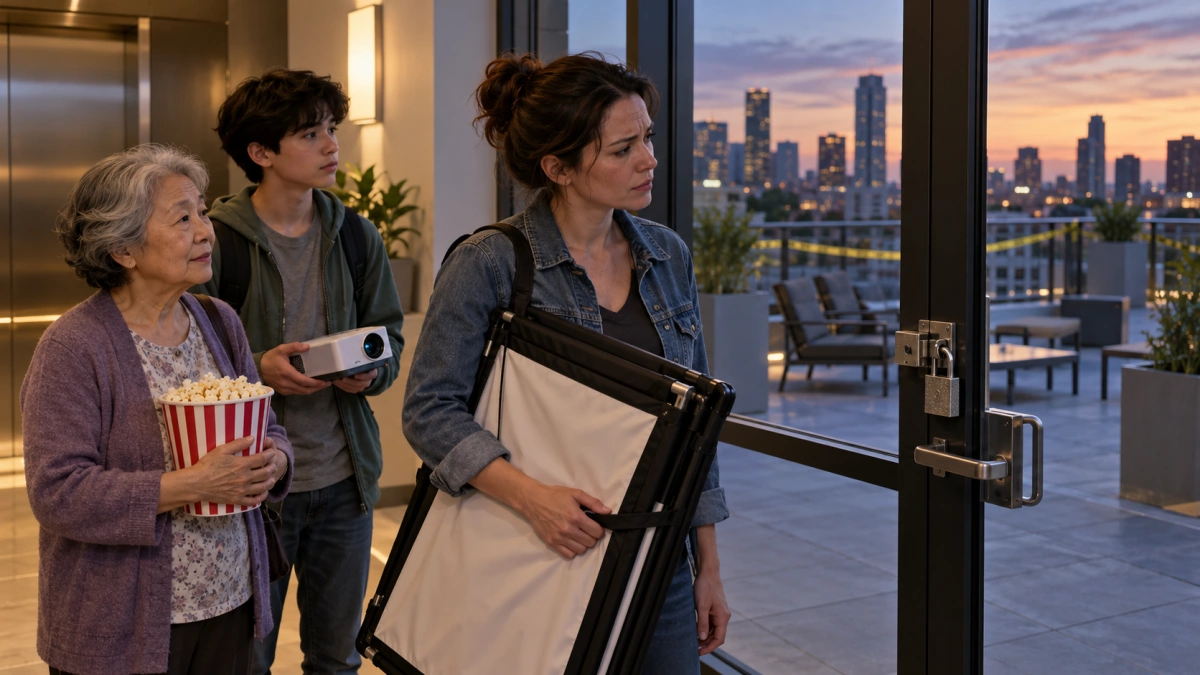
The folded movie screen was still under my arm when the elevator opened on the rooftop floor. Someone had put a new padlock on the glass door. A notice taped to it read, “AREA CLOSED DUE TO RESIDENT RULE VIOLATIONS.” Kai held the projector; Mrs. Sato carried popcorn; two children waited behind me. We had reserved the roof for movie night three weeks earlier.
I called Cal Mercer, the manager of Cedar Court. He said someone had left folding chairs and string lights on the roof overnight, so he had to lock it. Kai was seventeen. He had helped put up our posters and often sat up there reading after school. Someone in our group asked if he had done it. Kai said no, but their eyes stayed on the projector in his hands.
“The chairs are ours,” I said. “Mrs. Sato and I brought them up yesterday to get ready. You approved the reservation.”
Cal went quiet, then said there was “another issue” under review. He would not say what it was. He only asked me to take everyone back downstairs. I wanted to argue. More than thirty neighbors had chipped in for food, and one had traded a shift to be there. Then I saw a strip of yellow tape on the concrete beyond the locked door. It ran toward the north corner of the railing.
Four months earlier, I had submitted photos of a loose railing at that corner through the maintenance portal. The system acknowledged my report. A week later, my request was marked “Complete.” I assumed someone had repaired it while I was at work. Now the yellow tape sat exactly where the railing had shifted under my hand.
I pulled up the old confirmation email and asked Cal whether the lock had anything to do with the railing. He looked at my phone, then at the children waiting with us. “I can’t discuss this here,” he said.
A maintenance worker came out of the stairwell carrying a toolbox. She saw the notice and stopped. “Don’t let them outside,” she told Cal. “I reported that corner as unfinished.”
Nobody asked Cal to open the door after that. I sent the children downstairs with Kai and the projector, and Mrs. Sato followed with the popcorn. Cal stood in front of the glass as if the padlock needed his help. The maintenance worker, Laila Johnson, set down her toolbox. She had once fixed a leak in my kitchen.
She told us two connectors at the north railing needed replacing. Until a contractor had finished the job, she said, no one should be on the roof. Cal said the office would send out information about maintenance. I asked how the notice about resident behavior conveyed any of that. He caught one corner of the paper between his fingers, then let it go.
My name is Iris Walker. I had lived at Cedar Court for almost three years. The six-story building had no private balconies, and the rooftop was the only place residents could sit outside without crossing the parking lot. A month earlier, Mrs. Sato had suggested screening an old movie she used to see with her husband at summer theaters. I could borrow a projector from the library where I worked.
Kai designed posters, and a few neighbors collected money for snacks. We submitted a reservation form. Cal approved it by email and reminded us not to run a cable across the walkway. I never expected a single movie night to transform the building into a family. I had simply hoped to learn the names of people I had nodded to in the elevator for years.
In the lobby, people gathered around the bulletin board. Several wanted to go back up. The yellow tape was only in one corner, they said. I told them Laila had warned that the roof was unsafe, and I would not test a railing by putting thirty people next to it. Mrs. Sato asked what to do with the popcorn. I suggested we share it there and let people head home.
The lobby was an entrance and an elevator path, so we could not turn it into a theater. A little boy asked whether Kai had gotten the movie canceled. Kai stared at the projector. I said we had no evidence he had broken a rule, and the chairs were ours. The sentence did not clear every suspicious glance, but at least the boy heard an answer from an adult.
Cal came downstairs and offered to refund the reservation fee. There had been no fee, which made Mrs. Sato give a short, dry laugh. The snack money had come from residents. I asked who would tell us when the roof reopened. He said he would email when he knew.
Kai asked if Cal could say the roof was closed because of the railing instead of leaving up a notice that blamed the tenants. Cal replied that he had not finished looking into the chairs and string lights. I told him again who had carried the chairs up. He seemed to decide against arguing in front of the crowd. He said he would review the notice.
That night, I opened the resident portal. My report from four months earlier showed a green “Complete” badge and one short note: “Inspected on site.” It did not say a part had been replaced or a repair performed. I had read “complete” as repaired. Maybe the system meant someone had looked.
I saved a copy of the page and emailed Cal to ask when a contractor would work on the railing and whether the roof had remained open after management knew replacement was needed. I attached the approved movie reservation. I did not accuse him of hiding anything deliberately; I did not know enough to say that. But as long as the only public explanation was “rule violations,” people would look for a neighbor to blame while the damaged metal stayed where it was.
Kai and his mother, Nina, knocked on my door the next morning. Nina worked early shifts at the hospital and had learned about the movie night through the building chat before she got home. She asked if I was certain the chairs belonged to us. Several residents had typed Kai’s name under a photo of the notice. I showed her Cal’s approval and a picture Mrs. Sato had taken while we carried the chairs upstairs the previous afternoon.
Kai said he had run a power cord through the seating area when he tested the projector, then coiled it and brought it down. I believed him. I also said that if someone had left a cord overnight, we should learn who it was and whether that had anything to do with the closure. Nina agreed. She was not asking me to swear that her son had never made a mistake. She wanted an actual accusation before people put his name beside one.
Kai had made captions for the movie’s opening scenes so Mrs. Sato could follow the fastest dialogue. He offered to set the projector up in the ground-floor common room instead. That room held twelve people and had glass doors onto the main passage. I did not want to invite a few neighbors and tell the rest to wait their turn. The event had been announced to the entire building.
We agreed to reschedule once we knew when the roof would be repaired. Nina helped take sealed food to the community kitchen in the next building, which had agreed to accept it before we bought it. I returned the money for anything that could not be used. Working out a few dollars for each contributor was tedious, but I did not want people quietly carrying a bill as well as a grievance.
Cal emailed late that afternoon. The roof was temporarily closed for “safety assessment and review of usage”; there was no reopening date. I read the message aloud to Mrs. Sato. She asked whether those were two descriptions of the same problem. I said I wanted to know, too. She had lived at Cedar Court since the roof had only two metal chairs and a pot of rosemary.
People had forgotten things up there before, she said, and Cal usually reminded them and asked them to take the things down. She was unwilling to conclude he was using the chairs to conceal a railing problem without hearing him explain it. She was equally unwilling to let one broad sentence make the whole building guess for weeks.
I asked Cal for a meeting with resident representatives, Laila, and whoever could authorize the repair. He replied that the owner, Ms. Harlan, did not attend meetings for every maintenance ticket. I sent my four-month-old report again, along with the reservation approval and three specific questions.
Who had marked the report complete? When had management received a quote for the railing? Why did the door notice mention only resident conduct? He did not answer that day. I could not force him to read my email immediately, but I could make it harder for the next answer to drift away from the documents in front of us.
On Monday afternoon, I met Laila by the mailboxes. She said she could not show me a contractor’s internal correspondence. She could confirm she had opened a follow-up repair ticket after inspecting the railing. She had put yellow tape up on Friday because one connector felt looser than it had before. I asked if she would come to a resident meeting. If Cal invited her during her scheduled shift, she said, she would explain what she had seen.
She did not want her name circulating in the building chat as an anonymous source. I understood. She had stopped us at the door, but she still had to work here tomorrow. I deleted the draft message that began “Laila told me” and replaced it with what I could document myself: yellow tape, a locked door, and a report displayed as complete without any notice of a repair.
Samir in 4A sent me a private message. He had a small child and did not want the roof reopened until someone had examined all of the railing, not only the corner in my photograph. I agreed. Then he said people in the chat thought I was pushing to reopen because I had collected money for movie night. I explained that the contributions had been returned and that I would not bring anyone into an unsafe space.
He apologized for asking. I did not blame him. The door notice and scattered messages had made the issue look like a contest between a party and a padlock. We needed a different goal in writing: repair the railing, check the whole edge, tell residents when the space could be used, and then make a new reservation.
That evening I visited the apartments of people who had contributed to the event. I did not arrive with a petition and a pen. I asked what they needed to know before going back up. A resident on the sixth floor wanted confirmation that every side had been inspected. Mrs. Sato wanted a date to plan around; I had to return the library projector soon. Kai wanted the blame on the door removed.
Another neighbor wanted clear instructions about equipment after an event, since folding chairs left overnight could get in a worker’s way even if they had nothing to do with the damaged railing. I wrote down all four concerns. A letter that only demanded “open the roof now” would ignore the people who wanted to keep using it after one Saturday night.
Nina read my draft letter and asked me to remove the line “Kai was falsely accused.” She felt it was true, but we did not yet know who had left every item on the roof. Putting his name in a building-wide letter could make him live with the story longer. She wanted Cal to correct the notice. If management believed a specific rule had been broken, it could identify the rule and address it.
If the closure was about the railing, it should say so. I revised the letter. Kai looked surprised that his mother wanted his name removed. He told her he still wanted to hear Cal say, to his face, that he had no evidence against him. Nina said they could ask for that privately. She would not turn the building’s signatures into a vote on her son.
Nineteen residents signed. We attached photographs and dates, then asked for four things: a clear description of the hazard, a repair and inspection plan, a date for the next update, and an accurate notice on the door. I sent copies to Cal and to the owner’s contact address on our lease documents.
The letter contained no children’s names or private medical information. Mrs. Sato printed a large-type version of the request for people who preferred paper. On the public bulletin board I posted only its text, without the signatures and apartment numbers. A collective letter could carry weight without inviting every visitor to study the list of tenants.
Two days later, Cal scheduled a meeting in the common room. Ms. Harlan joined on a video call, and Laila attended on the clock. I brought my laptop and the old maintenance confirmation. Samir brought photographs of the rooftop perimeter taken before it closed; we did not enlarge them and pretend to be structural experts. Ms. Harlan said the north railing had been reported as needing repair.
A contractor had sent a quote three months earlier. She had hoped to combine that job with a fall deck replacement to avoid setting up a construction site twice. I asked who had determined the roof could remain open in the meantime. She said she had understood that Cal had restricted the corner with a temporary barrier. Cal looked down at the table.
Laila explained that the temporary barrier had shifted in strong wind. She had documented that it could no longer be relied on and had recommended closing the roof until there was a safer plan. She did not speculate about who had ignored whom. She read from her work orders, giving the date of her first inspection and the day she put down yellow tape. Cal said he had planned to close the roof before our movie. The notice had been written in a hurry from a template about resident rule violations.
He had also seen a photo of chairs left out overnight and thought the template applied. I asked why it did not mention the railing at all. He said he had not wanted to alarm people before he had a final report. Mrs. Sato said residents were already standing before a locked door, trying to decide which neighbor had caused it. Silence had not made them calmer. It had simply given their worry a convenient person to land on.
I had something to own as well. Mrs. Sato and I had carried up the chairs. The reservation form said equipment had to be removed after each preparation session. I had assumed we could leave the chairs overnight because the movie was the following evening. Cal had approved the screening, not the overnight storage. I said I would follow the rule when we rescheduled. But those chairs had not loosened the railing, and Cal agreed. Kai shifted beside Nina. We could admit a small mistake without accepting a different one on behalf of management.
Ms. Harlan asked whether they could close only the north corner and let residents use the rest. Laila would not sign off on that arrangement. People had to pass near the damaged section to reach the seating area, and a movable barrier might drift again. I stayed quiet, although part of me wanted at least a portion of the roof. The judgment of the person who had examined the connectors mattered more than my convenience.
Samir asked whether the contractor would inspect the remaining sides while on site. Ms. Harlan said she would request a revised quote for the entire railing and repair any failed sections. She would not promise a completion date until the contractor confirmed materials. We asked instead for a firm day when she would update us, even if the answer was that they were still waiting.
We ended the meeting with three items written on the room’s whiteboard. Cal would remove the old notice and state that the roof was closed for railing repairs and inspection. Ms. Harlan would schedule the contractor to survey it the next Monday and send an update that Wednesday. The common room could be reserved for a screening within its capacity, but our group would wait so we did not have to split the building in two.
I photographed the board after everyone had read it. Cal promised written minutes. I asked him to include that leaving the chairs overnight violated a setup rule but did not cause the railing damage, and that management had made no finding against Kai. Cal looked at Kai and said he would.
That evening, the “rule violations” notice disappeared. Its replacement read, “ROOFTOP CLOSED FOR RAILING REPAIR AND INSPECTION. DO NOT ENTER UNTIL REOPENING IS ANNOUNCED.” Kai took a picture. So did Mrs. Sato, though she reminded me that a correct notice was not a new piece of metal. I told her to remind me on Wednesday if no update arrived.
She said I did not have to become the building’s unpaid secretary. We divided the tasks. Samir tracked the contractor schedule. Mrs. Sato asked about reserving a new movie date. Nina stayed in touch with families with children. I kept the notices and correspondence. The issue felt less fragile once it no longer lived only on my phone.
The contractor came Monday. Residents could not accompany the crew onto the roof, but Cal emailed work photos after they left. The connectors, posts, and places needing replacement were marked. Ms. Harlan approved the railing work as a separate project instead of waiting for the fall deck replacement.
She acknowledged that doing it separately cost more, but the roof could not stay closed while another project with no start date sat on a schedule. I did not know what else was in Cedar Court’s budget. I knew the planned savings had left a shared space in a state where no one could say clearly whether it was fit for use. This time, the decision to spend money and the repair timetable had an owner’s name attached.
Wednesday’s update arrived on time and disappointed everyone. The contractor had found corrosion beneath the paint on a west-side post. It did not visibly move when someone leaned on it, but they recommended replacing it during the same job. The additional part had to be ordered, pushing the work back a week.
One person in the group chat wrote that if we had not made such a fuss about movie night, the rooftop would still be open. Samir replied that the corrosion would still be there whether or not we saw it. I thanked him privately. I was tired of waiting, too. The finding also showed why he had insisted on examining the entire perimeter.
I passed the update to neighbors who did not use the group chat. A man on the second floor usually got building news on paper, and Mrs. Sato wanted a copy she could read without enlarging a phone screen. We asked the office to post the same text in the lobby and at the rooftop door, with the next update date clearly printed.
Cal agreed. There would be no more “more information to follow” without a time to look for it. I began checking the bulletin board the way I checked the weather. I was not looking for a winner. I wanted to know which space I could use, and what had to happen before I used the other one again.
Nina told me Kai had taken the movie poster down from above his desk. Seeing it reminded him of everyone looking at him outside the locked door. I went over and asked if he would still like to run the projector when we had a new date. He shrugged and said someone else could probably do it with less trouble.
I told him we could find another person and he could still attend like any neighbor. I also said I was sorry I had not answered faster when someone first asked whether he was responsible. “You answered,” he said. “The paper on the door was louder.” I could not argue with that. He deserved to decide whether a movie was worth standing again in the place that had embarrassed him.
Cal sent the meeting minutes. They said a contractor would inspect the entire railing, the roof would stay closed through repair and final inspection, and the chairs left overnight belonged to the event organizers but had not damaged the railing. Kai’s name did not appear in the discussion of rule violations. Nina read the document, then asked Cal to meet privately with her and Kai.
I did not attend. She told me afterward that Cal said he had no evidence Kai had left anything upstairs. He apologized for a notice that had led neighbors to guess. Kai listened without announcing that everything was forgiven. Nina did not ask him to. She wanted him to see an adult correct words that had already hurt someone.
I asked Cal why my old report had shown “Complete.” At the office counter, he hid information about other apartments before turning his monitor toward me. The software used the same button to close an inspection and to close a repair. Laila had opened a follow-up work order, but residents could only see the first ticket. Cal said the office would change its process.
An inspection could end with the result “repair needed,” while the linked repair would get a tracking number sent to the person who reported the problem. The job would be marked complete only after a final inspection had been recorded. I asked him to put that change in the building update. A verbal promise would not help the next tenant know which number to follow. He added it to the next day’s email.
Laila caught me by the elevator and said the repair would take place during her regular shifts. Residents did not have to stand guard over the contractor for free. I laughed and said Mrs. Sato was teaching me how to go home on time. Laila had asked an office employee to keep the stairwell clear while materials were moved; that was building work, too.
She wanted me to know that the final inspection would include the connections behind the planters. I had thought replacing the piece that visibly moved would be enough. Listening to her, I understood the difference between a photo that was enough to report a problem and an inspection that was enough to declare a space safe.
While we waited, Mrs. Sato invited a few people to the common room for tea without screening a movie. Samir brought his child, Nina stopped by after work, and Kai sat near the door with a book. No one asked him to explain that night again. One neighbor who had typed his name into the chat arrived with cookies.
She awkwardly told him she had deleted the message. Kai thanked her for the cookies and returned to his book. I had no idea whether they would ever be friendly. I was glad that, this time, the adult was the one who had to carry her own awkwardness.
The material arrived the following Thursday. From a sixth-floor corridor window, I watched the workers remove two north-side connectors and a west-side post. They lowered each piece onto the roof rather than dropping it over the edge. The days were hot, and Mrs. Sato’s apartment was directly under the work. She complained that the drilling made her teacup tremble.
Cal checked the quiet hours in the lease and posted the noisiest times, so she could visit her sister. The inconvenience was real. She also knew why the drilling was happening, who was doing it, and when it was likely to end. She explained that to two neighbors who were about to call the office without reading the schedule.
By the weekend, the parts had been installed, but the contractor would not sign the final inspection. One weld had to be redone. Cal sent a photograph of it and a plain sentence: the roof remained locked. Nobody in the group chat accused him of being too cautious. The door stayed shut three more days. Then Laila and a contractor representative checked the full perimeter, including the joints behind the planters. Ms.
Harlan sent residents a written confirmation. The items in the contractor’s report had been repaired and had passed the post-repair inspection. The roof would reopen at nine Friday morning. The email listed an event capacity of thirty-six, the reservation process, and the requirement to remove chairs and cables after setup. I saved it beside my old “Complete” email. The same word meant something different when the work behind it could be traced.
The new system mattered to me for a reason beyond that railing. When I had first seen the green badge four months earlier, I had stopped asking questions. I had not been entitled to read an employee’s private notes, but I did need to know whether my report led to a repair or only a look.
Cal’s new email explained how residents could follow a linked ticket and whom to contact if its status did not match what they saw. Samir said he would use that process the next time a hallway light stayed dark after a visit from maintenance. It was a small test, but one people could actually make.
Mrs. Sato read the reopening notice with me in the lobby. She ran her finger under the line about event capacity and asked whether our old head count had ever been confirmed. It had not. More than thirty people had planned to come the first time, but several were children and I had counted invitations instead of replies. This time I would get a definite number and leave room below the limit.
She also asked if we could put a printed cleanup list by the supply cart. I wrote down chairs, cords, tape, food bags, and the projector case. Cal reviewed the list without pretending it was a substitute for the building rules. Mrs. Sato said she could now plan her popcorn without guessing whether the door would be open.
I reserved the roof for Saturday evening and asked who could actually attend before buying food. Twenty-eight people confirmed, below the posted capacity. Cal approved the screen’s location and the power-cable route. Samir helped tape down the cable with tape made for floors, and we planned to remove it after the show. Chairs would go up during our reserved hours and come down when we finished. Mrs.
Sato bought popcorn with the money people chose to send again, but told everyone they were welcome whether they contributed or not. I wrote Kai that his caption file was still on my computer. We could use it with his permission even if he did not want to handle the projector. Two hours later he answered: “I’ll bring it up. But please check the cable with Cal first.” I told him that was already arranged, and we could walk the route together before opening the door.
On Saturday afternoon, Kai came early with Nina. Cal unlocked the rooftop and showed us the replaced joints and the route that had to stay clear. He did not ask Kai for thanks. Kai set the projector on a table and tested the captions while Cal and I checked the cord. Laila passed us in the stairwell on her way home. She glanced at the screen and said Mrs.
Sato would like the size of those letters. Kai smiled for the first time I had seen since the night of the padlock. When neighbors came up, a few asked about the new railing pieces. Cal pointed to the inspection notice beside the door. Laila had gone home. I was relieved that she did not have to explain her paid work for free at our party.
The movie started ten minutes late because a child spilled water and we cleaned it up before turning down the lights. Mrs. Sato took a front-row seat where she could read the captions without craning her neck. A breeze moved the edge of the screen. Kai adjusted its stand; Samir reminded his child to stay away from the power cable.
From the back, I watched the neighbors laugh together at a scene Mrs. Sato had described to me weeks earlier. There was no speech about a victory. When the credits ended, we folded the chairs, pulled up the tape, collected the popcorn bags, and carried everything down on time. Kai let me hold one end of the screen but insisted on carrying the projector himself.
Before leaving, I stopped beside the glass door. The closure notice had been replaced with a reservation schedule and a number for maintenance reports. I remembered looking through the lock at yellow tape and wanting a quick answer for everyone waiting behind me. The accurate answer had taken longer. It came through work orders, a meeting, a contractor, and three extra days of inspection.
Mrs. Sato called that the elevator was here. Kai held its door for her, and Cal was downstairs to receive our reservation key. The rooftop behind us was empty, clean, and available to use again. If a railing shifted under someone’s hand tomorrow, they would know which ticket remained open and who owed them an answer until it was fixed. I kept the old photograph to remember why that mattered.
Read next
Three Knocks at 6:30

The Garden Gate Was Open

The Bags on the Porch

The Landlord’s Son Told My Neighbor to Leave Her Shop by Friday—Then She Handed Me a Receipt Older Than He Was
Reading notes
A locked rooftop brings neighbors into conflict over a shared space and the responsibilities they have avoided.
This is an original work of fiction. Characters and events are fictional. Explore public-domain books at Project Gutenberg or browse more stories on ReadStoryvia.