Original fiction
On this page
The Books in the Dumpster
The video began with Nina Park carrying a library book toward her car. It did not show the cart beside the dumpster, the rain starting, or the handwritten sentence that had made her stop.
By breakfast, a man she had never met was calling her a thief beneath a photograph of her volunteer badge.
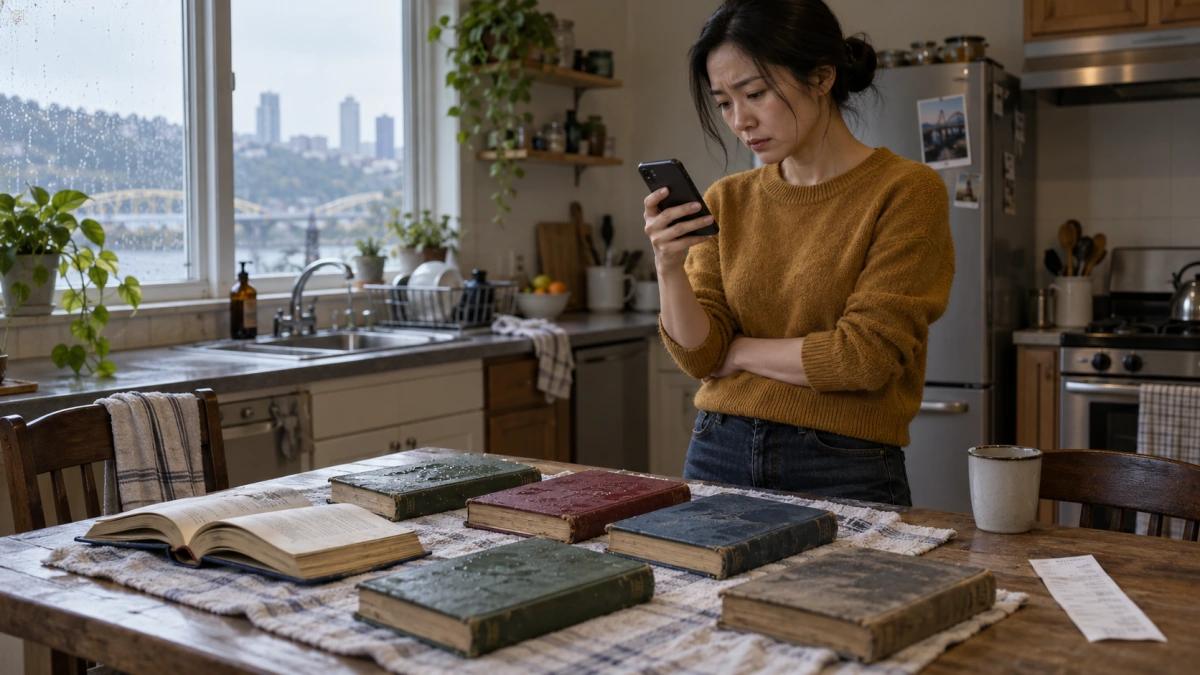
Nina watched the clip standing in her kitchen in the same ochre sweater she had worn the previous evening. Her black hair was still in its low bun. On the table lay six books, their faded cloth covers drying beside a grocery receipt.
Inside one, a dead man had written, Beth called. Did not answer. Must do better tomorrow.
She had not meant to take that sentence home. She had been looking for his descriptions of the neighborhood before the steel mill closed, the little observations he penciled beside whatever he happened to be reading. She had imagined saving a voice.
Now that voice was open on her table, saying something its owner's daughter might never have been meant to see.
Her phone rang. Gloria Hayes, the library manager, did not waste time asking whether Nina had seen the video.
"Bring everything back before we open. Don't post anything."
"They were withdrawn books."
"I know what they were. That isn't the same as permission to take them."
Nina looked at the six volumes. One had a warped spine. Another carried a red pencil line under the words forgive yourself.
"Can I explain when I get there?"
"Yes," Gloria said. "But bring the books first."
At the bottom of the screen, a new message appeared from Beth Voss.
Those are my father's. Please tell me you have not photographed the pages.
Nina had photographed three pages. Not the one about the unanswered call, but there was no comforting way to answer Beth without admitting that she had already made a decision nobody had asked her to make.
She wrote, I have three photos. I have not posted or sent them. I am taking the books to Gloria now. She almost added that she had been trying to help. She deleted it. Beth had asked about photographs, not intentions.
Outside, Pittsburgh wore the dull shine of rain that had stopped before dawn. Nina carried the books in a plastic storage box instead of the grocery bags she had used the night before. She wanted the return to look careful. Then she recognized that wanting and felt ashamed again.
Gloria opened the service door in a burgundy cardigan, her silver locs tucked behind her glasses. She moved aside without touching the box. Nina set it on the processing table. There was no security guard, no dramatic confrontation, only a clock ticking above a shelf of tape and replacement labels.
"All six?" Gloria asked.
"All six."
"Anything removed from them?"
"No. Three photographs on my phone. Nothing shared."
Gloria wrote that down. Nina had volunteered at the neighborhood lending library for eleven months. She knew where the paper towels were kept, which shelf leaned, and how to quiet the squeaking cart. Being asked factual questions as though she were a stranger hurt more than she had expected.
"Tell me from the beginning," Gloria said.
The beginning had been a cart of withdrawn books waiting beside the closed green dumpster in the service alley. Nina had spent the afternoon peeling obsolete labels from other volumes approved for the library's small sale. Near closing, she had taken flattened boxes outside and recognized a blue cloth cover on the discard cart.
Leonard Voss had read that book at the same table every Tuesday. He had been a retired machinist with broad fingers and a habit of making penciled remarks in books he owned. Sometimes he brought his own copies to compare with the library's. Nina had once asked why he wrote in the margins rather than in a notebook.
"Because that's where I am when I think it," he had said.
After his death in August, his daughter brought several boxes to the library. Nina knew they had been donations. She did not know what Beth had been told about their eventual use. Yesterday, seeing the blue cover, she had opened it to check whether it was Leonard's copy.
Beside a description of a factory town he had written about a bakery on Carson Street, its owner letting workers pay on Fridays, the smell of rye arriving before the morning bus. Nina had heard him tell a version of that story. The handwriting made the alley feel suddenly crowded with him.
She found five more familiar volumes on the cart. Rain began while she was looking. She carried them toward her car, intending to show Gloria the next morning and ask about a neighborhood history project. Cal Mercer, who rented workshop space across the alley, had stepped outside with his phone.
"Are those library books?" he asked.
"Discarded ones," she said, and kept walking.
That was what his video showed: a volunteer badge, an armful of books, an answer short enough to sound evasive. It did not show him asking anything else because he had not. It did not show Nina asking permission because she had not done that either.
Gloria put her pen down. "You knew the cart wasn't a free shelf."
Nina stared at the box. Beside the public entrance there was a clearly marked shelf where anyone could take approved giveaway books. The service alley was not that shelf. Volunteers had been told to leave outgoing material in its assigned area until staff finished routing it.
"I knew," she said.
The word made it impossible to retreat into a technicality about the books no longer belonging in circulation. Gloria explained their local practice, not a universal rule: staff reviewed condition and usefulness, marked withdrawals, and separated material for sale, giveaway, recycling, or disposal. A withdrawn stamp did not mean a volunteer could choose a destination. Some items on yesterday's cart were already approved for recycling; two were waiting on a final condition check.
"The rain wasn't good," Gloria said. "Neither was taking them to your apartment. You could have brought them inside and left me a note."
Nina had imagined exactly that alternative during the drive. She wished imagination after the fact counted for something.
Gloria said Nina would pause volunteer shifts while they checked the six books against the withdrawal list and dealt with the complaint. It was not a public declaration that she had stolen anything. It was also not permission to return that afternoon and act as though nothing had happened.
"Can we keep them safe until Beth comes?"
"We can keep them dry," Gloria said. "Safe is a bigger question."
Beth arrived at ten carrying a folded umbrella. Her short auburn hair was damp around her ears. Nina had seen her at the memorial reception, where Beth had stood beside a grocery cake while people told her how much they had loved her father. They had exchanged condolences, not telephone numbers. Beth had found Nina through the library after seeing the clip.
"Show me the pictures," she said.
Nina handed over her phone. One photo showed the bakery paragraph. One showed notes about a flooded street. The third included a remark about Leonard's brother selling a car and never paying him back. Nina had barely noticed that line beside the description of the old bridge.
Beth enlarged it with two fingers.
"That's my uncle. He's alive."
"I wasn't going to post that part."
"You hadn't asked me about any part."
Gloria offered chairs. Beth remained standing until Nina sat, then chose the chair furthest from the box. Her father had left crowded rooms and shelves, not a neatly labeled collection. She had donated readable books because she could not fit them all in her house and did not want to make grief into a storage bill.
The intake conversation had been ordinary. The library could keep suitable books, sell or give away others, and dispose of unusable material. It had not promised to shelve every volume or preserve annotations. Beth remembered nodding, relieved that someone could take the boxes.
"I thought I'd checked them," she said. "Apparently not well enough."
"You were clearing a whole apartment," Gloria said. "That isn't a failure."
Nina wanted someone to say that to her too, but the situations were different, and she knew it.
Beth asked whether anyone had read the pages about the family. Nina admitted she had read some. She mentioned the unanswered call because concealing it now would make the next discovery worse. Beth looked at the blue book for a long moment.
"Which call?"
"It doesn't say a date."
"Then you don't know."
Nina nodded. She had already supplied an argument, an estrangement, and a regret around that brief private note. Leonard might have been tired, angry, busy, or simply nowhere near the telephone. Margins were not transcripts of a life, however intimate the handwriting made them feel.
Beth asked for the photos to be deleted, including from the recently deleted folder. Nina did it in front of her. Gloria said they could decide separately whether any future images were appropriate. Deleting these was not a promise that nobody would ever document a page. It was recognizing that Nina's first copies had been made without an agreement.
Then Beth asked for all six books.
Gloria said she needed to finish checking their status and talk through what could be returned. Some were the family's donated property no longer needed by the library, but she would not improvise a new donation policy under pressure from a video. She could arrange a short hold while they worked it out.
"I don't want them exhibited," Beth said.
"Nothing is being exhibited," Gloria replied.
On the way home Nina passed Cal's workshop. Through the window she saw a half-built cabinet and a radio on a shelf. He noticed her, lowered the sander, and came to the door. She had planned a speech about incomplete footage. Seeing his face, anxious rather than smug, disrupted it.
"You posted my badge," she said.
"I thought people should know."
"Know what?"
"That books were being taken out the back."
"You said I was stealing them."
Cal looked down. "I said it looked like it."
"That's not what people remember."
He said his mother had donated money to the library every year. He had seen the cart for weeks and worried that usable things were being thrown away while staff asked for donations. Then he had seen Nina loading her car. The explanation did not excuse the caption, but it made his certainty less mysterious.
She told him the books were withdrawn but she had not had permission to remove them. He seemed almost relieved, as though admitting that part allowed him to stop defending every word he had posted.
"So what do I write now?"
"Start with what you actually know. Ask Gloria about the process. And take my badge out of the picture."
He said he would think about it. Nina hated that he got time to think after giving hundreds of people no time at all. She went home without forgiving him.
Her apartment smelled faintly of damp paper. A rectangle on the table marked where the blue book had dried. She had cleared that space with excitement the previous night, imagining an exhibit of Leonard's marginal neighborhood: the bakery, the flood, the old bus turnaround. In her imagination, Beth had been grateful before she had even been invited.
That was the part Nina did not want to tell anyone.
She had begun volunteering after her own father died in California. He had left almost no writing except grocery lists and instructions taped to appliance cords. Nina had regretted not recording his stories. When Leonard talked, she had listened with the particular hunger of someone who thought she had learned her lesson too late.
But Leonard was not a replacement father. His daughter was not a person placed in the story to approve Nina's recovery. She washed the empty storage box and left it upside down by the sink.
Two days later Gloria asked them both to return. The six books had been checked. Three were too damaged for sale or normal use, including one with staining that staff would not pass along. Two were duplicates with heavy annotations. The blue book was worn but usable, although its writing meant it would not return to ordinary lending shelves under their practice.
Gloria had also looked at the remaining donation boxes. Most had already been processed. There was no way to reconstruct every destination. Some books had sold at the weekend table, some had gone to the free shelf, and some had been discarded. Nina felt an urgent need to chase them down.
Beth put a hand flat on the table. "No public hunt."
"There could be more notes."
"There could. That doesn't mean we ask strangers to turn out their houses."
Gloria agreed. They could review what was still held at the library with Beth's consent. They would not publish a list of titles paired with a grieving family's name and invite people to send in private pages. Preservation could begin with what they actually had instead of pretending to repair every loss.
Beth sat down. Nina noticed that she had chosen a chair nearer the box this time.
They began with the blue volume. Nina read the bakery note silently while Beth looked over her shoulder. Beth remembered the rye bread, not the owner. Gloria asked what they could verify and what should remain described as Leonard's recollection. The distinction slowed Nina down in a useful way.
An address could be checked against an old directory. A smell could not. A story about a worker paying late might be affectionate to Leonard and embarrassing to that worker's family. They could retain the general observation without publishing a person's unpaid account as local color.
"I don't want him cleaned into a perfect man," Beth said.
"Neither do I," Nina answered, then stopped. "But I was trying to make him a perfectly useful one."
Beth turned a page. "He'd have hated that. He spent half his retirement trying not to be useful."
It was the first time she smiled.
They agreed to consider a small selection of neighborhood observations for a local history file. Gloria would write a plain description of where the material came from and what permission had been given. Access would be limited at first, by request through staff rather than loose pages on a public table or a searchable album online. They would revisit that arrangement before any exhibition or broader copying.
None of them called it a legal guarantee. It was a practical boundary they could keep with the time and storage they actually had. Gloria made clear that the library could not accept responsibility for preserving every annotated donation simply because one donor's notes had become interesting.
Nina offered to pay for archival supplies. Gloria thanked her and said they would first decide what they were preserving. Shopping was not the same as planning.
The next book contained the unanswered call. Beth read the sentence, then the page before it and the page after. There was a grocery price in the lower corner, a complaint about an author's ending, and a reminder to replace a furnace filter. Nothing explained the call.
"I called him all the time," Beth said. "Sometimes we annoyed each other. Sometimes his phone was in the other room."
Nina said she was sorry for assuming.
"You didn't tell me what you assumed."
"I think you could hear it anyway."
Beth closed the book. "Yes."
They set that volume aside for private return once Gloria finished recording the transfer. No photograph of that sentence would enter the history file. No gap marker would announce that a family secret had been removed. The absence did not need to become another invitation to speculate.
In a cookbook, they found a note beside a cornbread recipe: Beth likes edges. Use smaller pan. Beth pressed her thumb against the margin, carefully away from the words.
"That one," she said. "I want that one."
Nina looked at the warped cover. It was one of the books she had imagined repairing. Now she understood that its future did not have to involve her hands.
One damaged volume resisted even careful turning. The binding gave a dry crack, and Gloria stopped them. There were only two legible notes, both about the printed argument rather than the neighborhood. Beth read them where the book lay and said they could let it go.
Nina's immediate instinct was to ask for one more attempt. She folded her hands under the table until it passed.
Later, walking to the bus stop, she realized how much of her urgency had been fear of an ending. If every book remained repairable, then nothing had finally disappeared. But Leonard was dead. Keeping a damp spine on a shelf could not make that fact less finished, and making Beth handle it again might only move Nina's fear into someone else's day.
Cal posted an update that evening. He removed the close photograph of Nina's badge and wrote that the books had been withdrawn, that he had not known the library's process, and that the volunteer had returned them. He did not say her removal had been authorized. Nina read the update twice.
Some commenters accepted it. Others said returning the books proved she had been caught. One demanded to know which employee had given permission, as though no possible account could exist between organized corruption and innocence.
Nina drafted her own response with Gloria's knowledge. She had removed six withdrawn books without staff permission. She had returned all six. The library was reviewing whether a limited selection of annotations could be retained with the family's involvement. She asked people not to seek or share photographs of private pages.
She did not call herself a rescuer. She did not describe Cal as an enemy. She also did not say she deserved the video because she had made a mistake.
After posting, she switched off notifications and went to work. Her paid job involved scheduling deliveries for a plumbing supplier. Pipes arrived late, a driver needed a corrected address, and the world remained mercifully uninterested in her moral education for eight hours.
That Friday Gloria called her in for a volunteer meeting. Nina expected either reinstatement or dismissal, a clean judgment that would tell her how ashamed to remain. Gloria offered something less dramatic: a return to supervised sorting for a month, a review of the outgoing materials procedure, and no independent handling of Leonard's remaining books.
"I can agree to that," Nina said.
"If you have a concern about a discard, you set it aside inside and ask. You don't take it home to make the question easier to answer later."
"I understand."
"Do you?"
Nina thought of the storage box, the photographs, the exhibit she had already arranged in her head. "I understand that wanting the right outcome doesn't give me the right to choose every step."
Gloria nodded. She did not call that wisdom. She asked whether Nina could come Tuesday at four.
On Tuesday the cart squeaked exactly as it always had. Nina worked beside a college volunteer who asked, carefully, whether she was the woman in the video. Nina said yes. The volunteer looked embarrassed and reached for another stack of paperbacks.
"You can ask," Nina said. "Just ask me, not the comments."
They spent the afternoon checking covers, removing outdated flyers, and separating the books staff had already assigned. Nina found a volume with a pressed flower inside. She took it to Gloria. It was not a dramatic test, only an object whose meaning she could not know. Gloria placed it in an envelope while she checked whether a donor could be identified.
Nina returned to the cart. No one applauded. That helped.
During the first week back, Nina discovered that being watched was not always the same as being suspected. Gloria checked everyone's sorting that afternoon, correcting two labels on a pile Nina had not touched. The college volunteer asked why a popular paperback was leaving when people still requested the title. Gloria showed him the loose pages and explained that a replacement copy was already on order. The title was wanted; that particular object was worn out.
Nina had understood the difference in principle. In the alley she had forgotten it because the object carried handwriting. Now she watched Gloria place the damaged copy with the proper outgoing materials and enter the replacement where another staff member could find it. There was no grand betrayal of reading in the transaction. There was maintenance, paid for with hours people rarely noticed.
Afterward Nina asked whether the video had affected donations. Gloria said two people had called, one angry and one offering more books than they could store. She had answered both, but answering took time away from other work. Nina apologized. Gloria accepted without allowing the apology to become another meeting.
"You can help by finishing that shelf," she said.
Nina finished it.
At home, she considered writing privately to everyone who had defended her online. Several had described her as a heroic volunteer saving treasures from heartless staff. Their kindness had been comforting until she saw what it required of Gloria. She sent a short message to the friend whose post she had actually seen: please correct that description; staff were following a process, and I bypassed it. The friend replied that she was only trying to support Nina.
I know, Nina wrote. This would support me better.
The answer took longer to arrive. Then the friend changed her post. Nina realized that a correction could cost a person the pleasure of being publicly loyal, and that asking for it was still reasonable.
Beth encountered a different kind of loyalty. A former coworker of Leonard's heard about the notes and offered to help prove what a generous man he had been. Beth told Nina about it while they waited for Gloria to finish with a patron. She had thanked him and declined. Her father's generosity was not on trial, and she did not want the archive to become a defense brief for his character.
"People keep offering me a nicer father than the one I had," she said. "Mine was nice enough. Also irritating. I would rather keep him."
Nina said she understood, then corrected herself. "I'm starting to."
Beth gave a small nod. It was not forgiveness announced once and permanently granted. It was permission to continue the work that afternoon.
They looked together at Leonard's sketch of the corner. The bakery awning was too large, the bus too small. Beth recognized the thick pencil marks he used when his hand grew tired. Nina had been tempted to redraw the sketch neatly for the folder. Looking at those marks, she asked whether a plain copy would be better. Beth said yes. The uneven lines were not obstacles to the record. They were part of it.
That session ended with only two passages reviewed. Nina put the rest away rather than asking Beth to stay another ten minutes. Outside, dusk had already gathered under the elevated roadway. Beth zipped her coat and said she needed to buy groceries. Nina did too. For once they talked about prices and weather without returning to Leonard, and both seemed relieved.
The next morning Nina found an old grocery list of her father's in a kitchen drawer. She read it without deciding that she must suddenly preserve every scrap. She kept that one because she wanted it, privately, not because it could explain him to strangers. Other lists had already disappeared. Their absence did not mean she had failed to love him while he was alive.
She put the paper back and went to catch her bus. There would be more decisions, and some would remain uncomfortable after she had made them carefully. She was beginning to see that care did not promise freedom from regret. It only gave her a better way to choose what happened next, and a clearer reason to ask when the choice belonged to somebody else.
The history file took longer than the online quarrel. Beth came twice after work, sometimes tired enough to ask that they stop early. Nina learned not to fill those silences with enthusiasm. Gloria limited the sessions to what staff time allowed. They chose eight short passages from three volumes still held at the library, with one small sketch of the street corner.
They left out names attached to debts, illnesses, romantic speculation, and family arguments. They also left out a wonderful anecdote about a shopkeeper because nobody could tell whether Leonard had witnessed it or copied it from something he was reading. A good story was not automatically a reliable recollection.
For each selection, Nina typed the words exactly, keeping a separate note where a word was unclear. Beth checked the transcriptions against the pages. Gloria reviewed the description. None of them wanted a polished paraphrase that sounded more certain than the pencil.
The approved copies went into a labeled folder in the staff area, available only through the arrangement they had written down. The original blue volume and one other usable book were retained separately with that same provenance note. Beth took the cookbook and the volume containing the private call home. The damaged books followed the ordinary discard route after the selected observations had been reviewed. One contained nothing they retained at all.
Nina watched Gloria close the box for recycling. She did not ask to touch the contents again. Letting that box go was not proof she cared less; it was proof she had finally stopped treating caring as ownership.
In December Cal came to the front desk with a library card application. Nina was covering returns beside Gloria, and for a moment all three became overly polite. He had not come to donate money or stage an apology in front of an audience. He said he had been using his mother's card and should have his own.
Gloria handled the application. Then Cal asked Nina whether they could talk outside for a minute. She agreed, leaving her badge at the desk rather than making a point of wearing it.
"I should have come in and asked," he said.
"Yes."
"And I should have waited before posting."
"Yes."
He rubbed his palms together in the cold. "I can't get it back from everybody who shared it. I've asked the group where I posted to keep the correction with it. Some have."
"I know you can't erase the whole thing. I needed you to stop adding certainty you didn't have."
He nodded. She told him she had also been certain about things that were not hers. The admission did not make their mistakes equal or cancel either one. It simply kept the conversation from becoming another contest about who was allowed to be a person.
They returned inside separately. Nina did not invite him to look at Leonard's file.
That evening she saw his correction shared beneath an old copy of the clip. Nobody tagged her. The conversation continued without demanding that she appear to certify it. She closed the page, grateful for that small distance. A correction did not have to become another performance by the person whose face had made the first story so easily portable.
Beth brought the cookbook back one afternoon, not to donate it but to show Nina a loose recipe she had found tucked into the back. There were no neighborhood observations on it, only her mother's measurements and Leonard's emphatic instruction to use less salt.
"I'm keeping it," Beth said before Nina could answer.
"I assumed you were."
Beth seemed pleased by that. She asked whether Nina would like a copy of the cornbread recipe without the family notes. Nina said yes, if Beth wanted to share it. Beth took a clean sheet from her bag. She had already written it out at home.
They stood by the window while a delivery truck blocked half the street. Beth said she had spent weeks angry at her father after he died, mostly for leaving her all the ordinary decisions. Which chair, which box, which account to close. Hearing people praise him had sometimes made the anger worse.
"That doesn't have to go in any history," she said.
"It won't."
Nina did not take out her phone. She listened without deciding how the conversation might be used later.
By January her supervised month was over. Gloria let her resume regular volunteer tasks, with the same rules everyone else followed. The service cart moved indoors while awaiting final routing, partly because the alley arrangement had caused confusion and partly because rain had made it impractical. A plain staff note distinguished the public free shelf from outgoing materials. Neither change was announced as an acquittal of Nina or an indictment of Cal.
At closing one evening, Nina wheeled a cart toward the processing room. A worn blue spine caught her eye. For a second she felt the old rush: a voice might be waiting there, something valuable nobody else had noticed.
She opened the book just far enough to read the title, then checked the routing slip and put it on the correct shelf. If she had a question tomorrow, she knew whom to ask.
At home, she made cornbread in a smaller pan. The edges browned before the center, and she turned the oven down rather than pretending to follow every instruction perfectly. She ate one warm piece standing at the counter. In a drawer lay the copied recipe, containing only what Beth had chosen to give her.
The rest of Leonard's life remained larger than the folder, larger than the six books, and partly beyond anyone's keeping. Nina washed the pan, let it dry, and left the drawer closed.
Read next
The Porch Light at Number Seventeen
The Locked Rooftop
Three Knocks at 6:30
The Landlord’s Son Told My Neighbor to Leave Her Shop by Friday—Then She Handed Me a Receipt Older Than He Was
Reading notes
A volunteer saves discarded library books, then discovers that preserving memories also requires permission.
This is an original work of fiction. Characters and events are fictional. Explore public-domain books at Project Gutenberg or browse more stories on ReadStoryvia.