Original fiction
On this page
The Porch Light at Number Seventeen
The letter asking Dana Reeves to turn off her father's porch light arrived inside a sympathy card.
Someone had crossed out the printed message and written, I am sorry about Walter. I am also still awake at three in the morning.
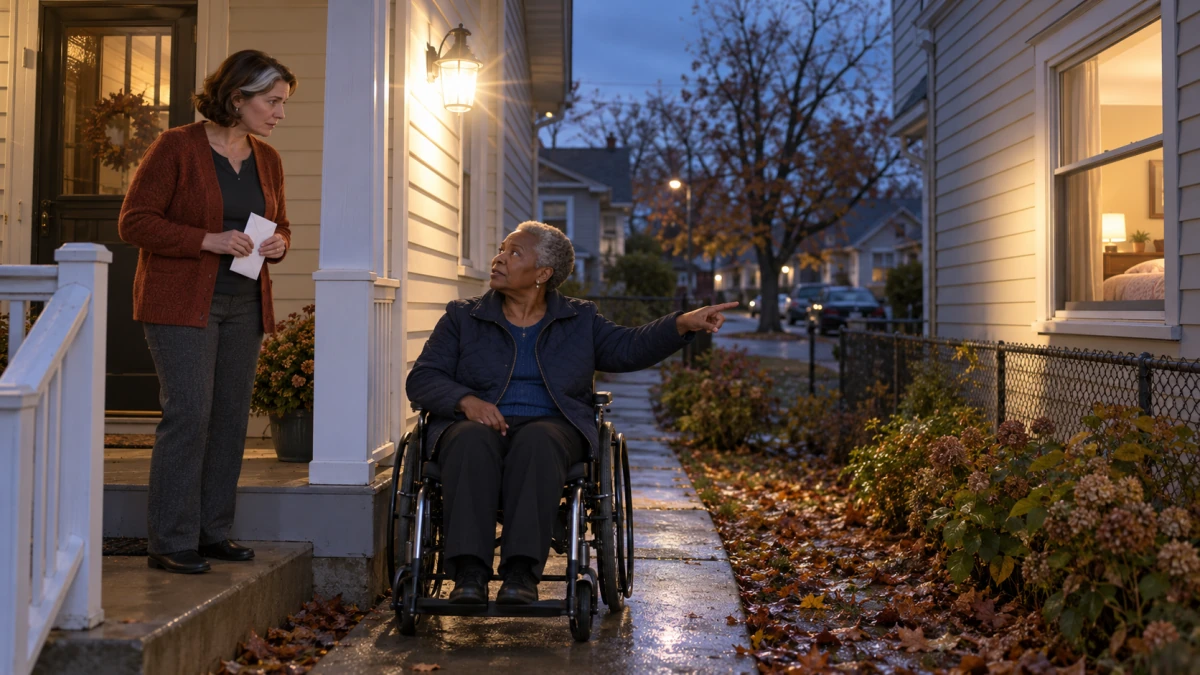
Dana stood beneath the clear glass fixture in her rust cardigan, holding the card by its corners. Across the narrow side yard, Ruth Bell waited on the concrete path in her wheelchair. Her navy jacket was zipped to her chin. She pointed toward the white rectangle burning across her bedroom curtains.
"I asked him twice," Ruth said. "He meant to fix it."
At forty-three, Dana had returned to Dayton with a divorce, a temporary bookkeeping contract, and the keys to a house full of things her father had meant to fix. The porch lamp seemed like one problem she could solve without a probate folder or a screwdriver.
She reached inside the door and flipped the switch.
Ruth's window went dark. So did the porch, the cracked flowerpot, and the empty wooden chair facing the street.
"Thank you," Ruth said, without triumph.
Four hours later, someone knocked hard enough to rattle the brass mail slot.
A man in a reflective vest stood outside. Behind him, a woman with a strawberry-blond braid hugged a green work jacket around herself. A city bus was already pulling away from its regular stop at the corner.
"I'm Eddie," the man said. "I drive the late route. Did something happen to Walter's light?"
Dana tightened her hand around the door.
"Walter died."
His expression changed. "I'm sorry. I didn't know."
The woman behind him glanced at the empty chair.
"My ride isn't coming," she said. "And I thought this was still where we could wait."
Dana recognized the particular shame of needing something from a stranger who had already been inconvenienced. She had worn that expression at her sister's kitchen table in April, asking whether the spare room was really spare. Still, recognition did not make her comfortable with two people on her father's porch after eleven.
"Wait for what?" she asked.
"A pickup," the woman said. "My cousin usually meets me here. I'm Tessa."
Eddie looked toward the corner. "Walter let a few riders sit under the roof. Not a bus stop. Just somewhere out of the weather while their rides came. We all got off at Maple like usual."
He explained that his own shift ended nearby. He had seen Tessa lingering beside the dark house and walked back after handing the bus over. Nothing about his uniform made him responsible for Dana's porch. He looked embarrassed that it might have sounded otherwise.
Dana stepped aside long enough to fetch the small battery lantern from the kitchen. She set it on the porch floor, where its glow stayed below the railing. Tessa sat. Eddie said good night, asked whether she had someone to call, and left when she nodded.
The night was dry but bitter. Dana brought out a blanket she had intended to donate. Tessa declined it first and then accepted, as though reconsidering might itself be rude.
"I didn't know about your dad," she said.
"Neither did half the people in his address book. Apparently I'm still making the rounds."
Tessa smiled without showing her teeth. She worked the closing shift at a grocery distribution warehouse. Her cousin's car had failed outside another warehouse twelve miles away. She was trying a coworker now. Dana could hear the unanswered ringing through the phone.
"Did he tell you the light was an invitation?"
"He said, if it's on, I'm up, and the chair's yours. After his knee got bad, he left it on even when he went to bed. We knew not to knock."
Her father had also left the downstairs television on after falling asleep, the garage unlocked, and bills tucked under a ceramic duck. Dana resisted the urge to make his generosity sound like another symptom of disorder.
At midnight Tessa's coworker arrived. Before leaving, Tessa folded the blanket into a hard, careful square.
"Please don't feel you have to keep doing it," she said.
It should have relieved Dana. Instead, it sounded like permission to disappoint someone who was already practiced at disappointment.
The next morning she found three envelopes under the duck. One contained money for gutter cleaning, one an expired coupon, and one a handwritten list: Tessa, Ben, Alma. Beside the names were first names of emergency contacts and phone numbers. Below them Walter had written, Ask before changing anything. Dana could not tell whether he meant the list, the porch, or the world.
She did not call the numbers. They were not hers to inherit like the dining table.
Ruth came over after lunch, carrying a dish balanced on her knees. Lemon bars, their sugar damp against the foil. Dana was immediately irritated by the possibility that the dish was payment for darkness, then ashamed of the thought.
"You don't owe me baking," she said.
"It's from the freezer. I was bringing it anyway. How was the first night?"
Dana told her about Tessa. Ruth closed her eyes briefly.
"I knew people sat there sometimes. I didn't know there was an arrangement."
"Neither did I."
Ruth looked toward the lamp. "That doesn't make the beam smaller."
They stood with the truth between them. Dana had hoped that telling the story would somehow turn a problem into a misunderstanding. Ruth would be moved, Dana would feel useful, and a reasonable solution would arrive without requiring anyone to surrender anything. Instead, Ruth described waking when the light struck her curtains, trying different curtains, sleeping in the living room during the hottest weeks because that room's window faced away.
"I have enough things that interrupt a night," she said. "I don't want another one to become proof I'm unkind."
Dana said she would not switch the old fixture back on. Then she said she needed time to figure out what else she might offer. Ruth nodded at the first sentence, not the second.
That afternoon Dana drove to a hardware store with a photograph of the fixture. A clerk suggested a lower bulb and a shielded replacement. The cheap bulb was available; the replacement would need ordering. Dana bought the bulb, a portable lamp, and a timer because buying components felt more decisive than admitting she had no agreement with anyone.
When she returned, her brother Miles was on the steps with a box of their father's records. He lived in Cincinnati and arrived mostly on Saturdays, when the difficult offices were closed.
"Please tell me you're not running a shelter now," he said after she explained the bag.
"A porch isn't a shelter."
"Exactly. Who's going to answer when someone falls? Or needs a bathroom? Or brings three friends?"
His questions were not ridiculous, which made his tone harder to forgive. Dana had been paying utilities from her dwindling savings while they decided what to do with the house. Miles wanted to sell. She wanted the option of staying, though she had not yet said it that plainly.
"Dad managed," she said.
"Dad didn't tell either of us he was managing."
Inside the box lay a photograph of Walter beside a grill, his arm around their mother. Neither of them was looking at the camera. Dana carried it upstairs before answering Miles, and by the time she came down, he had left.
On Monday she put a small note on the chair. Please knock before waiting tonight. New arrangement being worked out. She did not add her phone number. She disliked how quickly an ordinary courtesy could become a job description.
Ben arrived first, a hotel kitchen porter with a paper bag of shoes. Rain had entered one sole, and he changed on the porch before apologizing for doing it. He had been waiting there on Thursdays for nearly a year. Walter sometimes brought tea but mostly watched a baseball game through the screen door.
"I didn't know him like you did," Ben said.
Dana nearly laughed. "You knew what he did on Thursdays. That's more than I did."
Alma came with her sister, who was collecting her after a hospital laundry shift. She brought no dramatic story. The pickup curb near Maple was crowded at certain times; the porch was easier to describe and had a roof. They could wait elsewhere if necessary. It would just be harder.
These were not people who would cease to exist without her father's chair. That realization steadied Dana. Their need was ordinary, variable, and real. She did not have to save them in order to take it seriously.
She asked them not to tell anyone else that the porch was available until there were boundaries. Ben looked down at his hands.
"I told a guy from work last month. Only because it was raining."
"Then tell him we're figuring it out, too."
After they left, she plugged in the portable lamp. Its shade threw less light sideways, but the timer clicked loudly, and the extension cord crossed the doorway. She unplugged it. A solution that created a tripping problem was not a solution, however satisfyingly inexpensive.
At ten Ruth called from next door. "Are you testing something?"
The lower bulb was still on in the old fixture. Dana had forgotten it. From inside her kitchen, it looked almost dim. In Ruth's room it drew a smaller but still distinct rectangle across the bed.
Dana turned it off and went outside with her coat half buttoned. Through Ruth's open front door she could see a stack of folded curtains on a bench. Each had represented an attempt made before the sympathy card.
"I thought less bright meant fixed," Dana said.
"That's why I wanted you to see it from here."
Ruth invited her inside. The bedroom smelled faintly of clean cotton. The old beam was gone, but a streetlamp made a thin amber line along the ceiling. Ruth was not demanding a world without light. She was asking not to live inside Dana's experiment.
Back home, Dana wrote a message in the neighborhood group asking for anyone who used the porch to contact her privately. She kept out Ruth's name. Within twenty minutes someone posted that Walter's daughter was closing his kindness station. Someone else wrote that people had no business gathering outside houses at night. A third neighbor asked whether the city had approved a bus stop.
Dana typed three angry replies and deleted them. She finally wrote that the bus stop remained at Maple, the porch had always been private property, and she was seeking a workable arrangement rather than announcing one.
By morning there were sixty comments and a photograph of Walter lifted from his obituary. Under it, a woman Dana barely knew had written, He would never have turned anyone away.
She called Miles from the grocery parking lot.
"Did he ever say no to you?"
"Constantly. Why?"
She began crying so abruptly that she had to put the phone on the passenger seat. Miles stayed on the line, saying nothing useful, which was better than she had expected.
When she could speak, he apologized for the shelter remark. He still wanted a sale, but he admitted that wanting an easy decision did not give him the right to make her sound foolish. Dana told him she wanted to explore buying his share if her contract became permanent. Neither promise could be made that morning. They agreed to stop using their father as a vote.
Eddie called that evening. Tessa had given him Dana's number with her permission. He wanted to clarify something before the online discussion got worse.
"Nobody should be looking at your lamp to decide whether a bus is stopping," he said. "The posted stop is the posted stop. Drivers aren't watching your house for signals."
"I didn't think they were."
"Somebody online does. Better to say it plainly."
He explained that riders might use a familiar house as a landmark when telling someone where to meet them. That was different from a transit instruction. Whatever Dana decided, he could help tell the regular riders, but he could not promise what every driver or passenger would know.
"And you don't have to leave your light on for my conscience," he added.
Dana asked whether he had known her father well.
"Well enough to borrow a wrench. Not well enough to know he was sick."
That answer hurt less than another tribute would have. It left Walter human, capable of offering a chair and concealing a diagnosis in the same week.
She invited Ruth, Tessa, Ben, Alma, and two neighboring homeowners to meet on Saturday afternoon. Not a hearing, she wrote, and not a vote about someone else's sleep. She asked Eddie whether he could attend outside his work hours. He said he could stop by briefly as a neighbor, not as a representative.
Ruth replied separately. "I will come if I don't have to explain my health to justify the window."
"You won't."
Then Dana deleted a sentence from her own draft explaining why Ruth needed rest. It was astonishing how easily she had begun gathering another person's private life as evidence for a case she thought was good.
On Saturday the kitchen held nine adults, six chairs, and the smell of coffee nobody finished. Ruth chose the place with room beside the table. Dana had moved the rug that caught her front wheels. She did it before anyone arrived and did not announce it.
Mr. Phelps from across the street opened by saying property values could not survive an unofficial terminal.
"Three people waiting for a ride is not a terminal," Alma said.
"Three becomes thirty."
"Then we can discuss thirty if thirty comes," Ruth said. "Right now we have three and a light pointed at my bed."
Dana wanted to thank her for changing the subject and realized that Ruth had actually returned them to it. She placed a sheet of paper on the table. At the top she had written, What is actually happening?
Tessa described her schedule. Ben described his. Alma said she could usually wait at the corner, except when her sister was delayed in weather. They did not all use the porch every night. Sometimes two weeks passed with no one there. No one needed Dana to stay awake serving drinks.
Mr. Phelps asked why they did not buy cars. Tessa's face went still.
Before Dana could answer for her, Tessa said, "Because the car I can afford is currently making somebody else late. I'd rather discuss where I can stand on Thursday."
Eddie unfolded a rough map. The actual bus stop was two houses from the corner, on the other side of Maple. There was no bench or roof. He would pass along a shelter request through the ordinary channels, and the riders could make their own requests too. He was careful not to suggest that a meeting in Dana's kitchen could make a public shelter appear by November.
The laundromat owner nearby sometimes stayed open late, someone suggested. Alma shook her head. Its posted closing time was ten, and buying a soda did not purchase permission to remain after that. Dana wrote, Ask owner, not assume.
Then Ruth asked what would happen on a night the porch was unavailable.
"I could text everybody," Dana said.
"And on the night you don't want to manage everybody?"
The question made the room quiet. Dana pictured a future evening when she might want to leave town without arranging backup for her own front steps.
Tessa leaned forward. "We need our own backup plans. Not hers."
Ben offered to maintain a small group message for the people actually using the porch. No addresses or work schedules would be posted in the neighborhood group. Anyone could leave the message group. The porch would be an occasional option, not a promise that a ride would come or that someone would be inside.
They talked about the bathroom. Dana said no indoor access as a standing arrangement. She hated how formal it sounded, until Alma said clear rules were less humiliating than having to ask a new favor every time.
They talked about smoking, noise, litter, and visitors nobody had invited. Ruth did not want to be appointed monitor. Dana did not want a camera pointed at people seeking a dry chair. They settled on asking the regular users to keep the space quiet and to tell Dana when a boundary was not working, rather than making Ruth responsible for enforcement.
There was still the lamp.
The electrician Dana had called could replace the fixture with a downward shielded one, safely connect a timer, and check the existing wiring. The estimate was more than she had wanted to spend. Miles had offered half as a house expense after Dana sent him the photograph from Ruth's room. Mr. Phelps suggested a motion light instead.
"Then it wakes me every time someone shifts in the chair," Ruth said.
Nobody argued. For the first time all afternoon, a suggestion had been refused without becoming a judgment on the person offering it.
They agreed to test a low, warm light directed at the steps, not the street, on a limited timer. Its hours would be written privately for the small group. The light would never mean that transit service was running, that Dana was awake, or that the house was open. If the test still disturbed Ruth, it would stop while they reconsidered.
"Can you live with the possibility it doesn't work?" Ruth asked Dana.
She had expected to be asked whether she could make it work. This was harder.
"Yes," she said, and meant that she would have to learn.
The following week brought rain and no electrician until Thursday. Dana left the old fixture off. The porch was available in daylight only, and Ben told the group. On Tuesday Tessa waited under an awning near the closed pharmacy. Her coworker found her there after two phone calls. It was inconvenient, not catastrophic. Dana noticed her own relief and made herself notice the inconvenience too.
On Wednesday an envelope appeared through the mail slot containing twenty dollars and a note: For keeping Walter's promise.
Dana carried it across the street to Mrs. Keane, who admitted sending it before Dana had finished explaining. She had known Walter for thirty years and looked wounded when Dana returned the money.
"I'm not refusing help," Dana said. "But I can't agree that it's his promise I'm keeping."
Mrs. Keane sat on her front step. "He used to tell me he was lonely. I thought he was being dramatic."
Dana sat beside her. The street smelled of wet leaves and someone's dinner. For a while they talked about Walter's terrible coffee, then about how little a person could know while having a key to someone else's house.
Mrs. Keane took back the envelope. Later she offered to ask the laundromat owner about leaving a covered bench near his entrance during business hours. Dana said that would help, as long as the question was really a question.
The electrician arrived Thursday with muddy boots he covered at the door. Dana asked him to remove the old fixture entirely. Under it, the siding was a different shade of cream. She thought about keeping the fixture, then put it in the recycling pile after he separated the parts he could take. Not every object her father had touched needed to become a memorial.
The new lamp was smaller, with an opaque cap. At dusk Dana and Ruth inspected it from the porch, the path, and Ruth's bedroom. The steps were visible. The bedroom curtains remained dark. They tested what happened when Dana opened her front door and when a person stood beside the railing. Ruth asked for a slight adjustment. The electrician made it without sighing.
"Let's try a week," Ruth said.
Dana had imagined gratitude. Instead she felt the deeper comfort of being given a next step that did not pretend to be a conclusion.
The first night, Ben left a folded receipt on the chair: Stayed twenty minutes. No trouble. Dana told him the next day that he did not need to report every visit. He laughed and said he was still learning the difference between being welcome and being evaluated.
She kept the receipt for a day before throwing it away.
On the fourth night, Tessa brought a coworker Dana had not met. The coworker was waiting for the same ride, but the surprise made Dana's chest tighten. She stepped outside in her slippers and asked Tessa to speak with her the next day. She did not interrogate the man on the steps or turn off the light over both of them.
At lunch Tessa apologized. "I thought the rule was no hanging out. He wasn't hanging out."
"I thought we'd agreed on checking first. Maybe we didn't say it clearly."
"You said keep it small. I thought two was small."
They were both right about what they remembered. Dana added a simple request to the group: ask before bringing someone new; no promise she would say yes. Tessa said she understood, but her replies grew shorter for several days.
Dana wanted to smooth it over by withdrawing the rule. She did not. An arrangement that could survive only while nobody felt awkward would not survive the winter.
At the week's end Ruth called at nine, when Dana was rinsing a plate.
"I slept," she said.
Dana put the plate down.
"Not because every problem in my life disappeared," Ruth continued. "Just because that particular light wasn't in the room. I wanted you to know the difference matters."
They extended the trial another month, keeping the same cutoff time. Ruth reserved the right to say something if foliage changed or snow reflected more light. Dana wrote it down with the practical relief she used to feel when a difficult account finally balanced.
In November the laundromat owner agreed to keep two chairs under his awning while he was open. He declined anything after closing. Mrs. Keane reported both parts of the answer without trying to improve them. The riders submitted their shelter requests, and Eddie told them it might take time and might not happen at that location. The public problem remained public even while private people made it less uncomfortable.
Miles came the next Saturday to sort the garage. He saw the smaller lamp and said it looked good. Then he handed Dana a list of numbers from a mortgage conversation he had arranged for himself, not a promise on her behalf. They spent an hour calculating whether she could afford to stay.
The answer was not yet. She would need a longer contract and a smaller car payment. Miles agreed they could revisit the sale in spring if she paid the ordinary costs in the meantime. Dana could bear uncertainty when it had a date and terms. It was the unnamed obligations that had been crushing her.
That evening she found Walter's list again. She asked the three riders whether they wanted the old contact details returned or destroyed. Tessa asked for hers back. Alma asked Dana to shred hers. Ben wanted to copy a number before it disappeared. Dana did all three things. The list ceased to be a relic and became what it had always been: information belonging to living people.
She kept the envelope, empty, to hold spare timer instructions.
In the neighborhood group the argument faded beneath a lost terrier and a dispute about leaf bags. Dana posted one final clarification, without photographs of riders: the old lamp was gone; the new light was shielded and timed; the small private waiting arrangement was consensual and limited. Ruth read it before Dana posted it. Neither woman asked the other to sound warmer.
Before winter, Dana learned another limit she had not thought to put on paper. Her employer asked whether she could cover two evening inventory sessions. She almost declined because the sessions overlapped with the waiting hours, then caught herself drafting an explanation about people on a porch. Nobody had hired her to be available at home. Nobody waiting there had requested it.
She told the group she would be away. Ben answered with a thumbs up. Alma wrote that her sister had changed shifts. Tessa asked whether the chair was still available without Dana inside, and accepted the answer that it was, but the house was locked and no help was promised. The exchange took four minutes. Dana had spent forty fearing it.
When she returned from the first session, a paper cup lay beneath the railing. She felt a disproportionate burst of anger. It was one cup. It was also the evidence her brother and Mr. Phelps had predicted, or so her tired mind insisted. She photographed it before realizing she was preparing a prosecution instead of asking a question.
In the morning she deleted the photograph and told the group what she had found. Nobody claimed it. Ben offered to pick up anything he noticed, whoever had left it. Dana bought a small lidded bin, then decided not to place it outside because emptying one more bin was precisely the sort of invisible task she was trying not to accumulate. She asked everyone to take rubbish away. That was enough.
The second inventory session ended early. Dana came home while Alma was on the porch. She had a library book open on her lap and looked up with the wary speed of someone caught somewhere she had permission to be.
"You don't have to jump," Dana said.
"Old habit."
Dana sat on the other step, leaving space between them. Alma said Walter had once asked what she read and then argued with her about a mystery neither of them had finished. He had guessed the wrong murderer and refused to believe the ending. Dana remembered him doing exactly that with television shows, accusing the writers of cheating whenever he missed a clue.
"He wasn't cheerful all the time," Alma said. "Sometimes he barely nodded. I liked that he didn't have to perform for me."
After her sister arrived, Dana stayed outside. She had been imagining that welcome required a permanently softened face, a kettle always ready, and no private resentment. Her father's actual gift might have been smaller: a place where a tired person could be tired beside another tired person, without either one becoming an improvement project.
The following afternoon she carried the old wooden chair into the kitchen to tighten its joints properly. Under the seat she found a strip of blue tape with her mother's handwriting: Back left leg wobbles. It had probably been there twenty years. Dana laughed, then cried, then went to get the wood glue. Grief, she was discovering, did not always ask for reverence. Sometimes it asked her to stop sitting on broken furniture.
When the glue dried, she tested the chair herself. It held. She returned it to the porch without photographing the repair or telling the neighborhood what it meant.
Later Ruth asked whether the evening work had gone well. Dana told her the temporary contract might be extended, though nothing had been signed. Ruth said she hoped so, and then asked whether Dana wanted the name of the mechanic who had kept her old car running. The offer had nothing to do with the lamp. Dana accepted it with an ease that surprised her.
For the first time since moving home, she could imagine belonging on the street without being either Walter's replacement or the woman who had failed him. It would take longer than a month. But she had begun answering to her own name when people knocked, and that was a quieter kind of progress than keeping every light burning.
The first snow came thin and wet. Dana checked the reflection with Ruth, who reported no new glare. Ben salted a small patch of steps with Dana's permission. Tessa stopped leaving apologies with every thank you. Once, when her shift changed, she sent a message saying she would not be using the porch for a while. Dana answered, Good luck with the new hours, and did not feel abandoned.
One evening Eddie passed while walking home and nodded toward the new fixture. He did not call it a beacon or praise her for continuing anything. He asked whether the arrangement was still working. Dana said it was, so far. He accepted the qualification as part of the answer, and continued down the block carrying his lunch bag.
One Friday Ruth came over before the timer switched on. Dana was fastening a loose screw in the chair. Ruth had brought another dish of lemon bars and a photograph of Walter holding a fish much too small for his expression.
"This isn't payment either," she said.
Dana laughed and made tea. They sat near the front window while dusk gathered over Maple. Ruth told her that Walter had once borrowed a casserole dish for three years. Dana described the ceramic duck. Together they assembled a man less saintly and more familiar than the one in the neighborhood comments.
Outside, the new lamp came on so quietly that Dana noticed it only when Tessa's green jacket crossed the lower edge of the window. She had come from an extra shift and would be gone in fifteen minutes. She lifted a hand, not a request to enter, just a greeting.
Dana lifted hers back.
Ruth watched the steps, then glanced toward the narrow side yard and her own unlit window. She returned to the photograph. Neither of them had to turn the evening into a speech.
At the appointed time the lamp went off. Tessa had already left. The chair remained under the roof, empty and available again tomorrow on the terms they had all helped choose. Dana washed the cups, locked her door, and went upstairs without checking the street a second time.
Read next
The Locked Rooftop
Three Knocks at 6:30

The Garden Gate Was Open

The Landlord’s Son Told My Neighbor to Leave Her Shop by Friday—Then She Handed Me a Receipt Older Than He Was
Reading notes
A porch lamp disturbs a neighbor’s sleep, but switching it off exposes a promise made to late-night travelers.
This is an original work of fiction. Characters and events are fictional. Explore public-domain books at Project Gutenberg or browse more stories on ReadStoryvia.