Original fiction
On this page
Three Knocks at 6:30
At 6:30 every morning, three knocks sounded through my bedroom ceiling. I had usually been asleep for four hours after my late shift. My daughter, Molly, would burrow deeper under her blanket while I stared at the plaster and counted. Ever since we had moved into apartment 2B, the knocks had come at exactly the same time. Sometimes two softer knocks answered them, and then the building went quiet.
I emailed the property manager three times. Dale said the sound came from 3B, where Harold Whitaker, a retired man who lived alone, had an apartment. Dale promised to remind him that quiet hours lasted until seven. When nothing changed, I filed a formal noise complaint. I did not want Harold fined. I wanted forty-five more minutes of sleep before I got Molly to school and returned to work.
Yesterday afternoon, I saw a warning notice beneath Harold’s door. I was on the third floor returning a scarf Molly had dropped. Harold stood beside the notice, reading it twice. I walked past without admitting I was the person who had complained.
This morning, 6:30 came without the three knocks. I lay still, waiting to feel relieved. Instead, two sharp taps traveled along the heating pipe. They came again, faster. Footsteps shuffled in the hall, followed by pounding on my door.
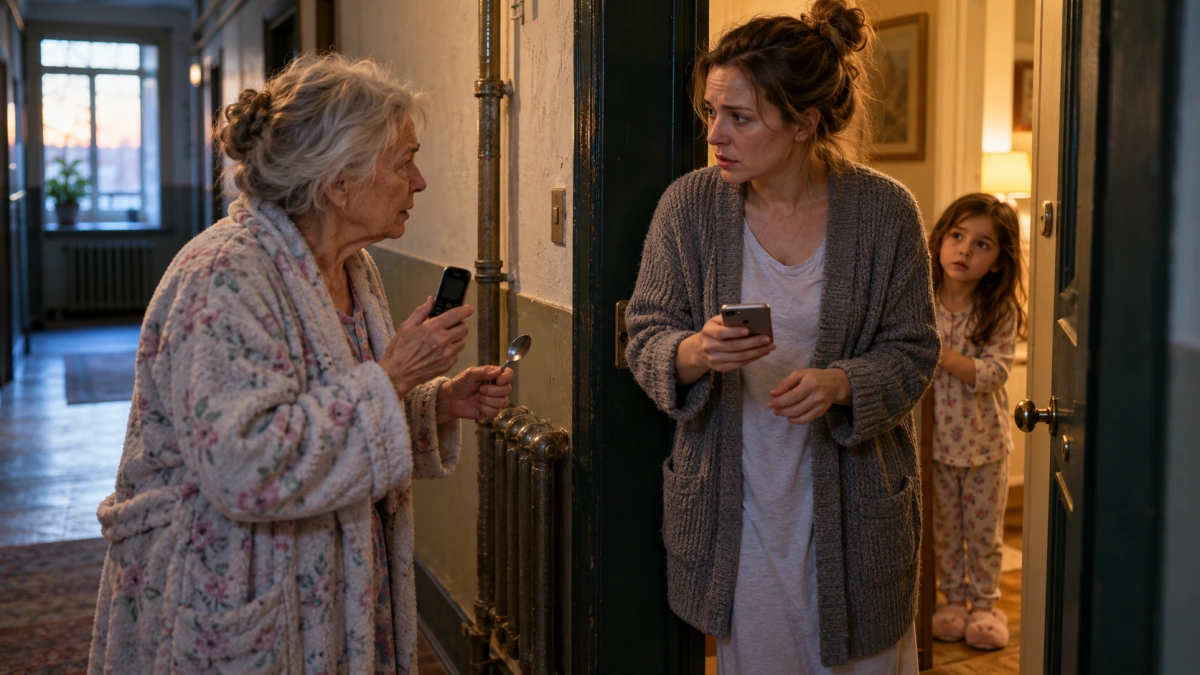
Beatrice Bell from 3C stood outside in her robe, clutching an old phone. “Harold isn’t answering,” she said. “I sent my signal twice. He has never missed a morning without telling me.”
My clock read 6:34. Beatrice pointed toward the spot on my ceiling where I had wanted the noise to disappear. “Do you have Dale’s number? I can’t get into Harold’s place. The lobby intercom is still broken.”
Molly appeared behind me, barefoot on the cold floor. For the first time, I understood that the three knocks were meant for someone other than the woman trying to sleep below. Now they had stopped, and the three of us had to decide what to do before waiting became its own decision.
“I’m calling 911,” I said. I sent Molly to the living room, told her to put on shoes, and asked her to wait by our door. Beatrice was still tapping the pipe with the handle of a spoon, twice, pausing to listen. I gave the dispatcher our address, Harold’s apartment number, and the reason his silence worried us.
She asked whether we could get inside. I explained that Dale kept an emergency key and that the broken lobby intercom would not let us buzz the crew in. Beatrice stopped tapping long enough to call him. I ran down to wait at the entrance. In my head I kept hearing the phrase I had typed on my complaint form: “Unnecessary banging at 6:30 a.m.”
The ambulance arrived within minutes. I opened the front door. Dale came in from the parking lot with his jacket half zipped and a heavy ring of keys in his hand. We took the elevator to the third floor. Harold was on the kitchen floor when the door opened, awake but unable to get up on his own. I stayed in the hallway with Beatrice while the crew asked his name and what had happened.
Harold said he had slipped reaching for the kettle, before it was time to send his signal. His phone was charging on a table too far away. They took him to be checked. Beatrice held the sweater he had asked her to bring. She was still holding it when the elevator doors closed, having forgotten to pass it to the crew.
Dale offered to drive her to the hospital, but she said her niece Nina would meet her there. I handed her the sweater and watched her leave. Dale rubbed his forehead and said he would check on the intercom that afternoon. I asked whether he had scheduled a repair after my earlier emails. He said he was waiting for the owner to approve it. I was too tired to argue in a hallway, but I wrote down his exact words before memory could improve either side of that conversation.
Molly was late to school. On the way, she asked whether Harold was going to die. I said I did not know what the hospital would find, but he had been talking when the crew took him away. Then she asked whether my complaint was why he had not knocked. I told her no. He had fallen before the usual time.
I had heard him say so. But I also told her that a person warned to stop making a sound might hesitate to make it again, even if it mattered. I did not yet know how to repair my part in that. I just did not want to give my daughter an answer designed to make me feel innocent.
My name is Erin Walsh. I was thirty-seven, newly divorced, and trying to make a smaller life fit into apartment 2B. I worked remote customer support for a travel company, usually until two in the morning. My shift included a scheduled break when I could remind Molly to turn off her light. I got her to the school bus stop at eight. I had picked the building because the rent was possible, there was an elevator, and Molly’s room got sunlight. I had not expected a heating pipe to become part of our family schedule.
The knocks started during our first week. At first I thought someone upstairs was moving a chair. By the third week, I could set my clock by them, Sundays included. I heard the two answering taps too, but mistook them for an echo. My first email to Dale was polite. The second listed dates. The third asked whether the ceiling or the pipe needed maintenance because the sound traveled so clearly.
Dale replied that older buildings carried pipe noise, but he would remind residents to keep it down. On the formal form, I checked “recurring noise” and never asked who had made the pattern or why. I was not trying to hurt anyone. I was tired, and tiredness had narrowed the questions I thought to ask.
That afternoon, Beatrice came to my door with store-bought cookies. Harold was staying at the hospital for observation. His shoulder hurt, but he was joking that the paramedics had taken him away before his tea was ready. Nina was there and would pass along news. I invited Beatrice inside.
She sat on the edge of the couch as though taking up less space might make this visit easier. I told her I had filed the complaint. She set down the cookies and looked at me for a long moment. “I figured,” she said. “You have a right to sleep. We should have told you what we were doing.”
She and Harold had met tending planters in the building’s small backyard. Her husband had died three years earlier; Harold’s wife had died before that. Neither wanted their families to make a daily welfare call over something as ordinary as waking up. Phones were unreliable for them anyway. Beatrice took out her hearing aids at night, and Harold often left his phone across the room to charge.
So they agreed that at 6:30 he would knock three times on the heating pipe that ran through both apartments. She would answer twice. If either person failed to respond after a few minutes, the other would call or come to the door. It was not an emergency service. It was a way for two friends to say they had started another day.
“Why not knock on the wall you share?” I asked.
“We tried. The wall is too thick. The pipe carries.”
“It certainly does.”
She gave a sad little laugh. “Now I know.”
The lobby intercom had been broken since the previous winter. Guests could not call apartments from downstairs. Older residents expecting a delivery or a caregiver had to go down themselves or arrange for somebody to wait. Beatrice had reported it three times. Harold had reported a package left outside the main door.
I remembered spending ten minutes in the rain when I forgot my key and could not call Molly upstairs. I had treated that as a separate annoyance. That morning I had run down to let the ambulance crew in because the same system still did not work. Several small inconveniences had turned out to share one address.
I said I would withdraw my noise complaint. Beatrice shook her head. “Your complaint was true. It woke you up. That needs solving too.” I had not expected the woman I had complained about to defend my need for sleep. She said she and Harold could change the hour or find another signal once he came home. I suggested we ask him before deciding. Beatrice nodded. In a single day, I had moved from asking nothing to wanting to fix everything. Both ways put other people’s choices in my hands.
That night I emailed Dale. I explained that the knocks were an agreed signal between two residents, not vandalism or deliberate harassment. I asked him to remove any penalty connected to my complaint while acknowledging that the sound had disturbed our apartment. I also requested a repair schedule for the intercom and a copy of the notice to the building owner. Dale wrote back that he was glad Harold was safe, quiet hours still applied before seven, and he would “continue following up with the contractor.” He gave no date.
Molly read the message beside me and asked what “following up with the contractor” actually meant. I said I wanted to know too. She offered to draw a “do not knock” sign for the pipe. I told her that would solve the noise in our apartment but might take away the way Harold and Beatrice checked on each other. She drew two apartments and a line between them, circled the lower one, and wrote, “This person sleeps too.” I put the drawing on the refrigerator. In four words, she had kept my part of the story from disappearing.
Harold came home three days later with a soft brace on his shoulder. Nina carried his bag. I met them at the elevator and introduced myself as the neighbor downstairs who had complained. He looked at me through thick glasses. “I figured I was bothering somebody,” he said.
“Dale left the paper.” I apologized for not knocking on his door first. He said he should have spoken to the neighbor below before turning the pipe into a bell. Neither of us could claim to have seen the whole picture. Nina pressed the button for the third floor and asked us to continue when Harold had rested.
The next morning, there were no knocks. I slept until 7:10 and woke to a text from Beatrice asking to visit that afternoon. She said Harold had tried calling her, but on his first night home he had charged his phone in the living room and she had not heard hers ring. Nina had called instead before going to work.
They disliked depending on a niece across town for a daily check. I offered to join a morning group text. Beatrice said perhaps sometimes, but she did not want a growing list of people monitoring when she woke up. I felt my face warm. Again I had offered an arrangement convenient for me without asking what would feel comfortable to her.
That evening I knocked on 3C with a blank sheet of paper instead of a proposal. Harold was sitting at Beatrice’s kitchen table, his left shoulder still sore and a cup of tea going cold in front of him. I asked what they wanted to preserve from the old routine. “Knowing my friend got out of bed,” Harold said.
“And being allowed to take a morning off if I tell her first.” Beatrice needed a signal she could see when she was not wearing her hearing aids. I asked what time it needed to happen. They looked at each other. Six-thirty was simply when Harold used to get up to feed a dog that had died years ago. Neither of them had chosen the hour for any reason that still existed.
“I can live with something after seven,” I said. “But if it can be quiet in my room, that would help. My shift usually ends at two.” Harold had assumed I worked early mornings at a hospital. He looked as surprised to hear about my nights handling canceled trips as I had been to learn about his morning signal.
Beatrice set down her cup. “So we need three things. We choose how to check in, Erin gets to sleep, and nobody guesses what a missing signal means.” I wrote them down. It was the first conversation about the three knocks that included everyone who heard them.
Harold suggested walking to Beatrice’s door at 7:15. She pointed out that the hallway carried noise too, and he would have to get dressed enough to cross it as soon as he woke. I mentioned a simple wireless doorbell kit, one with a flashing receiver, buttons, and batteries. Beatrice did not want a camera. I did not want a camera facing Molly’s door either.
I found a model without an app, account, or recording and showed it to them. They did not agree immediately. Harold asked whether the signal could pass through their walls and how they would know when a battery died. I said we could test one and return it if it failed. I did not buy it until they both said yes.
Nina went with me to the hardware store the next day. Harold insisted on paying half the cost, and Beatrice paid the other half. I held the receipt and spare batteries, not the money. We put the small buttons inside each apartment with removable adhesive and set a receiver on Beatrice’s bedside table and another near Harold’s kettle.
Each press made a light flash without a chime. We tried ten times from room to room. Two early presses failed when a metal cabinet blocked one receiver. After we moved it closer to the window, ten more presses worked. Harold wrote the battery installation date on the box and reminded us that a successful afternoon was no guarantee of a successful year.
They agreed that at 7:15, whoever woke first would press once and the other person would reply. If there was no answer by 7:30, the first person would call, then knock on the door. If they had reason to believe someone needed help and could not get in, they would call emergency services. A trip or a planned late morning needed a short message ahead of time.
Beatrice copied the steps onto a card she kept by the receiver. Nina got a copy because both of them wanted her to know the plan. No one else was automatically included. I read the card back and asked whether I should keep a copy. They said no. To my surprise, I felt relieved that this part of the solution did not belong to me.
On the first test morning, I woke at 7:18 because Molly dropped a spoon in the kitchen. The ceiling was silent. I lay there for a few minutes, waiting for my body to believe it no longer had to count. Down in the lobby, I met Harold carrying his recycling. He said the lights had flashed in both apartments.
I asked about his shoulder. It still hurt when he reached overhead, he said, but he had a follow-up appointment and Nina would take him. I did not ask for the details. A greeting did not entitle me to a medical report. We rode down in the elevator and parted at the bins.
The quiet made the broken front door system harder to ignore. On Thursday evening, I saw a home care worker outside in the cold, pressing 1A again and again. Victor, who lived in 1A and used a cane, needed several minutes to get downstairs. I let the visitor in after asking whom she was there to see.
Victor did not ask me to solve his problem; he only said it was the fourth time that month someone had waited for him. I asked permission to include that in a building email without naming him. He said to use his name because management already knew. But he asked me not to write that he could not come down. “I can,” he said. “I just shouldn’t have to race somebody standing in the rain.”
I found my own emails to Dale about the entrance system. The first reply, six months old, said they were waiting for a part. Two months later, the contractor would be in touch. Last week, he was still following up. I printed the three messages and highlighted the dates without adding any adjectives.
Beatrice had two similar replies. Harold had a photograph of the package left outside, but the label showed his phone number. He cropped it before passing the picture along. We needed evidence that the intercom was broken and that it mattered. We did not need to display a neighbor’s private information to prove it.
Molly heard us talking at the kitchen table and asked why three residents had to do Dale’s job. I said Dale was responsible for repairs; we were trying to make sure the owner saw that promises had not become work. At school, she said, a teacher had taped an “out of order” sign to a water fountain, but students still had to carry bottles to another classroom.
I asked whether the sign was useless. “It helps if the fountain works later,” she said. The next day I wrote a letter with three concrete requests: the name of the contractor assigned, the date of an inspection, and a plan for visitors while the system remained down.
I almost sent it under all three of our names. Beatrice crossed hers out of the draft header. She wanted to read the final version and sign it herself; she did not want unexpected calls during her rest hours. Harold changed a line about “elderly residents unable to access the door” to “residents having to come downstairs to let guests in.” I had used their age to make the argument sound stronger, though that was not how they described themselves. I revised the letter. An inconvenience did not need to be exaggerated before it deserved attention.
Dale agreed to meet us in the laundry room at six on Monday. He brought a folder of estimates and looked tired. The old repair company had gone out of business, he said, and replacement parts for the lobby panel were unavailable. The owner needed to approve a new system. I asked when he had learned about the parts.
He opened the folder and showed us an email dated four months earlier. Beatrice asked why residents had kept receiving “waiting for parts” replies after that date. Dale paused, then admitted he had reused an old response. Beatrice drew a breath. She did not raise her voice. “We arranged our lives around information that wasn’t true,” she said.
I did not pretend I understood all the electrical work. I asked whether the estimate included testing each apartment or only installing a new lobby panel. Dale pointed to a testing line, then admitted there was still no appointment. He feared giving a date the contractor would miss. I said he could give us a date for the next update even if he could not give us a completion date. Uncertainty could be explained; it could not serve as the same answer forever.
Victor arrived late and suggested a sign downstairs so visitors would stop pressing dead buttons. Another resident worried that instructions about waiting would encourage strangers to follow someone through the door. We agreed the sign would only state that the intercom was out and give the management office number. It would not ask residents to admit anybody they could not identify.
Before we left, Dale asked Harold whether he wanted the noise notice removed from his file. “I want the record to say what happened was explained,” Harold replied. “I want no fine. And if another neighbor complains, I want you to speak to us before you slip a warning under the door.” Dale wrote it down.
I said I still wanted the building to inspect how sound traveled through the pipe during the next maintenance visit. Harold agreed. We had changed the signal, but the sound path between apartments would still exist for the next residents. A problem did not evaporate just because everyone had finally been civil.
Two days later, the owner sent a letter to every apartment. It named an inspection date, outlined a possible replacement, and gave residents a way to report trouble getting visitors inside. There was no confirmed installation date. I was disappointed, but now there was a step to check.
I placed a copy on the lobby board designated for notices. Harold asked whether I could print one in larger type for Beatrice. She said she could read it with her glasses, then printed a large version herself in case someone else needed it. It was a small reminder that helping did not always require taking over.
A week later, Harold’s receiver failed during an evening test. Its battery light was on, but Beatrice’s button worked only some of the time. We reseated the batteries and tried both directions. The connection still dropped when a bedroom door was closed. Harold wanted to return the kit. Beatrice had grown fond of its silence, but she did not want to trust a plastic box more than it deserved.
I remembered Harold’s warning after our first test. We returned the kit and chose one with a plug-in receiver and a battery backup light. The store clerk made no promise it would work better through their walls. We took it home and tested it in the actual rooms before deciding to keep it.
The replacement worked for three days of tests, including with the doors closed and the elevator running. Harold plugged his receiver beside the tea table, where he did not need to reach over his head. Beatrice put her light where she could see it from bed and from the kitchen. They kept the same sequence of phone call and personal knock if there was no reply.
That mattered most. A light could tell somebody to go and check; it could not declare a person safe. Nina visited on Sunday, read the instruction card, and asked why Erin was not listed. Beatrice told her it was an agreement between her and Harold. If they wanted another person involved, they would ask. Nina smiled and said that was clear.
I thought I would immediately make up all the lost sleep once the knocks stopped. Instead, I woke at 6:30 on several mornings, listening to heat move through the pipe and imagining a spoon against it. My body had learned the pattern over weeks.
I started charging my phone away from the bed, closed the curtains more tightly, and asked a coworker to trade the latest shift with me one night a week so I could spend a longer evening with Molly. Not every strain in my life came from the apartment above. When Molly caught a fever, I slept badly anyway and had to arrange a doctor visit around work. A quiet ceiling helped. It did not make single parenting simple.
Beatrice brought us soup while Molly was sick. She knocked at five in the afternoon and did not stay when I said Molly was sleeping. I washed the container and returned it a few days later with bread from the bakery by the bus stop. Nobody called it a debt. Molly added people on all three floors to her drawing. She put a little light by 3C and a big pillow in 2B. At first, 3B was empty. Then she drew a teapot. I left the picture on the refrigerator, next to the update from Dale about the intercom inspection.
The contractor found that wiring between the lobby panel and two third-floor apartments was damaged. The panel was not the only problem. Dale sent a new notice moving the tentative installation date back ten days. I was angry when I opened it, but this time it explained the reason, listed the additional work, and said when we would hear more.
Victor called to ask whether workers would block the accessible route while running cable. Dale answered him that day. I did not know whether our letter had changed Dale or whether he had also grown tired of saying he was following up. A date gave everyone a chance to hold him to a promise.
During the delay, some residents organized a voluntary group chat for people willing to help verified visitors reach the lobby. I did not join the door shifts because of my sleep schedule. I passed along the notice and management’s phone number to anyone who wanted them. A woman on the first floor said a group chat would disturb her all day, so nobody added her.
Harold had assumed I would be the first person offering to open the door every morning. Once he understood my hours, he withdrew the suggestion. Kindness needed limits if it was going to last. I could help write and track the repair request. I could not become the intercom.
One evening during that wait, Molly asked why our new plan had so many steps. I showed her Beatrice’s card from memory: send a signal, try a call, go to the door, get help if there was reason to worry. Molly said she would probably forget the middle part if she was scared.
I told her that was why Beatrice had written it down, and why I had told her only the part that mattered to us: if somebody asked her to open the building door for a stranger, she should come get me. We practiced calling my phone from the living room, then put the paper with our own emergency contacts back on the refrigerator. It was our plan, separate from the one upstairs.
Harold passed me in the lobby the following morning while I was carrying laundry. He asked whether the pipe had stayed quiet. I said yes, though I still sometimes woke before my alarm. He said he missed the sound of Beatrice answering. The new light was useful, but its silence made their old signal seem like a tiny ritual he had lost.
I had only thought about the noise as something taken away from me, and it took effort to hear that he had lost something too. We stood by the mailboxes for a minute. Then he said the light let him set his kettle down before he looked for a reply. His shoulder made that a practical improvement. He smiled at the small contradiction. I could sleep better without needing him to pretend he had hated those three knocks all along.
When I carried the laundry upstairs, I passed the patch of ceiling above my bed. I had once wanted Dale to make Harold stop. Later I had wanted to solve every part of his and Beatrice’s mornings. What finally worked had come from asking two people what they wanted, naming what I needed, and letting each person keep a say.
The intercom repair was slower and messier, but it also moved only when residents could compare dates and test the result. I folded Molly’s school shirts and set my alarm. For the first time in weeks, I expected the morning to be ordinary.
Ten days later, the workers arrived. They spent two visits replacing the lobby panel and checking the lines on every floor. Dale sent a testing schedule for each apartment. I stood in the lobby and pressed 2B. Molly answered upstairs in a formal voice. “Please state your name and reason for visiting.” I told her I was bringing home milk. She pushed the release button, and I heard the lock click.
I tested 3C with Beatrice too. She wanted to know whether the indicator light was bright enough when her hearing aids were out. It was, but the release button stuck slightly. The technician adjusted it before leaving. Harold tested 3B himself while Nina waited downstairs. None of us had to accept the words “repair complete” merely because they appeared in a notice.
That evening, Dale emailed to confirm that Harold had no fine or violation in his file. He included a tentative date for pipe maintenance and said a technician would examine where sound carried between the apartments. I forwarded the message to Harold because he was the one who needed to keep it.
He thanked me, then added, “No need to knock tomorrow.” I stared at the line for a while. Weeks earlier, I would have read it as a victory. Now I knew it meant the neighbors upstairs had chosen another way to greet each morning. I replied, “I know. Have a good one, both of you.”
On Saturday, I woke at 7:40. Molly had poured herself cereal and saved some milk for me. Through our window, I could see the planters Harold and Beatrice had tended since spring. I took my coffee downstairs. Victor was speaking to a guest through the new intercom. He pushed the button and then went back to his apartment at his own pace.
I did not know exactly how the lights in 3B and 3C had flashed at 7:15. That morning belonged to them. When Beatrice came out to the garden, she asked whether I had slept. I nodded. She said she had too. Harold called us over to see new leaves on his basil. No one knocked on the heating pipe. We could still hear one another.
Read next

The Garden Gate Was Open

The Bags on the Porch

One More Stop Before Home

The Landlord’s Son Told My Neighbor to Leave Her Shop by Friday—Then She Handed Me a Receipt Older Than He Was
Reading notes
Three early-morning knocks interrupt a quiet routine and expose the complicated lives behind a neighbor’s door.
This is an original work of fiction. Characters and events are fictional. Explore public-domain books at Project Gutenberg or browse more stories on ReadStoryvia.