Original fiction
On this page
The Bridesmaid Budget
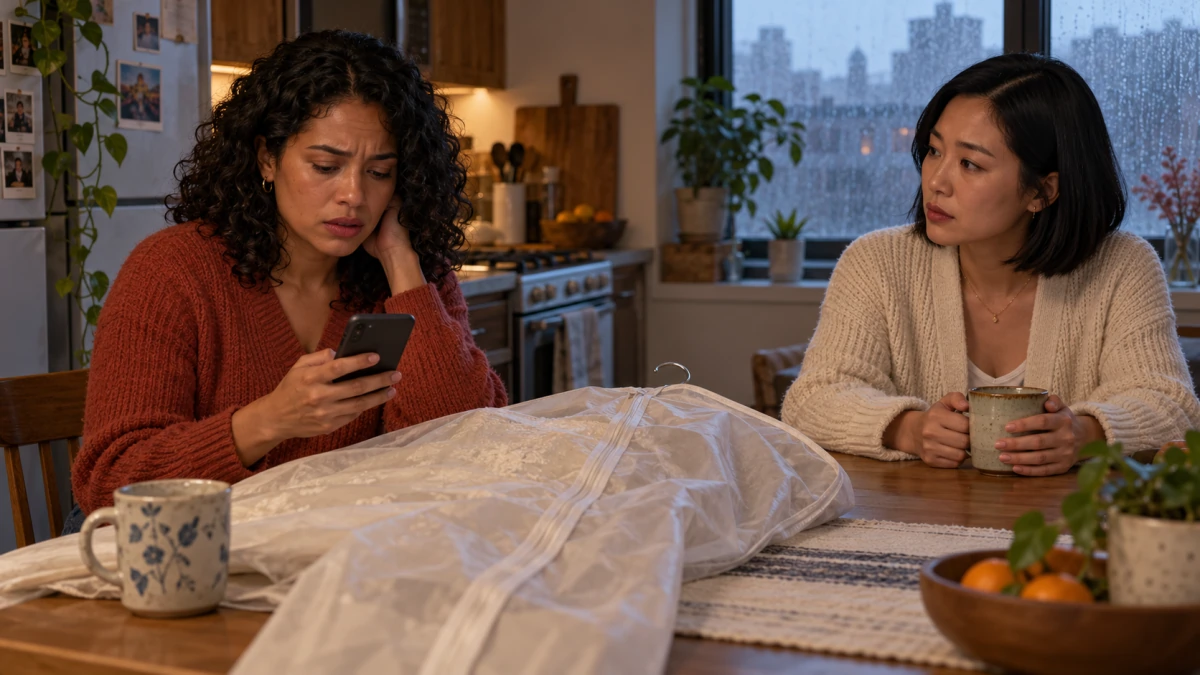
Lucia Moreno found out she was no longer in the bridesmaid photograph while standing in her own kitchen, holding a dress she had already paid for.
The dress had cost one hundred sixty dollars. The message on her phone cost nothing to send.
Celia had posted the new picture plan in the wedding group: four women beside the bride, arranged by height. Lucia's name was gone. Under the list was a note about keeping the morning simple for the girls who had committed to everything.
Everything had changed three days earlier, when a two-night trip outside Des Moines appeared in the chat. Shared lodging, activities, food, and travel would add six hundred eighty dollars. Lucia had privately told Celia she could not go.
She had not asked anyone to cancel. She had not mentioned rent, her aging car, or the small balance she kept between herself and trouble. She had said she could still afford their original agreement: the dress and ninety dollars in local wedding expenses.
Now she set the garment bag over a chair and read the word committed again.
Across the table, Nadine Cho put down her tea. Her cream cardigan sleeve brushed the saucer.
"Maybe she forgot to copy your name," Nadine said, without sounding convinced.
Lucia scrolled. Someone had replied with four heart emojis. Celia had answered, Perfect, finally settled.
She was thirty years old. She could manage her money, turn down a trip, and survive not being in a photograph. What she could not figure out was how a private limit had become a public measure of how much she loved her friend.
She typed a question, deleted the part explaining her checking account, and sent what remained.
"Celia, am I still a bridesmaid?"
The answer arrived while Lucia was putting the dress back into its bag.
I thought you wanted less responsibility. We can talk later. Please don't make this stressful in the group.
She had sent the question privately. She checked the recipient to make sure, an absurd little movement that made Nadine look away with care.
"It was private," Lucia said.
"I know."
Rain knocked softly at the kitchen window. They had planned to spend the afternoon hemming curtains, not examining the exact price of belonging. Nadine had brought a sewing kit in a biscuit tin. Its lid was still open beside the tea, needles anchored in a faded cushion.
Lucia hung the dress on the bedroom door. It was a muted rust color Celia had selected months ago, when the wedding still seemed built around people they actually knew. Lucia had liked it enough to imagine wearing it again. Now the fabric felt like evidence of something she had apparently failed to understand.
"Don't answer while you're shaking," Nadine said.
"I'm not."
She looked at her hands. She was.
They measured the curtains instead. Nadine read the tape while Lucia marked the fabric, and for ten minutes they argued about whether a crooked window frame should dictate a crooked hem. It helped to have a problem that could be laid flat on a table. When they finished, Lucia put her phone facedown and made fresh tea.
She and Celia had met nine years earlier at a neighborhood cleanup where both had worn shoes unsuitable for wet grass. Celia had lent her dry socks from a gym bag. Lucia had spent the afternoon pretending not to notice they were Christmas socks in April. Later came dinners, moving boxes, bad dates, and the year Celia stayed on her couch after a breakup, eating cereal from a measuring jug because all the bowls were dirty.
None of that was on the new picture plan.
At first, being asked to stand beside Celia had felt uncomplicated. They met at a local bridal shop. Celia chose a dress everyone could order separately, and Lucia said clearly that her total budget was two hundred fifty dollars: one hundred sixty for the dress, ninety for local costs. Celia had said that was fine. Lucia bought the dress the next week.
The trip arrived much later, presented as a deal that would disappear if they waited. The estimate was six hundred eighty dollars per person. Celia had found a rental outside the city, reserved an activity package, and paid her own nonrefundable booking deposit. Several women reacted with excitement before Lucia finished adding the numbers.
Lucia sent her refusal privately because she did not want to make a referendum out of a weekend others might enjoy. She wrote that she hoped they had a wonderful time and would see them at the local events already planned. She did not apologize for spending money she did not have. At least she had thought she did not need to.
That evening Celia called. Lucia answered standing beside the newly pinned curtains.
"I didn't remove you from the wedding," Celia said. "I just made the getting-ready pictures match who's actually getting ready with us."
"The note said the girls who committed to everything."
"I was tired."
"I believe you. It still said that."
Celia went silent. Lucia could hear water running, then stop. She pictured the little kitchen in Celia's duplex, the pale blue blouse she wore when she wanted to look composed, the stack of envelopes that had begun living by the toaster.
"I booked things based on people being there," Celia said.
"You didn't ask me before booking."
"I thought my bridesmaids would want to."
"Wanting and paying aren't the same thing."
There it was, the sentence both had been circling. Lucia waited. Celia said she could probably arrange installments. Lucia said installments would not change the total. Celia suggested asking whether the lodging cost could be spread among the group. Lucia said she was not agreeing to a price hidden in someone else's share either.
"Then what do you want me to do?"
"Tell me what being a bridesmaid actually requires now. If it's the weekend, I can be a guest. If we can keep the original agreement, we need to say that clearly."
She had expected the sentence to sound fierce. It sounded sad.
Celia said she needed to think. Lucia said she did too. After they hung up, she took the pins out of a curtain she had measured incorrectly and started again.
Monday at the small print shop where Lucia handled orders, a customer returned a stack of invitations because the paper looked warmer at home than under the showroom lights. Lucia checked the sample, explained the options, and resisted saying that most occasions contained larger problems than ivory. It was not the customer's job to receive the anger she had saved over the weekend.
During lunch she opened her budgeting notebook. Rent, utilities, groceries, insurance, a repair reserve, and the local wedding money were already assigned. She could find six hundred eighty dollars only by borrowing or pretending the reserve was spare. She shut the notebook. The decision was made. She was looking at it again because being judged had made certainty feel rude.
Her mother called that night to ask about a package delivery. Lucia almost told her everything, then realized she wanted permission rather than company. She explained anyway, without listing her balances.
"You don't need me to approve a number you already understand," her mother said.
"I know."
"Knowing doesn't always feel nice."
They talked about the curtains. Her mother thought she should have washed the fabric first. Lucia groaned because she had, and because ordinary criticism from someone who loved her was suddenly comforting.
On Tuesday, another bridesmaid, Paige, sent a private message. She had seen the changed plan and wanted to know whether Lucia was all right. Paige was going on the trip. She had saved for it and arranged childcare months earlier for a different weekend that she could now use. She was not rich; she was excited, and then embarrassed by her excitement.
"You don't have to stop wanting to go because I can't," Lucia told her.
Paige replied with relief, then offered to talk to Celia. Lucia said not yet. She did not want a coalition assembled on her behalf before she had decided what she wanted. Paige respected that. Their conversation moved to a recipe, and Lucia felt something unclench. A person could be on the other side of a spending choice without being on the other side of her.
Another woman in the group, Brooke, had less patience. In the chat she wrote that everyone was making sacrifices and perhaps people could skip takeout for a while. Lucia stared at it during a quiet minute behind the counter. Nadine answered before she could.
"We don't know one another's budgets. Let's leave them alone."
Brooke replied that she had meant no offense. Nadine did not begin an argument about intent. Celia changed the subject to flower colors. Lucia put the phone away and finished wrapping a customer's order, smoothing the paper with a care she could not apply to the conversation.
That same afternoon Lucia picked up a pair of shoes from a repair shop near work. She had asked for new heel tips instead of buying another pair for the ceremony. The man behind the counter brought them out wrapped in brown paper and showed her what he had replaced. She paid from the wedding amount already set aside.
Outside, she sat on a bench and opened the package. The leather had a crease she had stopped noticing years ago. They were good shoes. She liked the idea of walking into the wedding in something that already knew her feet. Then she felt foolish for needing to turn a practical purchase into a private poem, and laughed at herself.
A woman nearby asked whether the bus had gone. Lucia checked the route number on the sign and said she was not waiting for it. They talked for a minute about the wind, then went separate ways. No one asked her why she was sitting there holding shoes. No one needed to.
Back at work, she filed a customer proof under the wrong order and caught the mistake before printing. Her manager asked whether she needed ten minutes. Lucia took them. In the stockroom she drank water and looked at the shelves until the urge to explain everything passed. Being hurt did not have to become a public project, but it also did not mean she had to work through every break to establish that she was fine.
She returned to the counter and called the customer. They approved the corrected proof. The day moved forward, imperfectly but without collapse. She wished friendship disagreements came with such clear margins: a page size, a safe area, a line beyond which important words should never be placed.
That night she told Nadine she wished she had defended herself.
"You don't have to produce a speech every time somebody says something careless."
"I had a whole speech in my head."
"I assumed."
They laughed, then sat quietly. Nadine could afford the trip but had not decided to attend. Her father needed help that weekend, and she did not want his situation entered into a group debate either. Money was not the only boundary people had to make sound acceptable. Lucia knew that, but hearing it without comparison made her feel less singled out.
On Wednesday Celia asked to meet at the park near Lucia's workplace. Not a restaurant, Lucia noticed. They bought nothing, sat on a damp bench, and watched a man try to persuade an elderly dog to continue walking.
Celia's straight blond hair was pinned back unevenly. She looked younger without the determined smile she had been wearing in wedding conversations.
"I thought you were pulling away," she said.
"From the trip? I am."
"From me."
Lucia waited. Celia rubbed a loose thread on her sleeve. Some of her newer friends had known one another since college. They shared trips and photographs and private jokes that Celia understood half a second late. Planning the weekend had felt like a chance to gather everyone in one place, prove the friendships belonged together, prove she belonged at the center of her own wedding rather than at the edge of everybody else's plans.
"When you said no, I heard you saying I wasn't worth the effort."
"That's what you heard. It isn't what I said."
"I know that now."
"Do you? Or do you think if I showed you enough bills, you'd believe me?"
Celia flinched. She admitted she had wanted an explanation, something that would make the refusal feel unavoidable rather than personal. Lucia said her word had to be enough. She would not turn over her bank statements so Celia could rank the importance of her rent against matching pictures.
The dog finally moved. Both women watched it as though it had settled something.
"I put down a deposit," Celia said. "My part isn't refundable. I can't undo that."
"I didn't ask you to."
"I keep thinking if everybody comes, it won't feel like a bad decision."
Lucia looked at her then, really looked. There was the friend who had eaten cereal from a jug, frightened of having to admit that a choice had cost more than money. Understanding her did not mean paying for the choice.
"I can't make a booking right by making my own finances wrong," Lucia said.
Celia nodded, but not in the satisfied way people nodded when a problem was finished. They sat until the damp reached their coats. Before leaving, Celia asked for another day to decide which wedding plans actually needed everyone. Lucia agreed to a day, not to indefinite uncertainty.
On Thursday afternoon, Nadine arrived at the print shop with an envelope and a guilty expression. Lucia thought it contained curtain measurements. It contained a suggestion instead.
"What if I covered the weekend difference? Quietly. No one would know."
Lucia felt the offer land in the place already bruised. Nadine saw her face and stopped.
"I meant it as kindness."
"I know you did."
They went outside, where a delivery truck blocked half the alley. Lucia told her she could accept help with a real emergency, or a meal, or a ride. She did not want someone secretly paying to keep her in a social picture. The secrecy would make her an actor in a story where everyone assumed the original demand had been reasonable.
Nadine listened without insisting the money meant nothing. It meant something to her too. She had been prepared to use part of her own savings because she hated seeing Lucia hurt.
"I wanted to remove the hurt," she said.
"You can't buy that part away."
"I can take back the offer."
"Yes. Please."
Nadine put the envelope into her bag. It was empty, she admitted; she had brought it because holding something made the conversation easier. They both laughed at that, a small release neither forced. Nadine apologized for trying to solve a boundary by making it invisible.
Lucia went back inside and finished a batch of business cards. She loved her friend for listening. She was also angry that listening had been necessary. Affection and irritation spent the afternoon together without canceling each other out.
Friday brought a message from Celia with two choices. Lucia could attend as a guest, with no expectation of helping during the day. Or she could remain a bridesmaid for the ceremony and the agreed local events, skip the trip and the rented getting-ready suite, do her own hair and makeup, and join the full wedding-party photographs at the venue. Celia would arrange the schedule so coming from home worked. Neither option required explaining the decision to anyone else.
Lucia read it twice. The limited bridesmaid arrangement was close to what she had originally accepted. Still, she did not answer immediately. Being offered her place again did not erase how easily it had been made conditional.
She walked home the long way, past a closed garden center and a row of houses with damp leaves pasted to the steps. She tried to picture the wedding as a guest. She could wear the rust dress if she wanted. She could watch Celia marry, eat dinner, leave without carrying emergency tissues or fixing a hem. There was freedom in that picture. There was grief too.
At home she took out the dress and tried it on. It fit. She had been hoping, unreasonably, that some new problem would make the decision for her. Instead she stood in her bedroom and asked herself whether she still wanted to be beside Celia, assuming the limits were real.
The answer was yes, but it was a smaller yes than before. It had edges.
She called Paige before replying to Celia, not to ask permission but to hear what the revised ceremony arrangement would look like from another place in the line. Paige said the venue already had a room where anyone could leave a coat; Lucia would not be arriving at a locked door while the others drove from the suite. She also said she hoped Lucia came, then added that she would understand if she chose to sit with the guests.
"I don't want you to feel you have to prove a point either way," Paige said.
Lucia had not known how badly she needed someone to remove that second obligation. Refusing could become a performance too, if she felt she had to keep refusing every new possibility in order to make the original limit convincing. She could choose the arrangement she actually wanted without pretending the first hurt had not happened.
After the call she hung the dress back up. She did not rehearse a dramatic entrance in it. She tried sitting down, lifting her arms, and walking around the bed to make sure the hem did not catch her heel. The fabric moved well. There would be enough other things to manage without spending the ceremony thinking about a seam.
She found a loose thread and clipped it. Then she put the scissors away, resisting the impulse to search for more damage simply because she had finally found something she could fix.
She replied that she would accept the limited bridesmaid role if the total remained the agreed two hundred fifty dollars and there were no surprise shared charges. One hundred sixty had already bought the dress. The remaining ninety covered her local travel and parking, the casual local gathering, and the small incidentals they had discussed. She would not add salon services, gifts disguised as fees, or a later portion of the weekend bill.
Celia confirmed each point. Then she asked whether they could talk about the photograph message in person. Lucia agreed, because a budget agreement was not an apology and she still needed one.
They met in Celia's kitchen on Sunday. Nadine was not there as mediator. No bridesmaid committee waited to vote. Celia made coffee that was too strong and set out crackers because she had forgotten to buy anything else.
"I was hurt and I tried to make you feel smaller," she said. "I called it simplifying the morning. It was punishment. I'm sorry."
Lucia had prepared herself for a sentence beginning if you felt. Hearing a plain admission left her strangely unready.
"You made me wonder whether nine years had a weekend price," she said.
Celia looked down. "I know."
"You know I wondered. You don't get to know exactly how it felt."
"You're right."
They drank the fierce coffee. Lucia asked what had actually changed beyond her arrangement. Celia showed her the revised event list. The trip remained for people who still wanted it, with an accurate cost and no connection to wedding roles. An expensive group brunch had been replaced by an optional walk and coffee people could buy or skip. The local gathering was now at Celia's home with simple food. Nobody had to contribute to decorations beyond what they had already agreed.
Her own booking deposit was still lost. A portion of the rental remained payable, and she had adjusted her personal wedding extras to cover it rather than dividing it among women who had never approved it. She did not show Lucia receipts as evidence of suffering. She simply named the consequence.
"I wanted the pictures to say everybody was close," she said. "I was making it harder to be close to me."
Lucia could not improve on that. She asked for the correction to the group message to be as visible as the original note. Not a public explanation of her money. A correction of the idea that spending established commitment.
Celia typed while Lucia was still there, then handed her the phone to check only whether it exposed anything private. Lucia changed nothing. Celia sent it herself.
The message said the earlier photograph wording had been unfair, that attendance at the trip was optional, and that Lucia remained part of the ceremony and wedding-party pictures. It asked everyone to direct questions about the revised schedule to Celia. It did not say Lucia had a financial hardship. It did not praise her for being brave enough to admit one.
Responses arrived unevenly. Paige sent a heart and said the new schedule worked. Brooke wrote okay, then later apologized privately for the takeout comment. She said she had been stressed about her own costs and had mistaken being stressed for having the right to judge. Lucia accepted the apology without disclosing a single purchase.
One bridesmaid never commented. Lucia allowed herself to dislike that without making it evidence of a secret campaign against her. People could be awkward. Not every silence was a verdict.
The next week they held the local gathering at Celia's home. Lucia brought the snack she had already budgeted for, not a peace offering of extravagant size. Nadine arrived late with a board game missing its original instructions. For a while everyone looked at their phones too much. Then Paige invented a rule about drawing flowers with the wrong hand, and the kitchen filled with genuinely bad pictures.
Celia laughed until she had to sit down. Lucia laughed too. Halfway through, she realized she had not been checking whether the laughter included her. The realization did not restore the previous month, but it made room for an evening that was not a trial.
When someone asked about the weekend, Celia answered the practical question and moved on. She did not turn to Lucia with an apologetic face that would make everyone look. Lucia noticed and appreciated the restraint.
Afterward Nadine helped stack plates. She asked whether Lucia wanted a ride home, a normal offer with no secret envelope behind it. Lucia said yes. In the car they discussed the game, then the curtains, which were finally hanging straight enough. Neither felt required to announce that their friendship had survived a test. They were simply tired and going home.
The weekend trip happened two weeks later. Lucia muted the group for those days, not as punishment but because looking at pictures while doing laundry sounded unpleasant. She spent Saturday morning helping her mother reorganize a cupboard and the afternoon reading at the library. On Sunday she washed the kitchen floor and bought a bunch of inexpensive flowers for herself.
She had a good weekend in pieces. She also felt left out. Saving money did not make her immune to wanting to be invited into fun she could not afford. She let both things be true without reopening the notebook to find a different answer.
At the library she chose a novel from a display and found someone else's shopping list between its pages. Bananas, soap, birthday candles. She used it as a bookmark until she noticed a child's drawing on the back, then handed it to the desk in case anybody came looking. The librarian thanked her and slipped it into a drawer full of other small things waiting for their owners.
Lucia liked that drawer. It suggested a world where losing something did not immediately make it worthless, where being overlooked was sometimes accidental and could be corrected without a scene. She also knew the photograph plan had not been accidental. The difference mattered. She could let the library afternoon be gentle without using it to soften what Celia needed to own.
When she got home, her mother called to ask where they had put a particular serving dish. Lucia told her the cupboard beside the stove, then stayed on the line while she looked. Her mother found it exactly there and sounded offended by how easy the search had been. Lucia laughed. It was not the laughter from photographs of a weekend away. It was hers, happening in her kitchen, and it did not need to compete.
Celia sent one direct message afterward: a picture of a ridiculous roadside sculpture they had passed, with a joke Lucia would understand. Not wish you were here, not proof that the trip had been worth everything. Lucia answered the joke. They talked for ten minutes about something besides the wedding.
The morning of the ceremony dawned clear and windy. Lucia ate breakfast at home, did her hair, and put on the rust dress. Her dark curls refused to lie exactly as planned. She let them be curls. The terracotta sweater she had worn during that first kitchen conversation lay folded on a chair, ordinary again.
She checked the agreed schedule before leaving. Arrival at the venue, ceremony, group pictures afterward. No suite, no salon, no surprise errands on the other side of town. She tucked the parking money into her bag and drove with enough time to miss a turn without panic.
Celia was in a small side room, fastening an earring with shaking fingers. For a moment Lucia saw the nervous friend beneath every plan. She asked whether Celia wanted help. Celia said yes, then held still while Lucia closed the clasp.
"Thank you for being here," Celia said.
Lucia met her eyes in the mirror. "I wanted to be."
It was not the same as everything is fine. Celia seemed to understand. She squeezed Lucia's hand once and let go when the coordinator called them.
The ceremony contained wind, a microphone squeal, and a flower girl who stopped halfway down the aisle to examine her shoe. Lucia watched Celia take her vows and felt happiness arrive without requiring her to forget anything. She could love this friend and know more clearly what love did not authorize.
Afterward the photographer gathered the wedding party. There was a place for Lucia. Not squeezed into the edge after somebody remembered, not announced as a generous accommodation. The schedule had her name where it needed to be. They arranged themselves by height, then rearranged because the sun made everyone squint.
Someone offered to take a picture of just the weekend group. Lucia felt the old sting before Celia said they could do that later, after the scheduled photographs, if people wanted. She did not scold the person for asking. She simply kept the promised order.
Lucia smiled when she was ready. The photographer asked them to step closer, and she did. She did not count her worth by the inches between her shoulder and Celia's. The picture was a picture, not a certificate of equal spending.
At dinner, Brooke passed the bread and asked about the print shop. Paige showed her a picture of her child asleep in a car seat. Nadine spilled water on her own napkin and laughed before anyone could fuss. The room contained people, not a single category of people who had been able to take a trip.
Lucia left when she had planned. She hugged Celia, wished the couple a good night, and did not stay to prove she had not been a burden. In the car she checked her spending. The dress and local expenses stayed within two hundred fifty dollars. There was no borrowed balance waiting after the music stopped.
A month later Celia came over for soup. She asked before bringing anyone else, and arrived with bread rather than a plan. They ate beneath the curtains Lucia and Nadine had hemmed on the rainy afternoon when everything began to shift.
They were not as automatic with each other. Lucia no longer answered every request before checking what it required. Celia sometimes stopped mid-sentence to distinguish an invitation from an expectation. It could be awkward. It could also be honest.
Over dinner, Celia mentioned a concert she wanted to see in the winter. She started to say they should all go, caught herself, and asked whether Lucia wanted the details before tickets went on sale. Lucia said yes to the details. It was not a yes to buying. Neither woman hurried to fill the distinction with a joke.
Later they washed the bowls together. Celia dropped a spoon into the sink and splashed them both. Lucia handed her a towel. For a moment the years between them felt available again, not restored exactly, but still usable: the cleanup in wet shoes, the cereal jug, the boxes they had carried up narrow stairs. She had not imagined those years. The hurt had not made them false, just as those years had not made the hurt acceptable.
Celia asked whether she could come back next week. Lucia checked her work schedule on the refrigerator before answering. Thursday would work, she said, if they kept it simple. Celia said soup was simple enough and offered to bring vegetables. Lucia named two things she needed rather than saying anything was fine. Their plans fit inside an evening, with room left over for the rest of their lives. That did not look impressive in a photograph. It felt more like friendship than an entire weekend built around proving nobody could bear to miss it.
When the wedding photographs arrived, Celia sent Lucia the group portrait without a caption about loyalty. Lucia saved it. Then she put down the phone and asked whether her friend wanted more soup.
Read next
The Scholarship Interview They Wanted to Film
The Price of the Old Table
No Seat for My Mother
My Cousin Sold My Mother’s Funeral Flowers for “Charity”—Then the Florist Recognized the Delivery Address
Reading notes
An unexpected wedding expense turns a bridesmaid’s private budget into a public test of friendship.
This is an original work of fiction. Characters and events are fictional. Explore public-domain books at Project Gutenberg or browse more stories on ReadStoryvia.