Original fiction
On this page
The Price of the Old Table
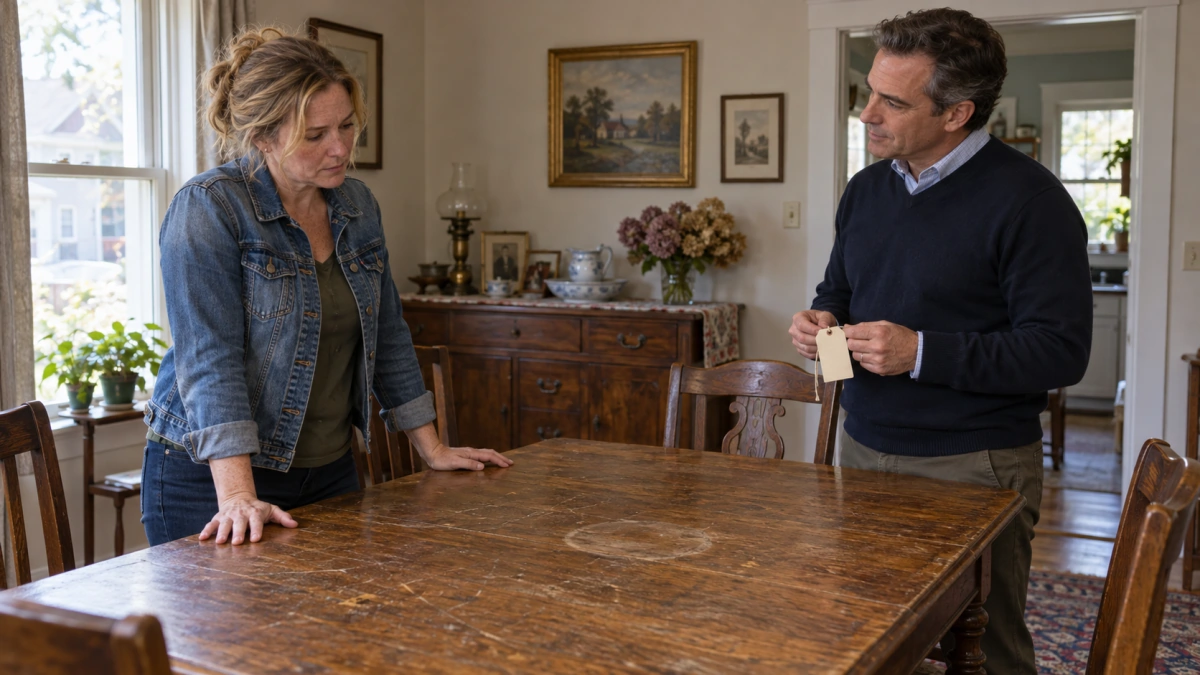
The man buying my mother's table brought a blank tag and a moving blanket. I kept both hands on the oak while he checked whether the legs would come off.
"One eighty, like we agreed," Adrian Shaw said.
I nodded. My car needed a six hundred forty dollar repair. I had four hundred sixty set aside, and the arithmetic was easier than looking at the empty dining room would be.
At forty six, I was old enough to know a scratched table wasn't my mother. Still, I could feel the pale ring where she had put a hot pan during the ice storm, feeding neighbors by candlelight. My dark blond hair kept falling across my face as I bent to undo the leaf catches. Adrian waited in his navy sweater, his dark hair gray at the temples, polite enough not to offer comfort I hadn't requested.
He paid. We carried the table out. I swept the rectangle of dust it had left behind.
Four days later, my brother sent me a photograph of the same table in Adrian's shop window. The asking price was twenty four hundred dollars.
That wasn't what made me sit down.
The sales listing called it a cherished piece from the private dining room of a prominent Louisville family. It described my mother's candlelit suppers as gatherings of civic leaders. Beneath that were photographs of Mom, my brother, and me, cropped to hide the paper plates and the broken screen door.
I had given Adrian those pictures to explain how the table came apart. Not to sell our childhood beside it.
Then I saw the surname he had attached to us.
It wasn't ours.
My brother Ben called before I could answer his message.
"Did you know he was going to do that?"
"Sell it for more? Yes. Do that? No."
Ben breathed into the phone. He worked nights maintaining grocery refrigeration, and I could hear a compressor behind him. "That's Mom in the picture."
"I know."
"Why does it say Whitcomb?"
I didn't know that either. Our mother had been June Wallace. At seventy four, when she died, she owned a small house, a paid off washing machine, and more casserole dishes than any cabinet could safely hold. She had never belonged to a prominent family. She had belonged to us, though even that sounded wrong, as if a person were something you could jointly own.
I saved the listing and put my phone facedown. On the floor where the table had stood, a lighter rectangle showed through the old finish. I had planned to put a rug there. Now I wanted to cover every window.
The car was at the repair shop. Its new alternator and belt were paid for with my savings and the sale money. There was no unpaid balance I could dramatically refuse. I would collect it after work, then drive to Adrian's shop.
Before leaving, I took the sale receipt out of the kitchen drawer. It described one used oak dining table, two removable leaves, six chairs excluded. The price was one hundred eighty dollars, paid in cash. I had signed it. Adrian had signed it. There was nothing false about the transaction on that page.
I wanted the page to contain some overlooked promise. It simply didn't.
The decision to sell hadn't happened in one desperate afternoon. For six months, I had eaten most meals at the counter because the dining room had become a place to store things I couldn't decide about. Boxes of Mom's linens sat on the chairs. Unopened mail spread across the table. Every time I cleared it, I felt briefly virtuous, then left another familiar pile there by Thursday.
The car repair made the decision urgent, but it didn't invent the problem. I needed the car to get to the warehouse before the early shift. A ride from Ben would have meant his driving across town after working all night. Buses existed, but the first connection wouldn't get me there on time. I had checked before calling the dealer, not because I expected anyone to interrogate me later, but because I wanted another choice.
Adrian had offered the amount after looking at my photographs of the wear. I had asked whether he could do two hundred. He said transportation and the uncertain condition of the extending mechanism made one eighty his limit. I could have refused. I had called one other buyer, who never returned my message. Then I accepted.
I remembered all of that now with an almost insulting clarity. Nobody had held my hand over a signature. Regret was real, but it wasn't a receipt I could take back to the world and demand reimbursement for.
Mom had bought the table secondhand when I was nine. I remembered the pickup because Ben, then six, had insisted the legs looked like upside down boots. That was family memory, not proof of age, maker, or value. I knew the difference. I just didn't like needing to know it now.
Adrian's shop occupied a narrow brick building beside a coffee place in Louisville. I had found him through a neighbor who said he paid promptly and collected furniture himself. When he came to the house, I wore my denim jacket because the furnace had been acting up. He had noticed the pale ring and asked whether it was water damage. I told him about the ice storm. He had smiled and said people liked a piece with a life.
I had thought he meant the worn surface.
At the shop, the table stood under a warm lamp. A folded linen runner covered the heat mark. Two chairs that weren't mine flanked it. The transformation was competent and beautiful enough to make me angry in a way I could not usefully explain.
Adrian was helping a customer choose drawer pulls. He saw me and said he'd be a moment. I waited beside a cabinet filled with glass birds. My reflection in its door showed freckles I had spent years trying to hide, then years forgetting to notice. Under the shop lights I looked like someone arriving to complain about a price she had already accepted.
When the customer left, I held up my phone.
"Take our photographs down."
Adrian leaned closer to the screen. "They're atmospheric. No addresses, no full names."
"That's my mother's face. That's my brother when he was a child."
"You sent them to me."
"To show the table with the leaves extended. You asked whether the center support was original."
He glanced at the table. "I understood them as background material."
"You understood wrong. And whose name is Whitcomb?"
His expression changed, not into guilt exactly, but calculation interrupted.
"It's a regional family reference. It creates context."
"It creates a different family."
A bell sounded as someone opened the shop door. Adrian lowered his voice. "Let's not discuss this in front of customers."
"You put us in front of customers."
The new arrival stopped beside a lamp and began studying its shade with excessive interest. Adrian asked me into the back office. I said we could talk there if the listing came down first.
He removed the photographs from the public page while I watched, but left the description. "There. Now can we talk?"
I took a screenshot of the changed page. Then I followed him past stacked frames into an office that smelled of furniture wax and old coffee.
He offered a chair. I sat because my knees were shaking and I didn't want that to become another fact he interpreted incorrectly.
"I can see this upset you," he said.
"It is upsetting. That's different."
He looked tired. I was tired too. We were two middle aged people in a room full of objects that had outlasted whoever bought them first.
"Do you want more money?" he asked.
For a moment I did. Not because money would solve the photographs, but because it would let me leave holding something measurable.
"I want you to stop saying my mother hosted civic leaders. They were neighbors with cold houses. Mr. Perez brought soup in a saucepan because his stove still worked. That's the story I told you."
"A listing has to be concise."
"Concise isn't the problem."
He rubbed the edge of the desk with his thumb. "Would you have sold if I'd told you I might list it around two thousand?"
"Probably not. But you didn't promise what you'd charge. I didn't ask for an appraisal. I asked for one eighty and you paid it. I'm not pretending the sale was theft."
Saying it felt like letting go of a railing. I had hoped to keep every possible complaint available until one of them carried me somewhere safe.
"Then what are we negotiating?" he asked.
"What you're allowed to say about people you didn't buy."
I left without agreement on the description. He promised not to restore the photographs. I asked him to put that in writing. He said he would email. Outside, the coffee place had set two chairs in the afternoon sun. I sat in one and called Ben.
He wanted to go back with me and demand the table. I told him the sale was completed.
"Then buy it back."
"With what?"
He said nothing. We both knew his own car needed tires.
"You could have asked me before selling," he said.
"I did. You said you didn't have room."
"I meant you didn't have to rush."
"That's not what you said."
I heard the compressor shut off, leaving his breathing suddenly clear. He told me he'd call later. I said okay. Neither of us meant okay.
At home, I made toast standing at the kitchen counter. The dining chairs were lined against the wall like guests waiting for an event nobody had planned. I had kept them because I needed chairs and because their loose joints were less valuable to a dealer than the table's broad top. Now they seemed to accuse me of splitting a set, though they had never matched perfectly anyway.
Mom used to call them the committee. One tall back, two ladder backs, three with curved rails. Ben and I had fought over the tallest until she told us the taller chair also came with responsibility for carrying the milk.
I sat in that chair with my toast. My feet reached the floor, a fact that felt briefly disloyal to the child in the photograph.
Adrian's email arrived after nine. He confirmed the pictures were removed. He called the family name a decorative attribution and said he would amend it when he revised the listing over the weekend.
I replied that an invented ownership history should not remain live while he found time. I asked where else the photographs had been used, whether he had shared the original files, and whether printed materials existed. I wrote three separate questions so he could not answer only the easiest one.
Then I closed the laptop. There was a temptation to search his name all night, to turn every old sale into evidence that I should have known better. I had work in the morning. I set an alarm and washed the plate.
I processed scheduling requests at a medical supply warehouse. It was work that rewarded accurate dates, not dramatic instincts. During lunch, my coworker Noreen asked why I was staring at a furniture listing. I told her enough to make sense of it, without forwarding the family photographs again.
"My cousin restores chairs," she said. "A high asking price doesn't mean it'll sell."
"I know. I keep needing to hear it."
"He could spend money on storage, repairs, rent. Still doesn't let him invent your mother."
That sentence separated two things my anger kept tangling together. I wrote it on the back of my lunch receipt, not to send Adrian, but to keep myself from wandering away from the actual problem.
That evening, Ben came over carrying a bag of groceries and the careful expression of someone who had rehearsed an apology in traffic.
"I remember you asking," he said. "I just wish my answer had been different."
I let him put the groceries down before I answered. "Me too."
He had brought ingredients for Mom's chicken and rice, though neither of us knew the right amount of broth. We opened her recipe box. Most cards were directions for other people's tastes: less salt for one neighbor, no mushrooms for an aunt. The chicken and rice wasn't there. She had made it too often to write down.
Ben found the photograph Adrian had used. It was tucked behind a grocery coupon from a store that had closed years earlier. Mom stood at the table with a dish towel over one shoulder. The original showed the broken screen door and paper plates. Cropped, it could look like a candlelit celebration. Whole, it looked like people surviving an outage with good food.
"He made us rich and still gave us the wrong name," Ben said.
"Apparently our real life wasn't enough."
"It was enough for us."
He said it angrily, not tenderly. That helped.
We compared the digital files I'd sent with the images on the saved listing. One showed the extended leaves at Thanksgiving. Another, from the storm, showed the center leg I thought he was asking about. I had told him the photographs were family snapshots, not certificates. The email thread confirmed his question and my answer. I saved it with the listing screenshots.
Ben suggested posting everything publicly. I asked whether that wouldn't distribute the photographs more widely. He set his phone down.
"I hate that he's making us careful," he said.
"Me too."
We agreed not to create a public campaign that used Mom's face to argue against using Mom's face. If we needed outside advice, we could show the materials privately. It was not surrender. It was choosing which door to open first.
Before he left, Ben walked through the empty dining room and stopped where Mom's chair used to stand. He remembered her sitting there to patch the knee of his baseball pants. I remembered her sorting coupons. Neither memory required a formal dinner, and neither would have looked particularly elegant in a sales listing.
"I wasn't trying to sell her," I said.
He turned around too quickly. "I know."
"I need you to say it without sounding surprised."
He leaned against the doorframe. "I know you weren't selling her. I know I left you with the house because I said you were better at sorting things. That wasn't fair."
I had wanted that admission longer than I wanted Adrian's. It came without a draft, without anybody negotiating the exact adjective. I didn't know what to do with it at first.
"You can take the linens," I said.
"All of them?"
"No. See? It's annoying to be the person who has to decide."
He smiled, then opened a box. We chose what each of us actually wanted. He took two towels and a tablecloth with a stain nobody could identify. I kept the blue napkins because I used them. The rest could wait one more week without becoming a judgment on either of us.
Adrian replied the next morning. The photographs had appeared in one email newsletter sent to his mailing list and on two printed display cards. He had not sent the full files to another dealer. His assistant had made the newsletter from the shop folder. He would ask her to delete her working copies, but couldn't retrieve messages already delivered.
That last sentence made my stomach sink. Removal was not a time machine.
The description now read, Traditional oak dining table with local family history. It still included candlelit gatherings of notable Louisville residents. I wrote back that notable was simply the same invention wearing a softer coat.
He asked to speak by phone. I asked for a meeting at the shop, with Ben present, so we could look at the printed materials. He agreed to Thursday morning before opening.
Wednesday night I dreamed the table was growing longer while I tried to reach its far end. In the morning I was annoyed with my sleeping brain for being so obvious.
I called the public library to ask where someone could learn about furniture marks without treating a guess as an appraisal. The librarian pointed me to reference books and a local historical collection, carefully explaining that staff couldn't authenticate my table. I thanked her. I wasn't trying to prove a fortune. I wanted to make sure I didn't challenge one unsupported claim by inventing another.
In my own photographs, there were no clear maker's marks. The table might be older than Mom, or might not. Oak was the word we'd always used, and Adrian's receipt used it too. I could describe the ring, the extending leaves, the purchase I remembered. I could not certify a century.
I put those limits in a note and took it to the meeting.
Adrian opened the door wearing the same navy sweater, this time with a pale thread caught on one sleeve. His assistant, Celia, stood near the desk. She was in her twenties and looked frightened enough that I immediately said I wasn't there to blame her for instructions she hadn't chosen.
"I chose the crop," she said. "He gave me the copy."
"Then we need to talk about both."
Adrian brought out the two cards. One was framed beside the table. The other lay in a folder with future newsletter ideas. They both used Mom's photograph. Ben picked up the framed one and turned it facedown.
"Please don't destroy anything yet," I told him. "We need to agree what we're documenting and what we're removing."
He let go. I knew that cost him effort.
Adrian said the prominent family name had come from another object whose intake sheet was stored nearby. He described a rushed afternoon, overlapping folders, a story assembled too quickly.
"But you called it decorative attribution," I said.
He looked at Celia, then back at me. "I was defending it. I shouldn't have."
"Was there a source linking this table to that family?"
"No."
Ben leaned forward. "Then say that without the folder story."
Adrian took a breath. "There was no source. I don't have evidence it belonged to them."
The sentence changed the room. Not because it repaired everything, but because we no longer had to wrestle with words pretending to be something else.
I said the table's physical description and any supported observations were his business. So was his asking price. Our names, faces, and private anecdotes were not props to make that price more convincing. He could describe the heat ring without explaining the neighbors who had eaten around it.
"The story matters to buyers," he said.
"Then a false one matters too."
Celia nodded, then looked down when Adrian noticed. He didn't reprimand her. He asked what correction I wanted.
I had written a draft on paper. It said the prior listing incorrectly attributed the table to a named family and described undocumented gatherings. The seller could verify neither claim. Personal photographs had been included without the family's agreement and had been removed. The table was a used dining table acquired locally, with its earlier ownership history unverified.
Adrian read it twice. "You want me to say without agreement, not without permission."
"I want language we can both honestly sign. I'm not a court. I'm telling you what I gave you the files for."
He nodded slowly. Ben wanted the word fabricated. I understood. Adrian resisted because he said it suggested every detail, including the table's material, was false. We settled on unsupported and incorrect, with the actual claims named. A vague statement about confusion would not do.
The newsletter presented another problem. Adrian offered to mention a correction in the next regular issue, three weeks away. I said people were considering the table now. He agreed to send a short correction to the same list within two days, without reproducing the photographs or adding our names.
Celia would remove the images from the shop's shared working folder and confirm deletion of her downloaded design copies. Adrian would remove the originals from his phone and email attachments after retaining a limited record of our correspondence and agreement. We discussed what that meant instead of pretending delete erased every backup instantly.
He could not promise to reach into customers' inboxes or guarantee no automated backup existed. He could promise no further use, no sale of the files, and a request to the newsletter provider to remove stored campaign images where its controls allowed. He would document what was done and tell us what remained outside his direct control.
I would keep my evidence privately. Ben would keep the original print. Neither of us had to hand over our own family material to prove we wanted privacy.
When Adrian asked whether money was part of the agreement, I said he could cover the modest printing expense for copies of the corrected statement we wanted for our records. I did not ask him to share a sale that had not happened. Ben looked at me, then nodded.
Adrian offered to sell the table back for the original price if it remained unsold through the weekend. I looked toward the showroom. I could see one corner beneath the lamp.
For a second, I imagined calling the mechanic and somehow reversing the alternator, as if every transaction in my life could unwind in order.
"I can't," I said.
Ben's jaw tightened. He couldn't either.
"And I don't want you holding it as the price of this correction," I added.
"I wasn't offering a condition."
"Good. Then keep the matters separate."
We left with the printed cards removed and a draft agreement Adrian would type that afternoon. It wasn't a verdict. We would have to check whether he did what he said.
Outside, Ben sat in my repaired car without shutting his door. "I could put it on a credit card," he said.
"You need tires."
"I know what I need."
"Then why are we trying to buy back the right to remember her?"
He shut the door carefully. "Because I know where to put a table. I don't know where to put this."
We sat without starting the engine. A bus hissed to a stop across the street. Somebody carried a large potted fern past the windshield, its leaves shaking like hands.
"You don't have room," I said finally.
"Neither do you, really."
The table had blocked my radiator and made the room hard to vacuum. Those facts were real too. Grief had a way of making inconvenience feel like evidence of devotion.
I drove him home. He asked me to call when the correction arrived.
That evening, I carried one of the chairs onto the porch and tightened its loose rail. I had watched Mom do it years earlier, turning the chair upside down on a folded towel. My first attempt made it worse. I stopped, looked at the joint, and fetched the right screwdriver instead of forcing the one already in my hand.
The chair wasn't valuable in any way I could document. It was useful. I could mend it badly or learn to mend it better. That seemed a more manageable relationship than requiring it to contain every dinner I'd ever eaten.
Noreen called while I was working. She asked whether the meeting had gone well. I said it had gone specifically. She understood that answer better than most people would have.
"Did he make the price smaller?" she asked.
"I didn't ask him to."
"Good. Then you don't have to spend the rest of your life checking whether the next owner sells it for more."
I laughed. Then I admitted I had imagined the table on television, revealed as something worth an absurd amount. She asked whether that would make the photographs more wrong. I said no. She asked whether it would make the original agreement disappear. Again, no.
"Well," she said, "you've got the difficult part clear. Doesn't mean the rest feels nice."
After we hung up, I finished tightening the rail. I tested the chair on the porch, sitting cautiously at first, then letting my full weight settle. A neighbor waved from across the street. I waved back with the screwdriver still in my hand. For once I wasn't looking at a screen where my family had been rearranged for strangers. I was outside my own house, fixing something I still owned.
It came Friday morning. Adrian sent the newsletter proof before distribution. There were no family images. The correction named the false association without suggesting the Whitcombs had personally endorsed anything. He had removed the story about civic leaders and the private storm supper. The current listing described measurements, extending leaves, wear, and a repaired joint he had found after purchase. It made no firm claim about date or maker.
The asking price was still twenty four hundred dollars.
I stared at it until the numbers blurred, then reminded myself I had not won control of his business. I had asked for truth and limits. Those were there, though seeing the price still hurt.
I approved the correction wording, not the table's valuation, and said so. Adrian sent confirmation after the mailing. Celia confirmed the design file cleanup. The provider removed the hosted campaign photographs from the old email's online version. Delivered messages could retain copies; we could not honestly say otherwise.
The two display cards came back to me by mail, with the images obscured on the shop's retained inventory copy. I kept one card as evidence and cut Mom's photograph from the other before recycling the text. For a moment I couldn't bear to throw even that scrap away. Then I did, because the photograph itself was safe in the recipe box.
Ben and I disagreed about whether this was enough. He wanted an apology that sounded less supervised. I wanted that too, but I was no longer willing to make our peace depend on Adrian finding the perfect sentence.
"He knows," Ben said.
"Maybe. He also knows what he's agreed not to do. I can check that."
We checked the listing together the following week. It stayed corrected. A week after that, the table disappeared from the page. Adrian's email said it had sold. He did not tell us for how much, and I didn't ask. He offered to pass along a note if we wanted the new owner to know about the storm.
I wrote three sentences and deleted them.
"No," I replied. "Please don't share any family story."
The buyer could make new scratches. Someone else's child could hide underneath during a loud dinner. That thought hurt less than I expected. I wanted the table used, not sealed in the life I could no longer afford to keep around it.
Saturday morning, I went to collect the last box from Mom's old closet. Inside were birthday candles, unused place mats, and a little bag of rubber feet for chair legs. She had kept practical answers to problems nobody else had noticed yet. I put the rubber feet in my kitchen drawer, where I could find them instead of preserving them in a box marked with her name.
There was no message hidden underneath. No envelope of money, no confession, no list of instructions for living after she was gone. I checked anyway. Then I folded the box flat and carried it to the recycling bin. On the way back, I noticed the dining room caught better afternoon light without the big table. I didn't have to enjoy that immediately. I could simply notice it, as I noticed the car starting cleanly instead of coughing before work. Useful things were allowed to matter alongside missing her. I opened both curtains and let the room warm up.
On Sunday, Ben brought a folding table borrowed from his neighbor. We set it in the dining room and put Mom's mismatched chairs around it. The legs rocked until he wedged a folded advertisement underneath. He said the temporary table had already developed provenance. I told him not to start.
We tried the chicken and rice again. This time we used less broth. The top browned properly, but the bottom caught at one edge. Ben scraped that part onto his own plate, as if taking the burnt pieces were an older brother's duty even though I was three years older.
"You always liked that bit," I said.
"I always told Mom I did."
We looked at each other and laughed. Another small family story had changed without becoming false.
After dinner, I brought out the photographs. We put them in sleeves, writing names on separate paper rather than on the originals. We left blank what we couldn't remember. Ben thought one winter picture was from a different outage. I thought he was right. Neither of us needed to invent a date to make the people in it worth keeping.
When we reached the table photograph, he traced the edge of the paper plate without touching the picture itself.
"She never got the good dishes out that night," he said.
"She was saving hot water."
"I thought she was saving the dishes from me."
That was possible too. He had broken a gravy boat the Christmas before. We left both explanations beside the picture, two memories allowed to sit together.
The folding table would have to go back on Tuesday. I had found a small used kitchen table I might buy after my next paycheck, but I hadn't promised myself anything yet. For now, the room could change. The repaired car waited outside, ready to carry me to work in the morning.
Ben asked for another serving. I handed him the spoon. He reached across the temporary table and steadied the dish while I served myself, a gesture so familiar that neither of us had to say where we learned it.
Read next
No Seat for My Mother
The Car Behind the Restaurant
The Missing Storefront Deposit
My Cousin Sold My Mother’s Funeral Flowers for “Charity”—Then the Florist Recognized the Delivery Address
Reading notes
After selling her mother’s table, a woman finds a dealer using invented history and private family photographs.
This is an original work of fiction. Characters and events are fictional. Explore public-domain books at Project Gutenberg or browse more stories on ReadStoryvia.