Original fiction
On this page
The Scholarship Interview They Wanted to Film
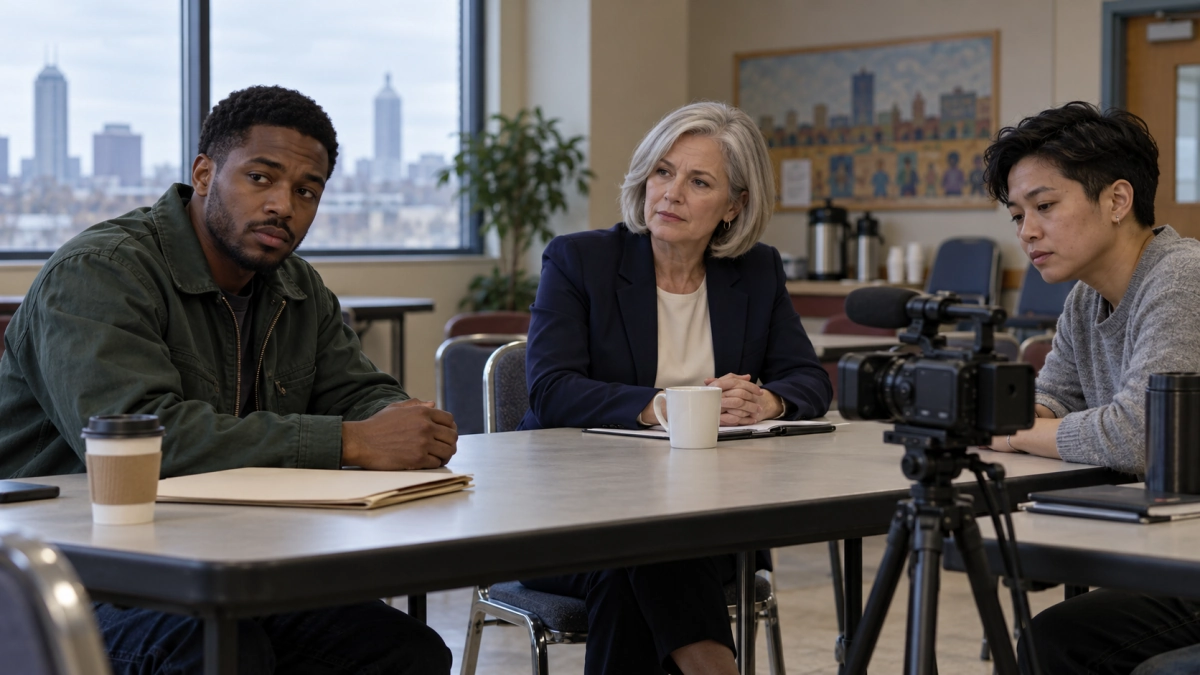
The camera was already pointed at Darius Bell's chair when he arrived for the scholarship interview. Beside the lens, someone had taped a sheet headed MY WAY OUT.
He recognized his name in the first sentence. Nothing after it belonged to him.
At twenty-eight, Darius had survived abandonment, hunger, and a family that never believed in education.
His mother had driven him to his placement test. His younger sister had bought him a calculator with grocery-store overtime. On Tuesday his uncle had spent two hours helping him understand fractions, admitting cheerfully that neither of them remembered enough.
There had been hard months. That did not make this their story.
"We can make it sound natural," said Ingrid Sloan, the scholarship committee chair, smoothing the sleeve of her navy blazer. "It's just a starting point."
Darius kept his dark green work jacket on. He had come to ask for eighteen hundred dollars toward electrical courses and tools, not to explain his family to strangers with donation buttons.
Behind the camera, Robin Tate stopped adjusting a cable. Their gray sweater had a tiny burn near one cuff.
"Before we start," Darius said, "is doing this part of being considered?"
Ingrid glanced at the empty chairs reserved for two other interviewers. "Our supporters like to meet the people they help."
That was not an answer. His parking meter had forty minutes left. Another candidate waited outside with a folder as carefully organized as his.
He could smile, replace a few sentences, and hope nobody noticed what he had traded. Or he could ask again and risk leaving with nothing except the bus schedule he had folded into his application.
Robin reached for the power switch, then waited.
Darius put the prepared sheet facedown on the table.
"I can tell you why I want to be an electrician," he said. "I won't say those things about my family."
For a moment the loudest thing in the room was the heating vent. Ingrid looked at the upside-down page as though it had become a document in another language. Then Robin switched the camera off. A little red light disappeared, and Darius felt his shoulders lower before he could stop them.
"We haven't recorded anything," Robin said. "That indicator was standby."
He thanked them. He disliked how grateful he sounded for something he had expected without thinking about it on the drive over.
Ingrid pulled out a chair. Her silver bob swung forward when she leaned toward the sheet. "Who sent you a draft?"
"Nobody. I read the one next to the camera."
"Then you haven't seen the release."
"No. The application asked about my course, my schedule, and what I could contribute. I answered those."
He slid his folder across the table but kept a hand on it. Inside were course prices, a tools list, his transcript, and a one-page budget that had taken him three evenings. There was no photograph of his mother. No explanation of why his father lived in another state. No permission to turn the difference between needing help and having nothing into a dramatic before picture.
The other interviewers arrived together, carrying coffee. One was a retired contractor named Ellis. The other, June, ran the foundation's small office three mornings a week. Ingrid quietly asked Robin to give them a minute. Robin said they would be in the hallway, and took the memory card out before leaving.
June frowned at the script. "That's the sample from last year's campaign. The placeholders should have been removed."
"It has my name," Darius said.
"Yes," she said, after a pause. "They should not have put your name into it."
Ellis wanted to proceed with the interview. There were four candidates that afternoon, he said, and everybody had rearranged something to be there. Darius thought of the woman outside and nodded. He had not come to stop her appointment. But before he answered questions about training, he wanted one question answered himself.
Ingrid opened the printed criteria. She read the page, then the back, although Darius knew there was nothing on the back except the foundation's mailing address.
"Promotional participation isn't listed," she said. "I can't add it now."
"Does that mean I can interview without it?"
"Yes. It doesn't mean I can promise an award."
"I didn't ask for that."
He heard the sharpness in his own voice. Ingrid heard it too. Neither apologized for the part that was true.
They asked why electrical training. He explained the maintenance job he had held in an apartment complex, the day a licensed electrician had found a dangerous connection he would not have known to recognize, and the uncomfortable usefulness of discovering exactly how much he did not know. He wanted the training, not a shortcut around it. His warehouse schedule allowed evening classes. He had already completed the introductory math requirement at community college.
Ellis asked what tools he owned. Darius listed them, careful not to inflate a screwdriver set into professional equipment. June asked whether he could cover transportation. He could, unless his car needed another major repair. He had included a small bus reserve in his figures rather than assuming it would never break again.
The questions became ordinary. That almost made him cry.
At the end, Ingrid said the application would remain active while she reviewed the process. Because she had overseen the interview arrangement, she would not score his application in the next round. An independent written review might take longer than the original two-week schedule. They would give every shortlisted candidate the same opportunity to supply information without being filmed.
"What if the money runs out while you fix it?" he asked.
June answered. The budget had already been set aside, but the amount available to any one applicant depended on the other eligible applications. They could not reserve eighteen hundred dollars for him simply because the afternoon had gone badly.
That was disappointing. It also sounded, for the first time, like an answer he could take home.
Outside, Robin stood by a bulletin board advertising a church supper and a missing orange cat. They handed him his parking receipt, which had slipped from his folder.
"I should have asked before I set up," they said.
"Did you write that?"
"No. I received a shot list and that page this morning. I still should have asked."
He looked at the small burn in their sleeve. Robin followed his glance and smiled without much pleasure. "Soldering iron. Different job."
There were many ways, Darius thought, to earn a day of work that did not resemble the work people imagined. He did not offer Robin absolution. He did tell them he appreciated the camera being off.
The woman waiting for the next interview looked up when he came out. He wanted to warn her and also did not want to turn her afternoon into his. "Ask what you're agreeing to before anything starts," he said quietly. She nodded and tightened her grip on her folder.
On the way home he missed a turn he knew well. He pulled into a grocery-store lot and called his mother, Denise, before he could rehearse a version that made him sound braver.
She listened while he described the script. Then she asked whether he had eaten.
"Mom."
"I'm mad. I can be mad while you eat a sandwich."
He laughed once, hard enough that it hurt. She had packed lunches at a nursing facility for thirteen years. When his hours were cut last winter, she had brought soup and told him he could return the containers whenever. In the campaign story she would have been a problem he had escaped. In the parking lot she was asking whether the sandwich place near the exit was still open.
"Did I mess up?" he asked.
"You might not get it," she said. "That isn't the same question."
At home, his sister Tessa was at his small kitchen table, borrowing the reliable internet for an online training module. She read the actual application instructions after he told her what happened. Then she pushed the laptop away.
"Please don't let this become three weeks of proving we loved you."
He had not realized he was already considering exactly that: collecting evidence of ordinary affection to rebut a story nobody should have written. A photograph of his uncle at graduation. Messages from his mother. The receipt for the calculator. Turning his family into exhibits would still make them perform, just in the opposite direction.
"I won't," he said.
They ate eggs on toast because neither had shopped. Tessa asked about the electrical course itself, the thing the interview had nearly erased. He showed her the lab schedule and described a training board with circuits students could build and test under supervision. While he spoke, his voice returned to its usual shape.
The next afternoon, Ingrid sent a short message acknowledging that inaccurate promotional language had been attached to his interview and that filming was not a published condition. She gave him a choice: withdraw, keep the existing application, or submit a written update by Friday. The same choice, with appropriate explanations, was going to the other shortlisted applicants. An answer would now come in four weeks.
Darius read the message during his warehouse break. Across the table his coworker Leon was trying to repair a zipper with a paper clip. Four weeks meant the scholarship decision would arrive two weeks before training began. It meant he could not wait for certainty before saving.
Leon noticed the course schedule. "You want my Saturday shifts?"
"How many?"
"Not all forever. Six, if the supervisor approves. My daughter has games."
Their weekend assignments were short inventory shifts. After deductions and the extra transportation, Darius figured each would add sixty dollars he could actually keep. Six would bring three hundred sixty. He already had two hundred forty saved beyond the money committed to regular bills. Together that made six hundred, which was useful but nowhere near eighteen hundred.
He wrote the numbers on the clean side of a shipping label. The arithmetic did not care how dignified his refusal had been.
After work he stopped at a hardware store because looking at tools steadied him more than looking at his inbox. A man in paint-stained trousers was comparing two levels, turning each as if the right angle might announce itself. Darius found the pouch from his list and checked the stitching. The cheaper version had shallow pockets. He put both back.
At the exit, an employee asked whether he needed help finding anything. He almost said a future. Instead he asked when their next ordinary sale would run. The employee checked a calendar, told him, and went back to stacking buckets. It was a small relief to be a customer who had not bought something, rather than a story someone had failed to buy.
In the car he called the college office to confirm the payment deadline. The clerk did not know about his scholarship application and could not hold a seat indefinitely. She explained which amount had to be paid before the first class and what confirmation from the foundation would count. He wrote her name and the date beside his figures, then repeated the instructions back.
There was no special door she could open because he had had an upsetting afternoon. He liked her more for not suggesting one. Before hanging up she reminded him that the lab schedule differed from the lecture schedule. He had known that, but checked both anyway.
At home he drew six small boxes on the back of an envelope, one for each Saturday. Tessa called it an advent calendar for tired adults. He laughed and taped it inside a cupboard where guests would not mistake it for a decoration. The boxes were not promises that nothing else would go wrong. They were simply a way to see what he was doing while he waited.
He left the first one empty until the pay actually arrived. Hope, he was learning, could be specific without being certain. It could have a date, a bus route, and a pencil line that could be erased without making the whole page worthless.
That evening he went to the college lab's open practice hour. He almost stayed home. He did not want to become the student who arrived with an interesting grievance and an unfinished worksheet. His instructor, Ms. Pruitt, handed him a practice exercise and asked him to find the error, not to tell his life story.
He placed two leads incorrectly and started over. A younger student beside him swore softly at a connection. The fluorescent lights hummed. For ninety minutes nobody needed to know whether he was inspiring. They needed him to pay attention.
When he lingered afterward to ask about the tool list, Ms. Pruitt distinguished required purchases from equipment available in the lab. The eighteen hundred he had requested covered the actual course balance and necessary personal tools; his application did not include optional premium brands. There was no hidden eight-hundred-dollar discount waiting for a clever person to ask. Still, she showed him how to inspect a used pouch and why a damaged meter was not a bargain.
"Don't buy something unsafe because a deadline makes it look cheap," she said.
At home he wrote his update. The first version began with the camera. The second began with his mother's work. He deleted both and started with the course number.
He described his completed prerequisites, planned attendance, current work schedule, and six hundred dollars he expected to provide through savings and approved extra shifts. He stated that he was declining promotional participation. He did not attach family messages or describe anyone's private difficulties. The update ran to less than a page.
For an hour he worried that it sounded cold. Then he remembered the questions he had answered in the interview. Ordinary information had been enough to explain what he meant to do. He sent it before he could add a paragraph thanking strangers for considering him worthy of a future.
Saturday morning, Leon introduced him to the inventory supervisor as though they had simply traded a schedule, which they had. Darius counted boxed hinges in a chilly aisle while a radio played a weather report for roads he would not be driving. By ten, his shoulders ached. At noon he bought nothing from the vending machine and ate the sandwich he had made.
He resented the sandwich briefly, irrationally. Then he resented the fact that he could not refuse a humiliating setup and become free of the need that had brought him there. The work was still work. Tuition was still tuition. His mother's pride could not be deposited against either.
That night Denise invited him over to help move a bookcase. His uncle Vernon arrived late, carrying felt pads and an enormous opinion about where the furniture should go. Darius expected questions about the scholarship. Instead, his mother wanted the shelf moved three inches left, then one inch right.
When they finished, Vernon asked him to check a lamp. Darius unplugged it first and said the damaged cord needed replacing; he was not qualified to pronounce the whole thing safe. His uncle grinned. "School's already doing something. You used to say probably fine."
They ordered a pizza they split three ways. Nobody made a speech about how much the family believed in him. He was grateful they let the room remain a room instead of a rebuttal.
During the second week, the foundation sent a practical request through June: the reviewers needed confirmation of the course balance and whether his extra shifts were approved. The message went to every applicant whose budget contained projected income. Darius forwarded the supervisor's brief confirmation and the college invoice. It took eleven minutes. He allowed himself only twenty more to wonder whether other people had been asked for less.
Ingrid called later that week, outside working hours, and first asked whether he wanted a call at all. He nearly said no. Then he stepped onto the apartment landing because Tessa was asleep on the couch after a late shift.
She said she had reviewed the campaign preparation. A volunteer had copied last year's sample, changed names, and treated difficult circumstances from several applications as if they were interchangeable. Ingrid had approved the interview schedule without checking the script. The explanation did not make it an accident without an owner.
"I'm sorry," she said. "I was thinking about making the fundraiser work. I stopped thinking about what sitting in that chair would require of you."
He watched a neighbor carry a bag of laundry down the stairs. "I don't want a second interview where I explain how you should have treated me."
"You don't owe me one."
She told him the revised process separated optional publicity from scoring. Applicants could agree later, refuse, or change their minds before recording; the foundation would have to plan its promotion around actual volunteers. She was not asking him to approve the wording. The independent reviewers had not received the campaign script.
"Does the board know why?" he asked.
"Yes. Without your family details."
He let out a breath. That mattered more than the length of her apology.
Before hanging up, Ingrid asked whether he wanted updates only in writing. He said yes. Afterward he sat on the landing another minute. He did not feel reconciled. He felt that a door he had been holding shut now had a latch.
The next Saturday brought rain and a dead battery. His car clicked once, a small mechanical refusal that nearly undid him. The extra shift started in forty minutes. He called Leon, then stopped himself before asking him to miss his daughter's game. Instead he checked the bus route he had folded into the application. One transfer, a twelve-minute walk, arrival late enough to require an explanation.
The supervisor let him stay later to finish his assigned count. That was not a new permanent favor; the next shift would begin on time or go to someone else. Darius bought a replacement battery from the regular maintenance money he had budgeted, wincing at the balance afterward. His six hundred dollar school plan remained intact only because he had not called every unspent dollar savings.
On Sunday he slept through an alarm and missed breakfast with Tessa. She was annoyed. He apologized without mentioning that he was tired for noble reasons. They bought groceries together that afternoon, comparing unit prices and arguing about whether a large bag of spinach was optimism or waste.
Life kept furnishing him with occasions to be ordinary. Some days that felt like mercy. Some days it felt like extra weight.
One evening Vernon brought over the lamp with its replacement cord, not to ask for free work but to show Darius what the repair shop had done. They sat at the kitchen table while rain pressed against the screen. His uncle had brought the old cord in a paper bag. The split insulation looked less dramatic than the worry it had caused.
"They explained it without making me feel dumb," Vernon said. "That's a skill too."
Darius turned the bag between his hands. He remembered being sixteen, asking Vernon about a tire gauge, pretending he already understood the answer. His uncle had explained twice without mentioning the pretense. There were kinds of teaching that never appeared on a transcript.
"Did you ever wish somebody would just pay for your classes?" Darius asked.
"Sure. I also wished I'd taken some. Those aren't opposite wishes."
Vernon had worked several jobs, none arranged into the neat ladder a brochure might draw. He told a story about missing a training session because a supervisor changed the shift, then another about walking out of a different session because he was embarrassed to ask a question. He did not present either as a lesson Darius had to follow.
"Sometimes I made the wrong call," he said. "Doesn't mean every hard thing after it was my punishment."
Darius had been trying to decide whether the interview would become a mistake if no award came. Here was his uncle refusing to let consequences turn every earlier choice into a verdict. He poured them more water and let the idea settle without announcing that it had helped.
They checked the lamp worked, then talked about basketball. When Vernon left, he took the bag of damaged cord to throw away himself. Darius stayed at the table and finished his worksheet. He got two answers wrong and corrected them. The evening had not solved tuition, but it had returned a little room inside his head to the work tuition was supposed to make possible.
At the third week's practice lab, the woman from the interview hallway walked through the door. Her name was Mara. She was applying to a different training program but had come to collect a reference from Ms. Pruitt. She recognized Darius and stopped beside the vending machines.
"They turned the camera off before I went in," she said.
He nodded. He wanted to ask whether she had agreed to publicity later, whether she had heard anything, whether her application was stronger. He asked instead how her program was going.
"Starts next month if I can make it work."
"Same here."
She smiled, tiredly. They stood with that unsatisfying resemblance between them. He could want a fair process and still hate that there was not enough money for everyone. He did not have to pretend competition became pleasant because nobody was filming it.
Robin emailed once during the waiting period. They still held copied application pages and asked whether he wanted those returned in a folder or securely discarded instead. Darius said he had his originals; they could destroy the copies. Robin confirmed they had done that. Then, in a separate sentence, they said they had asked the foundation to obtain permission before scheduling any future portrait session. He appreciated the practical question.
He wrote thank you and nothing else. He did not need a new friendship with every person who changed a small part of the process. A small part was still worth changing.
By the fourth Saturday his body had adjusted to the extra hours, although his laundry had not. Clean work shirts hung from every available chair. He ate dinner standing at the counter, then sat because he heard his mother in his own head telling him a chair was not a luxury item.
The foundation's decision arrived on a Thursday while he was taking a quiz. He saw the notification when he turned his phone back on. For several seconds he read only the greeting. Then he found the number.
Twelve hundred dollars.
Not eighteen hundred. Not nothing.
He read the whole letter twice. The independent panel had reviewed written applications against the published criteria and divided the available budget among several eligible candidates. His award would be paid toward the approved course and tools through the stated process. It was not conditional on photographs, interviews, or attendance at the fundraising dinner. He needed to accept by Monday.
The letter did not say he had won because he had refused. It did not make his decision into a lesson for other applicants. He was glad, then surprised by how much he wanted a clean triumphant ending anyway.
He called Denise from the parking lot.
"Twelve hundred," he said.
She made a delighted sound and immediately asked, "What does that leave?"
"Six hundred. I've got two forty saved. Six Saturdays makes three sixty. Two more to go."
"Can you do them before the bill?"
"Yes. Classes start in two weeks. Last shift is the Saturday before."
She offered dinner, not money she did not have. He accepted before she could ask twice.
At her table that evening, Vernon wanted to know whether the foundation would apologize publicly. Darius said he had not requested that. He did not want his family introduced to a larger audience as the people who had not abandoned him. Denise passed the rice and said a private correction was not imaginary just because strangers could not applaud it.
Tessa asked whether he would apply again if another grant required a filmed statement from the beginning. He considered the question. A clearly optional invitation was different from a condition hidden until he was in the chair. A stated requirement would give him a choice before he spent time applying, but it could still be a choice he disliked and declined.
"I'd read it," he said. "Then I'd decide. I'm not making a rule for everybody else."
He knew some applicants wanted to tell their stories. He knew some needed money badly enough to make a different bargain. His refusal did not tell him what they could afford.
On Monday he accepted the award in writing and asked June to confirm the payment dates. She replied with the ordinary information he needed. He printed the confirmation at the library, slipped it into a new folder he had bought himself, and took the bus to his final practice session before enrollment.
There was still paperwork. There were still numbers that made him tired. But none required a sentence about being rescued from his own people.
The day before his last shift, he ran into Mara at the library copier. She was feeding coins into a machine that accepted every other one. He held the lid while she straightened a certificate, and she told him she had received a smaller award than she had requested too. She did not say the amount. He did not ask.
"I'm still figuring out the rest," she said.
He offered the name of the clerk who had explained his deadlines, making clear that she had supplied information, not extra money. Mara wrote it down. Then they discussed which bus stop was closer to the library entrance because rain was coming. Neither of them turned the other into proof that things worked out.
Outside, Darius saw a foundation flyer on a community noticeboard. The picture showed an empty training bench and a pair of safety glasses. It might have been Robin's work; it might not. There was no face he recognized, and no claim that a whole life could be explained by a single gift. He looked at it briefly and kept walking.
He still wanted the foundation to raise money. He wanted other students to receive help without being told in advance what kind of people they must have been. Those wishes could share space. He did not have to choose between gratitude for twelve hundred dollars and dislike of what had almost happened in that room.
At the crosswalk, his phone buzzed with a message from Tessa asking him to buy milk. He checked his grocery balance, crossed when the light changed, and went to the store.
His fifth inventory shift was boring enough that he caught himself humming. On the sixth, Leon stopped by after a game to collect a forgotten jacket. His daughter wore muddy cleats and asked what Darius was counting.
"Things that all look alike until one is in the wrong box," Darius said.
"That sounds terrible."
"It has moments."
Leon laughed. He did not say Darius owed him. Darius did not promise a future favor of impossible size. He said he hoped the games had gone well, and Leon said they had lost three and learned plenty. Then they left, and Darius finished the row.
When the last extra pay cleared, his savings reached six hundred dollars. The course cost fifteen hundred; required tools cost three hundred. The foundation paid twelve hundred toward tuition. He paid the remaining three hundred to school and reserved three hundred for tools. Together, those payments covered the eighteen hundred needed.
He bought the required tools, choosing a sturdy plain pouch rather than the bright one he liked. He could want the bright one without needing it. At home Tessa helped label the inside flap with his initials. She made them crooked and refused to apologize.
Before putting the tools away, he spread the receipts across the table and matched each purchase to the approved list. One item had rung up twice. He went back the next morning, waited behind a contractor returning unopened boxes, and explained the error to a cashier who looked exhausted. She checked, corrected it, and apologized. He thanked her without telling her why those dollars mattered.
On the way out he realized how much practice he had acquired at deciding which explanations belonged to which people. The cashier needed the receipt, not his scholarship letter. His instructor needed his attention, not proof of gratitude. His family deserved his company without having to establish their innocence before an imagined audience.
He was not excellent at this. That afternoon he started telling Leon too much about the foundation and stopped halfway through. Leon asked whether he wanted advice or simply somebody to listen. Darius said listen, and they spent the rest of their break outside near the loading doors, where the wind kept lifting the corner of an empty carton. When the bell sounded, they went back inside together. Nothing had been fixed during those ten minutes. Something had become easier to carry because he had chosen who carried a little of it with him, and when.
The first evening of training, Darius arrived early. He wore the dark green jacket because the air had turned cold, and carried a lunch his mother had not packed. In the parking lot he called her anyway.
"I'm here," he said.
"Then go learn something."
Inside, the instructor asked everyone to put phones away and check the equipment at their stations. There were no cameras. No taped slogan beside a lens. A student across the bench introduced himself and asked whether the empty stool was taken.
Darius moved his bag. "Not yet."
He opened his notebook to a clean page. For once, nobody had written the first sentence for him.
Read next
The Price of the Old Table
No Seat for My Mother
The Car Behind the Restaurant
My Cousin Sold My Mother’s Funeral Flowers for “Charity”—Then the Florist Recognized the Delivery Address
Reading notes
An adult student challenges the invented family story prepared for his scholarship interview.
This is an original work of fiction. Characters and events are fictional. Explore public-domain books at Project Gutenberg or browse more stories on ReadStoryvia.