Original fiction
On this page
The Second Pickup Contact
The unfamiliar name appeared between Owen's father's number and the box for special instructions.
Leah Mercer. Authorized pickup.
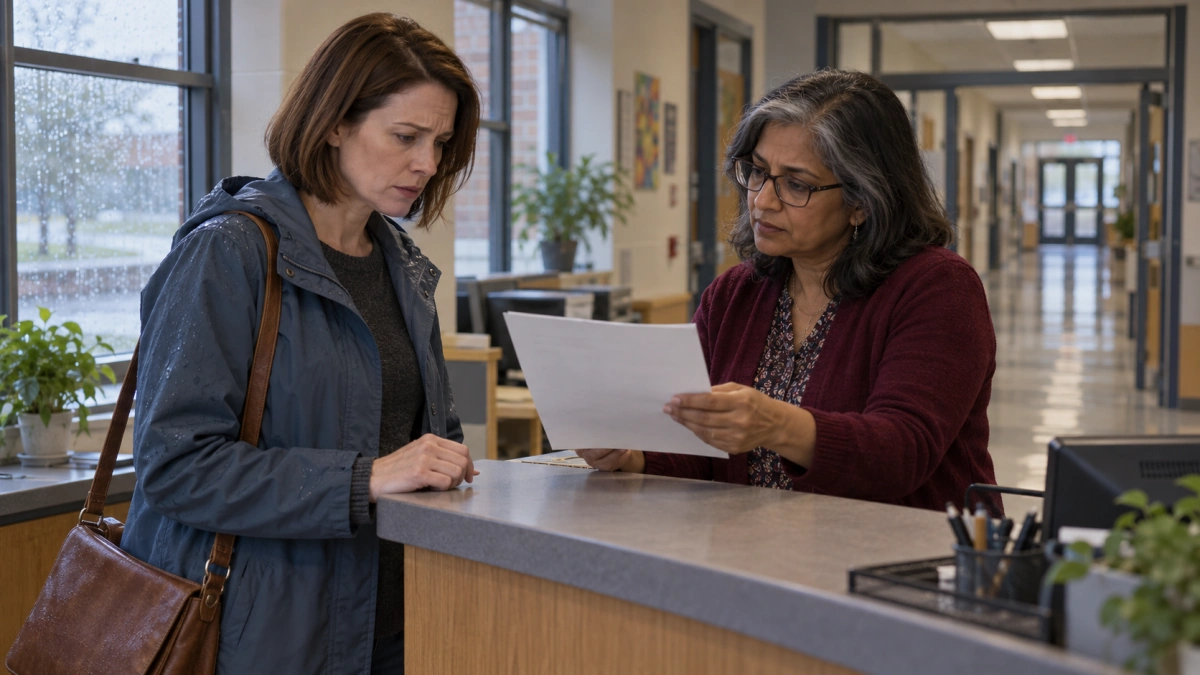
Claire Bennett read it twice while rain ran down the school office window. She had come to collect her eight-year-old for a dentist appointment, not discover a stranger on his emergency form.
"Who added her?"
Ms. Patel turned the paper so she could check the entry. "His father submitted the update. Let me look at the notes before we make assumptions."
"Has she picked him up?"
"No. Owen is with his teacher. You're the person collecting him today."
The administrator's calm helped Claire keep her own voice low. She loosened the strap of her brown shoulder bag and asked for a copy of the form. Beneath her slate-blue raincoat, her sweater felt suddenly too warm.
Daniel had mentioned no new girlfriend. Their divorce agreement had not made them experts at telling each other things, but they usually managed schedules, shoes, and school notices without surprises.
Claire called him from the empty stretch of counter.
"Who's Leah Mercer?"
For a moment she heard only the indicator clicking in his car.
"I meant to explain."
"Explain now."
"She won't pick Owen up without us talking. I told her that."
"Then why put her on the form?"
He stopped the indicator. Somewhere behind Claire, a copier started feeding paper.
"Because she asked if she could help sometime. Because I thought it would make things simpler."
"What things?"
His next answer arrived quietly enough that she had to press the phone closer.
"She's my daughter."
Claire looked at the unfamiliar name again. Daniel had been her husband for eleven years. Owen knew every cousin on his father's side, every dog the family had owned, every version of the story about the broken canoe.
He had never been told he had a sister.
Claire did not ask the next question while standing in a school office. She asked Daniel to stay available, thanked Ms. Patel, and requested that the unfamiliar contact not be used while the adults clarified the arrangement. The administrator explained that she would record the concern, speak to both parents, and follow the school's ordinary procedures. She did not promise Claire powers she might not have, or turn the counter into a courtroom. Today Owen would leave with his mother, as planned. Nothing about this revelation needed to change that.
In the car Owen asked why they had stopped at the office instead of the classroom door. Claire said there had been a form to check. It was true and not the whole truth, a distinction she would have to consider more carefully now. He wanted to know whether the dentist had the orange toothpaste. She promised to ask. Driving across Columbus, she concentrated on lights, lanes, and the familiar impatient rhythm of her son's sneakers against the seat.
After the appointment she took him to her mother, who had already agreed to watch him while Claire worked late. She did not supply a reason for arriving early. Her mother gave Owen apple slices and asked Claire whether she wanted coffee. Claire said not yet. She needed one conversation that did not begin with somebody trying to soften what was coming.
Daniel met her at a diner near the highway. He wore the tan jacket he always left in his car and had trimmed his beard unevenly. Those ordinary details offended her more than a guilty expression would have. A man could carry a whole concealed life and still worry about where to park.
"How old?" she asked.
"Twenty-four."
He had been nineteen when Leah was born, before Claire met him. Her mother, Marissa, had moved to western Pennsylvania when Leah was small. Daniel had visited, then visited less. He had sent money inconsistently in the early years and more reliably later. Claire did not ask for amounts. She was not there to audit his fatherhood into a number that could make it comprehensible.
"When we got serious," he said, "I didn't know how to tell you."
"Before the wedding would have been one opportunity."
He looked at the laminated menu. "I know."
"Before I had your child would have been another."
He nodded. She hated the nod because it looked like agreement without giving her anything to work with.
Leah had stopped replying to him at seventeen. There had been occasional birthday messages afterward, mostly unanswered. Three months ago she contacted him about some family medical history and whether he still had photographs of her grandmother. Daniel had answered the questions. They began exchanging messages. Last week she drove to Columbus for a training course through her employer and agreed to coffee.
"She works with adults who need support getting to appointments," he said. "She's responsible."
"I'm not asking for her résumé."
He flushed. "No. You're right."
At coffee, he had mentioned being late collecting Owen because a job ran over. Leah said she could help one day if he needed it. Daniel added her name to the school form that night. It had felt, he admitted, like making a place for her before she changed her mind.
Claire put both hands flat on the table. "You used our son's school to make a place in your family for a person you hadn't told us existed."
"I didn't mean it like that."
"You need to stop telling me what you meant long enough to hear what you did."
He drew a breath, then let it out. Outside, a truck reversed toward the diner's service door. Its warning beeps counted off the silence.
Claire asked whether Leah knew about her. He said yes, now. Whether Leah knew he had concealed her during the marriage. Another silence. Then he admitted he had said things were complicated, that he hadn't wanted to confuse Owen while the divorce was fresh.
Their divorce had been final for two years. They had separated three years ago. Leah had been an adult before either event. Daniel had chosen a version of time that made his delay sound temporary.
"Don't tell her I asked you to hide her."
"I didn't say that."
"But you left room for her to think it. Correct it."
Claire paid for her own untouched coffee. Before leaving, she asked him to confirm in writing that Leah would not be used as a pickup contact while they clarified the school record. He agreed. She would check with the school herself, not as punishment, but because trust had become something more demanding than accepting his relieved expression.
That evening Ms. Patel called while Owen built a cardboard bridge on the living room floor. Both parents had confirmed the temporary change. The school had recorded that Leah was not currently to be used for collection and would review any later update through its usual process. Claire thanked her for handling it without involving Owen. Ms. Patel said that keeping adult conversations away from children was often the most useful part of a busy day.
Claire watched her son test the bridge with a toy truck. He asked whether it would hold a bigger one. She said they could find out. She could not make every bridge in his life safe by testing it first. She could keep this one from becoming an experiment in his father's guilt.
At nine Daniel sent a message asking if they should tell Owen together that weekend. Claire stared at the word should. It made a fresh problem sound like a calendar item awaiting her organizational skills. She wrote back that they first needed to agree on what they would say, and that she would not surprise Leah with an introduction. Then she put the phone down before he could convert her answer into another plan.
She slept badly. The hurt was not jealousy, though she tried that explanation because it was familiar. Leah wasn't another woman replacing her. She was a child Daniel had grown older without acknowledging in the life Claire knew. Claire replayed their wedding photographs, the pregnancy announcement, his mother's funeral. At each event there had been a person absent from the frame for reasons Claire had never been allowed to understand.
At breakfast her mother asked what had happened. Claire waited until Owen was in the bathroom, then gave the shortest version she could manage. Her mother immediately said she had always known Daniel kept things to himself. Claire asked her not to turn this into proof that everyone had understood her marriage except her. Her mother stopped, visibly reconsidered, and apologized. Then she offered to collect Owen on Thursday if Claire needed time. A specific offer was easier to accept than a retrospective judgment. Claire said Thursday would help, and asked her to keep the news private for now.
During lunch Claire searched old messages for Leah's name and found nothing. She searched Mercer, then stopped. She could spend weeks reconstructing opportunities Daniel had avoided, mapping her ignorance as if a more complete map would give those years back. There would be questions she needed answered, especially about what Owen might hear from relatives. There were also questions that belonged to the marriage she had already left. She wrote the necessary ones on paper and closed the messages. Restraint didn't make her less angry. It kept anger from becoming the only work she could do.
The next morning she asked Daniel who else knew. His parents had known. His sister knew. A cousin probably knew. His father was dead, his mother dead, but his sister Beth was very much alive and had sat across from Claire at birthday dinners for years.
Claire called Beth after dropping Owen off. Beth cried before Claire finished the first sentence. She said Daniel had insisted the subject was private. She said Leah's mother didn't want the family involved. She said she regretted not pushing harder.
"Did Marissa tell you that herself?"
Beth admitted she had not. Daniel had been the source of nearly everything. Claire did not demand that Beth produce a complete history. She asked her not to contact Owen, arrange meetings, or send photographs until the parents had spoken to him. Beth agreed. Being sorry did not give anyone permission to arrive with a family album and a rescue mission.
Later that day Leah wrote to Claire. Daniel had given her Claire's email after Claire agreed that direct contact was welcome. The message was short. Leah apologized for the surprise and said she had not understood that offering help would place her on a school list. She had never planned to appear without an invitation. She did not ask to meet Owen.
Claire read the message three times, looking for a demand hidden inside its careful politeness. Then she became ashamed of looking. She had good reason to be cautious, but Leah was not responsible for every deception that made caution necessary.
She replied that the surprise was not Leah's fault. The school arrangement was paused. She would welcome a conversation between adults, without children or Daniel, if Leah wanted one. A coffee shop near Leah's training location might be convenient. She added that declining would not offend her. She reread that sentence until she was sure it meant what it said.
They met Friday afternoon. Leah had dark curly hair gathered in a low bun, a denim jacket over a rust sweater, and the habit of sitting where she could see the door. Claire noticed a resemblance to Daniel around her eyes, then reminded herself that a face was not evidence of a personality.
Leah ordered tea. Claire ordered coffee she intended to drink this time. For several minutes they discussed parking and the rain. Claire was relieved to find that neither woman knew how to begin. It meant there wasn't a script she had failed to learn.
"He told me you knew," Leah said eventually.
Claire set down her cup. "About you?"
"He said you knew he had an older daughter, but things were distant. I thought maybe you didn't want me around Owen yet."
Daniel had left more than room for a misunderstanding. He had furnished it.
Claire kept her voice level. "I found out your name on Tuesday. I didn't know about you before that. I never asked him to keep you away."
Leah looked toward the window. "Okay."
The word held no immediate relief. Claire understood why. One explanation had been removed; an uglier one stood behind it. Leah wrapped both hands around her cup and asked whether Claire wanted to know what Daniel had been like when she was growing up.
"Only what you want to tell me. I'm not asking you to help me prosecute him."
Leah smiled without amusement. "Good. I'm tired of proving things."
She described phone calls made from borrowed phones, a promised summer visit that became a weekend, the gradual discovery that not asking was easier than waiting. There had also been a bicycle he taught her to ride and a Saturday when he drove four hours to see her school play. She did not erase those memories to make the rest fit. She wanted a father who could admit both kinds of history.
Claire resisted telling her all the ways Daniel had disappointed her. A shared adversary could look like intimacy, but it would not necessarily be trust. She said she was sorry Leah had been given a false explanation about her. Leah nodded and said she was sorry Claire learned the truth in a school office. Neither apology tried to settle somebody else's debt.
Leah explained that the offer to help had been casual, made while Daniel complained about traffic. She hadn't offered to become a second parent or an emergency service. She worked changing shifts and was still figuring out whether she wanted regular contact with him. Seeing her name on a school record, even described in an email, had frightened her too. It made an invitation sound like an assignment. Claire said she understood the distinction. She had spent years hearing Daniel describe wishes in the future tense as if agreement had already happened. Leah gave a small, wary nod.
They agreed on how to contact each other. Email for ordinary messages, a phone call only if something truly urgent involved information both needed. Neither would carry messages between Daniel and the other. If either needed a break, she could say so without explaining her entire childhood or marriage. Claire almost laughed at how formal it sounded. Then she remembered that informality had brought them here with completely different versions of the same facts. A little awkward clarity seemed worth trying. Leah typed the number into her phone and asked Claire to check it before saving.
Before leaving, Leah asked one question about Owen. Did he like books? Claire said he liked books about bridges, weather, and animals that probably should not be kept as pets. Leah laughed. She had loved a library book about suspension bridges when she was little. Then she became serious again.
"I don't want to be a surprise he's required to be happy about."
Claire felt the first small loosening in her chest since Tuesday. "Neither do I."
That night she spoke to Daniel by phone, not at a handoff where Owen could hear. She told him exactly what Leah had said. He claimed he had meant Claire knew he had a past. Claire said a past wasn't a daughter, and vague language wasn't an accident when it repeatedly produced the conclusion he needed.
He began to cry. Once, that would have sent Claire searching for a softer way to finish. Now she waited. She could believe his distress without treating it as an instruction.
"What do you want me to do?" he asked.
"Correct what you told her. Decide what you're willing to do differently. Don't make me write your apology."
He asked whether she hated him. She said she wasn't available for that question tonight. They still had to discuss Owen's Saturday soccer game. She gave him the time, confirmed the cleats were in the blue bag, and ended the call. Co-parenting could continue without becoming absolution.
Before talking with Owen, they each consulted people they trusted and agreed to use simple truthful language, not a chronology of Daniel's failures. Claire did not claim there was a perfect way to deliver the news. They could choose a calm day, leave time for questions, and avoid attaching a meeting to the revelation.
Daniel came to Claire's house on Sunday afternoon. Owen sat between the dining table and his unfinished bridge, visibly concerned that this might be a conversation about his recent spelling test. Daniel said he had something important he should have shared sooner. Before marrying Owen's mother, he had become the father of a girl named Leah. She was grown now. That made her Owen's older sister.
"Like a real sister?"
"You have the same dad," Claire said. "You haven't met, and nobody expects you to feel a certain way right away."
Owen looked at Daniel. "Did she die?"
"No. She's alive. I wasn't part of her life the way I should have been. I didn't tell you about her. That was my mistake."
"Did Mom know?"
"Not until this week," Daniel said. His voice shook, but he did not look at Claire for help.
Owen wanted to know whether Leah had a bedroom at Daniel's house. Whether she knew his birthday. Whether she could be his sister if she had another mother. The questions arrived in no order that would have occurred to the adults. They answered what they knew and said when they didn't know. They did not promise that Leah would become a regular visitor.
Finally Owen asked if he could show her his bridge. Claire said he could choose to offer a photograph, but Leah could choose when to reply. Daniel nodded. The distinction mattered enough to say twice in different words: Owen did not have to perform being a brother, and Leah did not owe him an immediate answer.
After Daniel left, Owen asked whether his father might have another child nobody knew about. Claire felt the floor shift under a question she couldn't safely answer for someone else. She said she didn't know of anyone else, and she would ask Daniel directly. She would tell Owen what he said, not pretend she could see everything inside another person's life.
At bedtime Owen wanted the hallway light left on. Claire did it. No one named it a symptom or predicted how long it would last. A child could need more light after discovering the family was larger and less familiar than he'd thought.
The next day Owen asked whether he should tell his best friend. Claire said this was part of his family and he could talk about his feelings, but Leah's private history wasn't a story to trade at recess. He frowned at the difference. She tried again: saying he had an older sister was fine; guessing why she hadn't been around could hurt people and might not be true. He asked whether adults guessed too. Claire said they did, and adults also had to learn to stop. He considered that, then asked if his friend could see the bridge photograph.
Claire sent Daniel a brief account of the questions so he wouldn't answer a different version next weekend. He replied with thanks and an apology that began with how ashamed he had felt at nineteen. She read it without responding immediately. His shame could explain the first silence, perhaps, but not every later choice. When she did reply, she asked him to tell her what he would say if Owen asked again whether Claire had known. Daniel wrote the exact answer: she hadn't known, and that wasn't her fault. Claire saved it with the other practical messages.
Daniel confirmed there were no other children. Claire relayed the answer without adding a guarantee she could not own. Over the next week Owen asked three more questions, then seemed to forget for two days and remembered while eating cereal. Claire learned not to treat silence as proof the matter was finished.
Leah received a photograph of the bridge with a message Owen dictated: It holds six trucks if they are small. She replied two days later, apologizing for the delay because work had been busy. She admired the supports and sent a photograph of a pedestrian bridge near her apartment. No hearts, no instant sisterly nickname, no promise to love each other forever. Owen inspected the railings and asked Claire to print it.
In November Daniel proposed bringing Leah to Thanksgiving at Beth's. He described it as getting everyone together at last. Claire asked whether he had spoken to Leah. He had mentioned it. Had she said yes? Not exactly. Claire told him not to put Owen's excitement in an invitation as leverage. Daniel sounded tired of being corrected. She said he could stop needing the correction by asking before planning.
Leah declined the gathering herself. She told Claire afterward because she didn't want Owen thinking she had rejected him. Claire asked what she was comfortable having Owen told. Leah said the truth: she wasn't ready for a big family dinner, but she liked seeing his bridge. Claire used those words. Owen said big dinners were loud anyway, and asked whether there would be pie.
The holiday passed without a reunion photograph. Daniel went to Beth's for part of the day, Owen spent the afternoon with Claire, and Leah ate with a friend. Nothing healed through everybody being present in the same room. Nothing was ruined because they weren't.
Beth called afterward and asked Claire whether she should send Leah some photographs directly. Claire said she would need to ask Leah, not obtain permission from the woman who had once been married to her father. Beth seemed surprised, then admitted she was afraid of saying the wrong thing. Claire understood that fear now. She suggested starting with a truthful sentence and a choice Leah could decline. Later Beth reported that Leah wanted scanned copies, not a visit. Beth sent the scans. The family could recover a piece of its history without organizing an event around its own relief.
For Claire, the harder work was resisting the urge to announce every reasonable decision as evidence that she was handling this well. Some days she felt generous; other days she resented being asked to make room in a life she had only recently made manageable. She told those feelings to a friend, away from Owen and Leah. The friend listened without calling her either saintly or bitter. Then they talked about a leaking dishwasher and a deadline. Claire was grateful. Her ordinary life needed room too, and acknowledging that did not make Leah an intrusion.
In December a work emergency meant Daniel couldn't reach school by dismissal. He called Claire first. She was across town, unable to leave immediately, and felt the old surge of alarm when he mentioned Leah. Then he stopped himself.
"No. I haven't asked her. I know she isn't on the list now. I'll call Beth."
Beth was already an established contact, but they still confirmed she was available and told the office who was coming. Owen waited with staff until she arrived. Nobody improvised an authorization through a frightened child or a message passed between strangers. Claire left work late, grateful for an ordinary problem handled ordinarily.
Daniel apologized later for even suggesting Leah. Claire said thinking of her wasn't the problem. Treating her as available before she agreed would have been. He listened instead of claiming that was what he'd meant. It was a small exchange, and she did not send him praise for it. Some improvements needed to become routine before they could carry much weight.
Leah's contact with Daniel remained uneven. He sent a long apology that she read but did not immediately answer. She asked him for copies of photographs rather than stories about why he had missed things. He found the photographs, labeled the ones he could identify, and admitted which dates he didn't remember. Claire heard this from Leah, not because Daniel submitted progress reports. She was not supervising his relationship with his daughter.
Once Leah canceled coffee with him after he introduced her to a coworker as his girl, as though an affectionate phrase could skip twenty years of uncertainty. He apologized without demanding another appointment that week. They met again later. Claire did not know whether they would become close. She began to understand that leaving that question open was part of respecting Leah, not a failure to care.
In January Leah wrote that she would be in Columbus one Saturday and wondered if Owen still wanted to show her a bridge. Claire asked Owen privately. He said yes, then asked whether she would be sad if he got bored. Claire told him adults could manage their own feelings about a short visit. They agreed on the public library, forty-five minutes, with Claire staying. Daniel was not included in this first meeting. He disliked that, then accepted it without asking Owen to argue for him.
Before confirming the library visit, Claire asked Leah whether forty-five minutes sounded manageable. Leah suggested meeting near the return desk, somewhere easy to find without anyone scanning every face in a crowded room. She also asked that they not take photographs on this first day. Claire agreed and explained the plan to Owen.
He asked why. She said sometimes people wanted to remember an experience before deciding whether to share a picture of it. He accepted that more readily than she expected. Daniel received the same request, though he would not be there, so nobody could ask Owen afterward for a photograph he hadn't been allowed to take.
On Friday Daniel called Claire to say he had told Beth plainly that Claire never knew about Leah. He had also corrected the story with Leah herself. Claire thanked him for making the correction, not for being honest as though honesty were an unexpected gift. He said he understood the distinction. Perhaps he did. She no longer needed to decide immediately whether every better sentence proved a different man. There would be more sentences, and actions after them. She returned to packing Owen's lunch for the next day.
The night before, Owen packed three books and then unpacked two. He chose the photograph Leah sent, folded at the edges now, and asked Claire whether she would recognize his sister. Claire said yes. He asked if he had to hug her. No. Could he shake hands? If both wanted. Could he just say hello? That would be plenty.
After he went to sleep, Claire checked the library hours once more. Then she put her phone away. There was no extra preparation that could guarantee Owen and Leah would like each other. She could make the place predictable, keep the visit brief, and stay. Those were promises within her reach. The rest belonged partly to two people who hadn't yet met, and she would have to leave it there.
Leah arrived carrying no present. Claire had quietly appreciated that when they discussed plans: nothing to make affection look purchasable or to leave Owen owing a performance of delight. In the library entrance she crouched slightly, then seemed to reconsider making herself smaller and simply stood with her hands at her sides.
"Hi, Owen. I'm Leah."
"I know. You have the bridge."
"A picture of one."
He showed her the creased photograph. They went to the children's nonfiction shelves, where Claire sat close enough to hear and far enough away not to translate every silence. Leah asked Owen about his cardboard supports. He explained at length. When he asked about her work, she described helping people organize rides and appointments, not an impressive résumé offered in exchange for admission to his life.
After half an hour Owen wanted to find a book about tornadoes. Leah stayed with the bridge book and Claire while he searched the next aisle in sight. She looked tired, but not unhappy.
"Is this strange?" Claire asked.
"Very."
"We can finish early."
Leah shook her head. "Strange isn't the same as bad."
At forty-five minutes Claire said it was time to leave. She did not extend the visit because it was going well. Keeping a small promise about time seemed more valuable than proving they had achieved closeness. Owen asked Leah whether she could send another bridge photograph sometime. She said she could probably do that, and would tell him if she couldn't. He nodded, apparently satisfied with a promise that had edges.
Outside, the rain had stopped. Leah and Claire stood by the return slot while Owen zipped his coat. Leah said Daniel had asked whether she wanted to be considered for pickup again someday. She had told him not yet.
"You don't have to want it later either," Claire said.
"I know. I wanted him to know that too."
Owen returned to ask whether Leah knew how to make an arch bridge. She said she knew a little. He said he knew a little too. It was an unremarkable exchange, two people comparing the small part of the world they happened to share.
At the car Claire watched Leah walk toward the bus stop. She did not picture a repaired family arranged around a holiday table. She pictured the school form at home in its folder, corrected; her son's questions, still welcome; a woman free to choose another visit or not. Behind her, Owen opened his tornado book and asked if bridges could survive very strong wind.
She fastened her seat belt before answering. Across the street Leah raised one hand, not a promise or a request, simply goodbye. Owen waved through the window. Claire waved too. There would be messages to send later and questions neither could anticipate. For now, nobody needed to decide anything else.
"Some can," she said. "It depends how they're built."
Read next
The Key That No Longer Fit
Mom’s Moving Day

The Name on the Baby Bracelet
My Sister Gave Away Dad’s Workshop Before He Moved Out—Then His Apprentice Arrived with the Missing Order Book
Reading notes
An unfamiliar school pickup contact reveals a hidden family relationship and the need for honest boundaries.
This is an original work of fiction. Characters and events are fictional. Explore public-domain books at Project Gutenberg or browse more stories on ReadStoryvia.