Original fiction
On this page
The Garden Gate Was Open
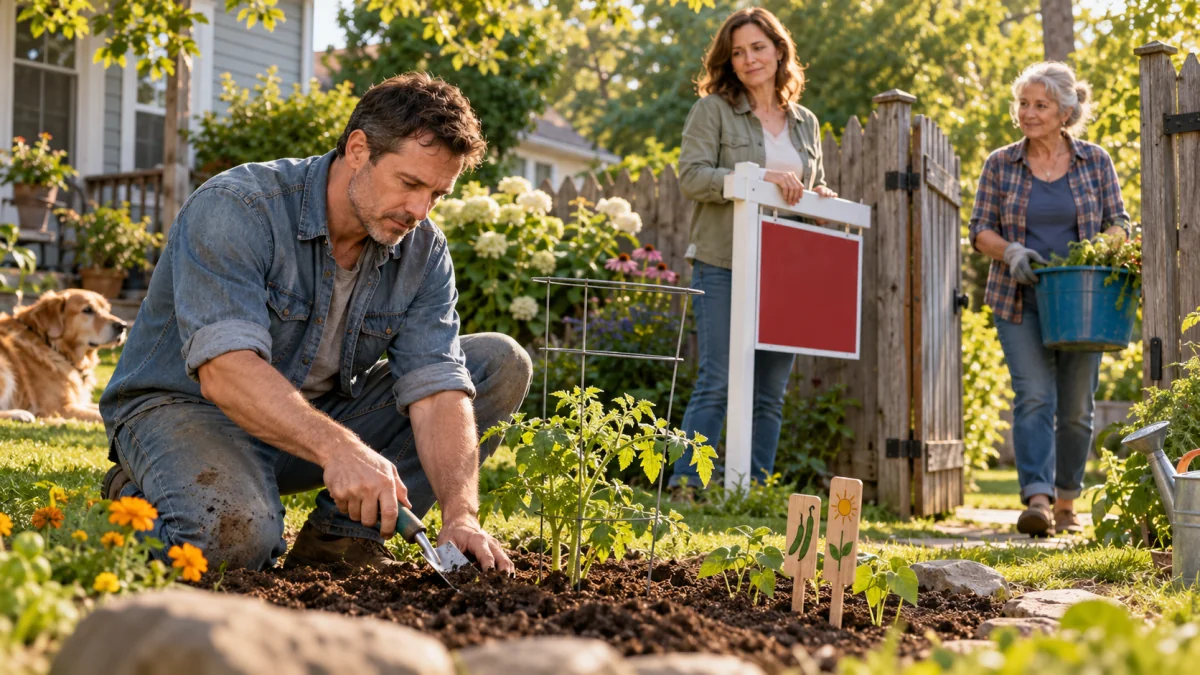
The woman holding the real estate sign asked Nathan Vale to move his tomatoes before she photographed the yard.
He had just lowered a seedling into the bed beside Ruth Bell's kitchen window. Dirt darkened the knees of his only decent jeans. Behind him, the garden gate stood open, exactly as Ruth had always left it.
“These aren't mine to move,” he said.
Claire Bell looked at the flat of plants by his feet. “But you're planting them.”
Ruth had been dead for nineteen days. Her daughter had driven down from Toledo with a borrowed trailer, three empty coffee cups, and the belief that clearing a house meant dealing with things inside it.
Nathan had moved into the upstairs apartment next door after his divorce. For most of last summer, Ruth's garden had been the only place where he could spend an evening without hearing his refrigerator switch on.
“She told me to keep it going,” he said.
Claire set the sign against the fence. “She told me she wanted less work.”
Before either could answer, Alma Ruiz appeared at the alley entrance carrying a blue bucket. She stopped when she saw the new tomato plants.
“That's where the marigolds go,” Alma said. “We put them there for Luis every June.”
Across the fence, a boy's voice called, “Did you move my beans?”
Nathan looked down. A row of little sticks lay beside his trowel. He had mistaken them for winter debris.
Claire shut her eyes for a moment. Then she opened the gate wider, not as an invitation but to make room for everyone who seemed to have a claim on her mother's backyard.
“Nobody plants anything else,” she said. “Not until somebody tells me what my mother promised.”
The boy came through the gate without waiting. Miles Carter was eleven, narrow as a rake handle, with one shoe tied and the other flapping. He crouched beside Nathan's trowel and gathered the sticks into both hands.
“I wrote on them,” he said.
Nathan could see the faded pencil now. BEAN. BEAN. One said TALLEST, in capitals pressed deep enough to split the wood.
“I'm sorry. I thought they were old markers.”
“They were markers.”
Miles's mother, Tessa, followed him carrying a laundry basket against her hip. She worked the evening shift at a rehabilitation center and had the pale, stretched expression Nathan recognized from his own bathroom mirror.
“We can come back,” she said.
Claire pointed at the bucket, the basket, the plants. “Apparently everybody already has.”
It came out sharper than she intended. Nathan saw her glance toward the kitchen window, as though Ruth might appear and tell her to watch her tone. The window reflected clouds instead.
Alma set down her bucket. Inside were small orange marigolds, their leaves trembling from the walk. Her husband had died four years earlier. Nathan knew that much. He had not known this narrow strip of soil had anything to do with him.
“Ruth said there would always be a place,” Alma said.
“A place for what?” Claire asked.
“For the flowers. For me to sit. We didn't make a contract.”
“Neither did we,” Nathan said, too quickly.
Claire looked at him. “Then please stop answering like somebody handed you one.”
He stood, brushing his knees. A divorce mediator had once asked him to stop describing his marriage as if it were a property dispute. He had disliked her for being right. Now he disliked Claire for a similar reason.
They moved to the cracked patio because everyone needed somewhere to put their hands. Nathan brought out folding chairs from Ruth's shed, then stopped with the third one halfway unfolded.
“Can I?” he asked Claire.
She nodded. The small permission embarrassed him more than a lecture would have.
Claire explained that the house would be listed in June. She could afford the insurance and utilities for a little while, not indefinitely. Her job scheduling deliveries for a furniture warehouse was in Toledo. So was her daughter. She had already used her paid leave during Ruth's final hospital stay.
“I can't keep driving three hours to cut grass,” she said. “And I can't be the person everybody calls when the hose breaks.”
Nobody suggested she could. Nobody looked pleased, either.
Nathan described Ruth finding him on his apartment steps the previous May, eating crackers over the package. She had handed him a watering can and said the tomatoes needed somebody dependable. He had come back the next evening, then the next. In February, while they sorted seed packets at her kitchen table, she had told him, “If I can't do it this year, you keep it going.”
“I understood that to mean the garden,” he finished.
“It probably did,” Claire said. “That doesn't tell me for how long.”
Alma's promise was older. After Luis's funeral, Ruth had brought her here because people were still arriving at Alma's house with casseroles and questions. They had planted marigolds along the warm brick wall. Each year afterward, Alma bought the flowers and Ruth saved the space.
Tessa looked at Miles before speaking. In August, Ruth had offered him a bean row for a school growing project. The project had ended in October. Miles kept coming because Ruth let him talk about things other adults interrupted.
“She said the row would be waiting in spring,” he said. “She said I could try the purple ones.”
Claire stared at the empty chair beside the door. “She told me she was finished with beans.”
For the first time, Nathan heard the difference between contradiction and the way Ruth had spoken to separate people on separate afternoons. A tired woman could be finished with beans and still promise a boy a row. A lonely woman could offer the same garden as company, work, remembrance, and a reason to get through Thursday.
The offers fitted together while she was there. Without her, they had edges.
Claire went inside for water and returned with five mismatched glasses. Nathan recognized the tall green one Ruth had always given him. Claire took it herself. He noticed his own disappointment and felt ashamed of it. Even a glass could become a little territory if he let himself think that way.
“Did she talk about moving?” Claire asked.
Alma said Ruth had mentioned a smaller place once. Tessa remembered a brochure for apartments beside the grocery store. Nathan remembered Ruth dismissing the brochure as something Claire worried about.
“I worried because she fell,” Claire said. “Twice. Not because I wanted her furniture.”
Nobody had accused her of wanting it. Still, Nathan could hear how often she had answered an accusation nobody quite spoke. He wondered what Ruth had said to her about the three of them. Perhaps they had been a comfort. Perhaps, on a bad day, they had been more people wanting something.
“I'll give you until Sunday to tell me what needs moving,” Claire said. “Nothing permanent leaves without asking. Not the bench, not the tools, not that birdbath.”
Alma lifted her chin. “I gave her the birdbath.”
“And I don't know that,” Claire replied. “That's the problem.”
Miles walked out carrying his sticks. Tessa followed. Alma took her flowers home. Nathan stayed to lift the tomatoes he had planted, easing their roots back into their little plastic cells.
“You don't have to do that right now,” Claire said.
“I shouldn't have started.”
She watched him for a moment. “Those can stay while we figure it out. That isn't permission for next year.”
He put the last tomato back in the flat anyway.
Upstairs that evening, Nathan placed the plants in his bathtub. His apartment had two north windows and a lease that prohibited containers on the fire escape. His former wife, Natalie, had kept their little house. He had agreed because their son Owen knew every floorboard, and because agreeing had seemed easier than admitting he wanted something too.
Now he had eighteen tomato plants and nowhere that belonged to him.
Owen called during dinner. At fifteen, he had developed a courteous voice that made Nathan feel like an appointment.
“Mom says you can get your grill Saturday.”
“I don't have anywhere to put it.”
“Okay.”
Through the phone came the clink of plates. Nathan pictured the old kitchen and the back door with its stubborn latch. He almost told Owen about Claire. He almost described being thrown out of the garden, although nobody had thrown him out.
Instead he asked about algebra. Owen said it was fine. Their call lasted four minutes.
On Saturday, Nathan arrived at his former house with a borrowed handcart. Natalie had cleaned the grill and taped the loose knob in a sandwich bag.
“You could sell it,” she said.
“I understand.”
“I wasn't making a point.”
He believed her, which made his defensiveness more tiring. Owen stood inside the screen door, watching them negotiate an object that had once required no discussion at all.
Nathan asked if he wanted to help at Ruth's garden. Owen shrugged. “Are you allowed?”
The question was innocent. Nathan heard the question underneath it anyway: did his father have a place to bring him, or only places other people let him stand?
“For now,” Nathan said.
Owen came. They worked quietly until Miles arrived with a packet of purple beans. Nathan began clearing the strip beside the fence, then caught himself.
“Let's ask Claire first.”
She was inside sorting towels. When Nathan knocked, she appeared holding a faded yellow washcloth against her mouth. She lowered it immediately.
“What?”
He asked about the beans. She looked toward the garden, then back at the washcloth.
“I need an hour where nobody needs a decision.”
“We can wait.”
They did. Owen sat on the patio step and showed Miles how to repair a split marker with tape. Nathan filled watering cans. From inside came the irregular sound of drawers closing.
When Claire returned, she said the beans could go into pots, not the ground. Anything planted now had to be something they could take away.
Miles objected that beans disliked having their roots disturbed.
“Then use pots big enough to stay in,” Claire said.
“We don't have those.”
She held out her hands, empty. “I don't either.”
That evening Nathan called the city recreation office. The community garden nearest his apartment had a waiting list. The next one had an opening but no water connection; gardeners brought containers from home. A third required residents to live in a different district. He wrote the information on the back of an electric bill, then put down his pen. None of it became a solution because he had written it neatly.
Alma knocked the next morning with coffee in a thermos. He met her downstairs.
“We could ask Claire to leave the garden until fall,” she said.
“She might need to sell before then.”
“A buyer could understand.”
“Or not want us in their yard.”
Alma turned the thermos lid between her palms. “You're very reasonable now.”
He felt the rebuke. Three days earlier he had sounded like the garden's appointed caretaker. Now that his own plants were in danger, she thought he had surrendered everybody else's memories to save himself embarrassment.
“I don't know how to ask her for that,” he admitted.
“Then I'll ask.”
She did, that afternoon, while Claire was stacking dishes in newspaper. Nathan heard the conversation through the open kitchen door. Alma offered to weed, mow, even pay a little toward water. Claire listened until Alma mentioned Luis's ashes.
“His ashes?”
“Only a spoonful. Ruth said it was all right.”
Claire set down a plate so carefully that Nathan understood she wanted to throw it.
“My mother let you bury somebody in the yard and didn't tell me?”
“It wasn't a burial.”
“Then what am I supposed to call it?”
Nathan stepped away from the door. There were conversations he had no right to help himself to, even when a garden lay on the other side.
Later Alma found him by the shed. Her face had gone gray with humiliation.
“I shouldn't have said it that way,” she said. “It was almost nothing. The wind took half.”
He resisted saying that this made it better. “Where?”
She pointed near the wall. The tomatoes he had planted had stood directly in front of it.
He understood her expression on the first morning then. Not simply annoyance about flowers. He had been cheerful with a trowel in a place she approached as carefully as a grave.
“You didn't know,” she said, before he could apologize.
Neither of them knew what to do with that mercy.
On Sunday they gathered again. Claire brought no paperwork, only a calendar from the refrigerator. Ruth had written dentist appointments beside little sketches of onions. The house would be photographed the following Friday. They could meet Wednesday evening to decide what was leaving and what would remain.
“I'm not asking anybody to forget her,” Claire said. “I'm asking you to stop making me prove I loved her by keeping her house.”
Tessa rubbed the worn seam of her work pants. “I don't think anybody means that.”
“I know. It still feels like the test.”
Nathan asked whether the wooden planter boxes counted as fixtures. Claire said two were rotted through and the third could go if they carried it rather than dragging it across the lawn. The bench would stay. It had been her father's. Alma could have the birdbath if she could arrange transport.
“I remember now,” Claire told her. “The blue ribbon around it. Christmas.”
Alma nodded without smiling. Recognition did not undo the afternoon before. It did make room for the next one.
Miles asked about Ruth's watering can. Claire said she wanted that herself.
He looked wounded. She did not offer a substitute immediately. Nathan was grateful. Children could survive discovering that someone else's grief had a shape, too.
Afterward, Tessa stayed behind with him. She said the rehabilitation center had an unused concrete rectangle behind the staff break room. It had once held a smoking shelter. Smoking was no longer allowed on the grounds, but the pad remained, fenced from the parking lot and close to an outdoor faucet.
“Could we put containers there?” Nathan asked.
“I can ask. Don't buy anything.”
She stressed the last sentence. He deserved it.
On Monday, the center's facilities manager said no. Ambulances needed the adjoining lane, and loose pots could become obstacles. Tessa took Nathan to look after her shift. They stood outside the fence in the white spill of a security light. The concrete space itself was clear of the lane. A gate opened inward. There was room, but room was not permission.
“We can propose something smaller,” Tessa said. “They said no to pots everywhere. We haven't shown them where.”
Nathan wanted to measure immediately. Instead he asked whether she had time.
“Ten minutes. Then I need sleep.”
They measured with his tape. Four planting tubs could stand along the inner fence, leaving the gate, faucet, and access path unobstructed. They would need water trays removed because standing water attracted mosquitoes. Nothing could lean on the fence. The staff would not become gardeners by accident.
Tessa repeated that last point when they met the manager Tuesday. Her name was Bev Shaw. She had spent twelve years finding abandoned bicycles, unwanted furniture, and good intentions behind the building.
“Who takes everything away when enthusiasm wears off?” Bev asked.
“I do,” Nathan said.
Tessa shook her head. “We do. With dates and phone numbers. Not just Nathan.”
It was not a stirring speech. It was better than one. Bev said she could approve a trial through September if the administrator agreed, if they used stable containers, and if nobody treated the space as a public park. Garden visits would be during posted hours. Residents could visit only with staff arrangements, not because Nathan thought fresh air would be nice.
“And there will be weeks when this place has bigger problems than your beans,” Bev said.
“We understand,” Tessa answered.
Nathan thought they probably did not yet. He said they would follow the rules anyway.
The trial was approved the next afternoon. There was no grant and no ceremonial key. There was an email, a list of conditions, and permission to use the faucet without entering the building. They had to supply everything else.
Alma refused at first. “A parking lot isn't Ruth's garden.”
“No,” Nathan said. “It isn't.”
He did not tell her it could be just as good. It would be hotter, uglier, and closed at eight. Luis had never sat there. Ruth had never handed anyone a peach over that fence.
Alma looked relieved that he understood the loss, then angry that understanding did not restore it.
Miles wanted to know whether purple beans could grow in twenty gallon tubs. Nathan said yes, with drainage and supports, though they would need regular water. Owen offered to help drill holes. Tessa said she could cover mornings after her shift twice a week, not every day. Nathan took evenings. Miles needed an adult with him. Alma made no commitment.
They priced containers at the hardware store and left without buying them. New tubs and soil cost more than Nathan had expected. His checking balance had not become generous simply because a project was worthy.
Owen suggested selling the grill.
Nathan felt a small, ridiculous resistance. It was a good grill. He had cooked birthdays on it. Then he pictured it rusting on a friend's porch while he defended what it used to mean.
“Help me take decent pictures,” he said.
They sold it for ninety dollars to a young couple who arrived with the wrong size car. Nathan helped them remove the legs. Natalie passed out the missing knob and said nothing about the money. That restraint felt like a gift neither of them needed to name.
Tessa found used food grade tubs through the center's kitchen supplier, with the manager's permission. They had held pickles and still smelled faintly sour after washing. Two cost nothing; two cost ten dollars each. They bought plain potting mix, not the decorative bags stacked by the entrance. Miles counted the change on the hood of Tessa's car.
Nathan wanted six tubs once he saw the low price. Tessa reminded him they had permission for four.
“Right,” he said.
Owen glanced at him, then looked away. It mattered that Nathan had said it without an argument.
Wednesday arrived cold enough for jackets. Claire had placed a few things on the patio: twine, empty pots, a cracked kneeling pad. Not gifts from the dead, not compensation, just things she had chosen not to keep.
“Take what you'll use,” she said.
Nathan chose the twine. Miles chose three pots and asked before taking a fourth. Alma came empty handed and stood by the brick wall.
“I'm not going to dig,” she told Claire.
Claire nodded. “I wasn't asking you to.”
“I know. I wanted to say it.”
They stood quietly. Alma touched the wall with her fingertips, not the soil. She said Luis had hated marigolds until he discovered they were the only flowers she could keep alive during a heat wave. After that he bought them every year and pretended they were his favorite.
Claire laughed once. It broke into a cough. “Mom told me he had excellent taste.”
“Your mother told everybody something useful.”
“Sometimes,” Claire said, “she told everybody yes.”
Alma did not defend Ruth. Nathan thought that might be the hardest kindness of the day.
Inside the shed, he and Owen emptied the planter box. Its bottom crumbled as they lifted it. Keeping it would mean rebuilding most of it and transporting wet, heavy soil. Nathan set it down.
“We can leave it,” he said.
Owen asked if he was sure.
“I'm sure I don't want to make every broken thing into something I have to save.”
His son nodded, considering more than the planter. They carried the rotten boards to the collection pile Claire had marked beside the driveway.
Miles brought his bean markers to the new tubs on Friday. They had painted no slogans on the containers. Owen had written watering dates on a clipboard that stayed in a weatherproof pouch. It was practical, and unromantic, and nobody expected it to prove who deserved to be there.
Nathan let Miles choose the bean tub. Two tomatoes went into another. A third held salad greens. The fourth waited. They had agreed not to fill every inch before the missing person had decided whether to come.
Alma arrived Sunday morning carrying six marigolds and a bag of rolls. She surveyed the concrete, the parked delivery van, the exhaust vent humming above the break room door.
“Terrible view,” she said.
“Yes,” Nathan answered.
She put her flowers beside the empty tub. “The sun is good.”
They planted in silence. She placed no ashes in the soil. When Miles asked whether the flowers were for Luis, she said they were also for her. It sounded like a discovery she did not entirely welcome.
After lunch they walked the nine blocks back through their Dayton, Ohio, neighborhood. Nathan carried the empty plant trays. Alma walked slowly at the crossings, and Miles kept doubling back to tell them something he had forgotten. Tessa had gone home to sleep. Owen walked beside his father without looking at his phone.
At Ruth's corner, Alma stopped. The familiar gate was shut for the photographs. For years she had turned in without ringing, and her feet seemed to have expected the turn before she did.
“I don't like that I need to call now,” she said.
“Neither do I,” Nathan admitted.
Owen waited a few steps ahead. Nathan thought of all the Saturdays he had arrived at his former house early and been surprised that Natalie wasn't ready to let him in. He had called it being flexible. Perhaps it had felt different on the other side of the door.
“Do you think she wanted us to fight?” Miles asked.
“No,” Alma said. “I think she liked not having to disappoint anybody while they were sitting with her.”
“That sounds nice.”
“It can be,” Nathan said. “Until the answer has to be something other than yes.”
He expected Alma to object, but she only shifted her bag of leftover rolls. They continued to the crossing. When they reached his building, Owen asked whether he could leave an old sweatshirt there for working in the garden. Nathan said yes, then specified the bottom drawer, because a drawer was something he actually could give. Upstairs, his son folded the sweatshirt himself and put it away. The drawer still looked mostly empty. Nathan closed it gently, leaving room instead of trying to fill everything immediately.
By June, the garden was inconvenient in ordinary ways. The hose connection leaked. One tomato developed blossom end rot. Tessa missed a morning after a double shift, and Nathan found the greens limp in the afternoon heat. He started to send a sharp message, then watered first.
At their next meeting they changed the schedule. Owen could cover Saturdays if Nathan picked him up. Alma wanted Tuesdays but not if a medical appointment ran late. They agreed that anybody unable to come would call by noon. The point was keeping plants alive, not proving devotion through exhaustion.
Ruth's house went under contract in late June. Claire told Nathan herself while he helped carry a box to her trailer. The buyer was a school bus driver with two dogs. She wanted the fenced yard. She might keep the brick border, or she might not.
Nathan felt the old impulse to explain the garden before this stranger could misunderstand what she was getting. Instead he asked Claire whether she needed help with anything else.
“The dresser upstairs,” she said. “If your back is good.”
It wasn't especially good. He said so. They took out the drawers and moved it in pieces.
At the trailer, Claire handed him a paper envelope. He felt himself stiffen.
“Photographs,” she said. “Copies. Nothing you need to sign.”
One showed Ruth beneath the bean supports, holding a cucumber like a microphone. Another showed the garden in February, empty and muddy. On the back Claire had written the year.
“I used to hate that she sent me pictures of dirt,” she said. “I wanted pictures of her.”
“She was usually on the other side of the camera.”
“I know that now.”
He did not tell her now was enough. Sometimes it wasn't. He put the envelope carefully in his jacket.
In July, Owen asked to come over on a Wednesday. There was no birthday, pickup obligation, or garden emergency. He wanted to cook pasta and see whether Nathan's secondhand fan actually sounded like a helicopter.
Nathan bought too much food. Owen noticed and ate two helpings without making fun of him. Afterward they walked to the center with a container of leftover pasta for Tessa's break.
Alma was already there, arguing with Miles about when a bean was ready. Miles wanted to leave the longest one because it might become a record. Alma wanted dinner. They compromised on harvesting the others and measuring the champion every Sunday.
Through the break room window, Tessa raised her fork in thanks. She did not come out. Work remained work, even when friends were nearby.
Nathan watched Owen tie a loose support to the fence, then stop and untie it.
“No leaning on the fence,” his son said.
They fixed the support inside the tub instead.
Later that summer, a storm warning brought Nathan out with his raincoat over pajamas. The wind had already bent the bean supports when he reached the center. He wanted to carry the tubs under the delivery awning, but the awning covered the emergency lane. He called Bev instead of deciding the weather made him an exception.
She answered from home, listened, and said the tubs could stay against the inner wall if the gate remained clear. Nathan photographed the placement for her, then put his phone away. The picture was a practical message to the person responsible for the building, not proof of his goodness.
Owen arrived ten minutes later. Natalie had driven him over because he had seen the forecast and worried about the beans.
“You didn't have to come,” Nathan said.
“I know.”
They worked in the slanting rain, lowering the supports together. One snapped. Miles would be upset. They could not prevent every disappointment simply by getting wet enough.
Natalie waited beside her car, holding a flashlight. When Nathan thanked her, she said Owen had wanted to help. He understood she was giving their son the credit and leaving their old marriage outside the fence.
The next afternoon, Miles cried over the broken bean stem. Nathan almost pointed out that three others had survived. Instead he sat on the concrete beside him until Miles asked for the twine.
They tied the damaged stem loosely to a short stake. It never recovered. A week later Miles cut it off himself and put it in the yard waste bag. He saved the largest dry pod in his pocket, separate from the beans they planned to eat.
Alma watched him do it. “You can keep something without keeping all of it,” she said.
Nathan did not know whether she meant the plant, Luis, or Ruth's yard. He let the sentence belong to her.
In August, Claire stopped by on her way back to Toledo. She had asked Tessa about visiting hours first. Her daughter, Beth, stayed in the car finishing a library book until Claire invited her out. They brought neither presents nor news about the buyer, just themselves.
Alma offered Claire a marigold bloom to take home. Claire shook her head, then reconsidered.
“Could I take a picture instead?”
Alma moved aside. Claire photographed the flowers, the pickle tubs, and finally all of them standing awkwardly together. Nathan asked her to get in the next picture. Beth took it, warning them that she was not waiting for everybody to look dignified.
For a moment Claire laughed with her whole face. Then she wiped her eyes. Nobody asked which feeling had come first.
September brought a meeting with Bev. Nathan had expected approval for another season, because the concrete was clean and the plants had grown. Bev said the administrator was considering a storage enclosure for medical equipment. They could finish the harvest, but next year's permission would not be decided until February.
For a moment, he felt the familiar anger of someone being asked to start over. Then he remembered four pickle tubs. They were not roots reaching under another person's house. They were movable by design.
“We'll empty and store them by the deadline,” he said. “Can we ask again in February?”
“Yes,” Bev said. “Ask. Don't assume.”
He repeated that to the others. Alma sighed, Tessa marked the date, and Miles asked whether his beans could dry for seeds before they moved. There were still practical things to learn, even from an uncertain season.
They took the supports down on a bright October afternoon. The last tomato was small and cracked. Owen cut it into pieces with his pocketknife, and they each ate one, except Miles, who said tomatoes still tasted like wet grass. Nobody made him grateful.
Nathan stored two cleaned tubs in his friend's garage. Alma kept one beside her back steps with permission from her landlord. Tessa arranged winter storage for the fourth at the center, away from the equipment route. Nothing was abandoned for somebody else to solve.
On his way home, Nathan passed Ruth's old house. The gate stood open. A dog lay across the path, watching the street. Beyond it, the brick border had become a strip of grass.
He stopped long enough to feel the loss without inventing an injury. Then he continued toward his apartment, where Owen was waiting with groceries and the windows were open to the cool evening.
Read next
The Bags on the Porch
One More Stop Before Home
The Obituary with My Phone Number
The Landlord’s Son Told My Neighbor to Leave Her Shop by Friday—Then She Handed Me a Receipt Older Than He Was
Reading notes
After a garden’s owner dies, her daughter discovers that the open gate carried promises she never knew about.
This is an original work of fiction. Characters and events are fictional. Explore public-domain books at Project Gutenberg or browse more stories on ReadStoryvia.