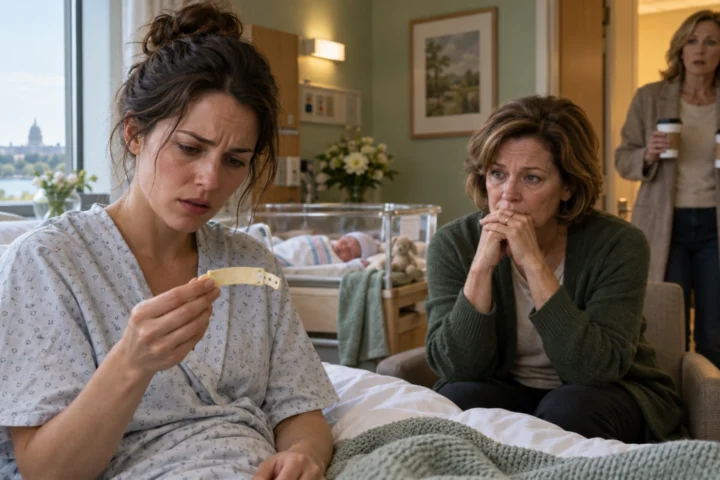
My mother brought the old hospital bracelet while I was learning how to hold my newborn daughter.
“It would look lovely beside her photograph,” she said. “Yours from when you were born.”
I held it beneath the light. The plastic had yellowed, but the date and birth weight were legible. The mother's name wasn't my mother's.
It was Aunt Carol's.
Mom reached for it. I kept it in my palm, safely beyond my daughter's tiny fingers.
“Why is her name here?”
In the hallway, Carol had just arrived with two coffees. She stopped at the question. A lid came loose, spilling coffee across her hand. She didn't look down.
My husband stood and settled our daughter in the bassinet. Nobody spoke while he fetched a towel.
“The hospital made a mistake,” Mom said.
Carol looked at her. “Don't do this again, Helen.”
I remembered birthdays when Carol left before the family photographs. Mom said she didn't like children, although she was the only person who remembered I needed a night-light in an unfamiliar room.
“Do what again?” I asked.
Mom sat, hands folded over her purse like someone in another waiting room years earlier.
“You've just had a baby. We'll talk when you're stronger.”
I looked at my sleeping daughter. All morning, people asked permission to hold her, open the blinds, or call the nurse. Only a question about my own life was being answered with later.
I put the bracelet on the table.
“I'm asking now. Who gave birth to me?”
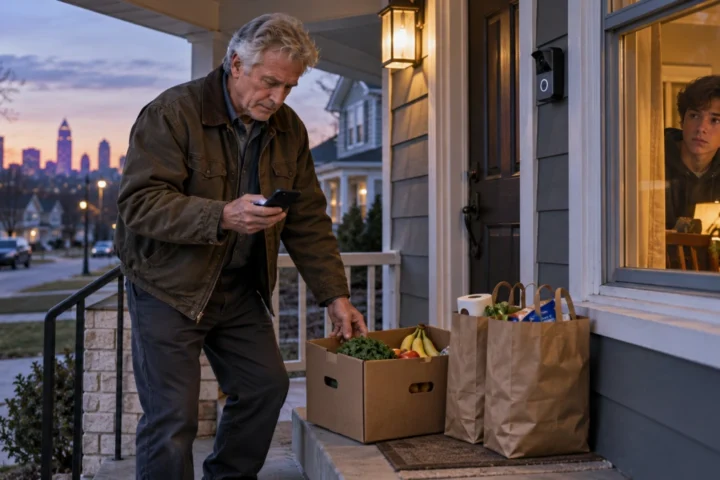
My grandson turned his phone toward me before taking off his coat.
In the video, I was lifting two grocery bags from Mrs. Walsh's porch. The caption read: This man has been stealing from our neighbors for months.
“You told me you were helping people,” Owen said.
I set down my tool bag. Cleveland was turning dark outside our small house. I'd repaired two washing machines that day. Nothing had made my hands feel as heavy as the phone he was offering.
“I was helping.”
“Then why does Megan say not to let you near anybody's house?”
The clip lasted fourteen seconds. It didn't show me delivering those bags to the house at the end of the street. It didn't include Mrs. Walsh's message from seven that morning, or the schedule explaining who was collecting what.
It also didn't show me setting down a new box before lifting the bags.
I called Mrs. Walsh. Voicemail. She was in the hospital, and her daughter had asked us not to call unless it was important.
Owen needed an answer he could take to school tomorrow.
I opened my old messages. There were names, addresses, and things neighbors had told us privately when asking for help. I closed the screen before he could read them.
“I'll prove what I did,” I said. “But I can't use somebody else's private life to do it.”
Then my phone vibrated. The woman who posted the video had just shared my home address in the neighborhood group.
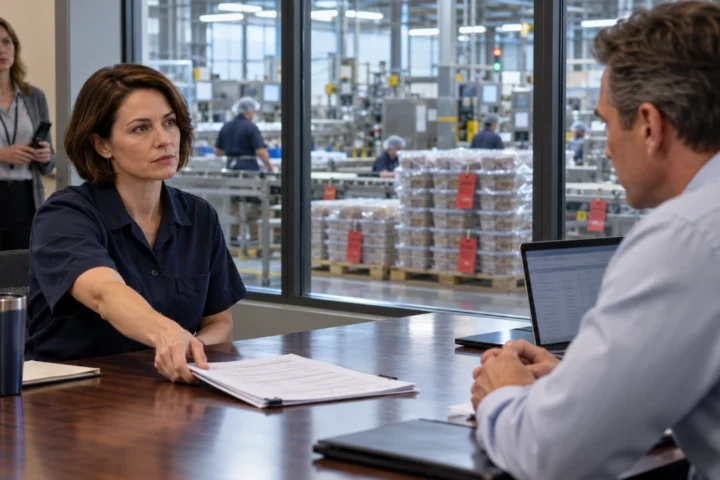
The plant director put the admission form on the table before I could sit down.
“Sign it. We'll call it a resignation instead of a termination.”
Through the glass, I could see my name on a locker in the packaging plant. After eleven years, that name had never appeared on an office door. Today it appeared beneath a sentence I hadn't written: I authorized shipment despite incomplete test results.
I pushed the paper back.
“I put that lot on hold.”
Mark Delaney, the operations manager, opened his laptop. The lot status read RELEASED. My employee number appeared beside it.
“The system says otherwise.”
Three days earlier, I'd attached red hold labels to eight pallets of food trays after seal testing failed. Mark said the equipment was wrong. I requested a retest. He said the truck was waiting and our customer wasn't paying us to argue.
Now the customer was returning the shipment. The company wanted me to carry the blame through the gate.
I checked the release time: 6:42 p.m.
“I was at the hospital with my daughter.”
My daughter had finally stopped wheezing when somebody at work used my employee number.
Mark folded his arms. “Anybody can tell a story.”
The door opened. Denise from human resources came in carrying the cordless handset from my workstation.
“The customer is waiting,” she said. “They want the person who sent Monday's hold notice.”
I looked at the director.
“Before you tell me what I authorized, you should read what I sent.”
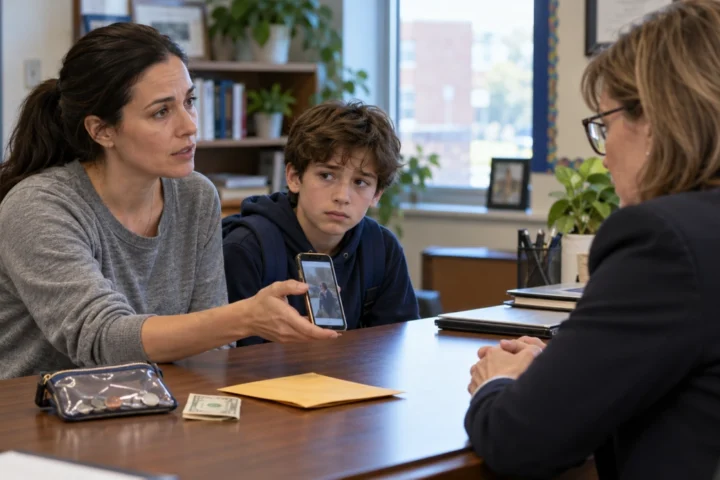
The principal put a bag of coins on the desk beside my son's backpack.
“We need you to explain why fundraiser money was in Noah's things.”
I had clocked out of the packing warehouse at six that morning. There were still adhesive marks on my wrist. Noah sat beside the window with his coat on, watching me as if my arrival could turn this into a small misunderstanding.
The bag contained a twenty-dollar bill and loose change. I'd given him exactly that much for snacks at the school fair the night before.
“That's my money,” I said.
Vanessa Cole, the parent association's treasurer, pushed a handwritten total toward me.
“We're missing four hundred eighty dollars. Your son was the last student beside the cash table.”
Three days earlier, that same woman had watched me count coins to pay for Noah's field trip.
“Next time, you could exchange those first,” she'd said with a smile. “We're all busy.”
I hadn't argued. I didn't want Noah remembering his trip as the time his mother fought at school.
Now he gripped his backpack strap.
“I only helped carry her box of cookies,” he said. “She gave me an envelope.”
Vanessa shook her head immediately. “You're confused.”
I opened my photos and found the picture Noah had sent after the fair. In one corner, a yellow envelope rested beneath a cookie box. Two handwritten words were visible: BUS MONEY.
I turned the phone toward the principal.
“Before you ask what my son took, we need to know what an adult handed him.”
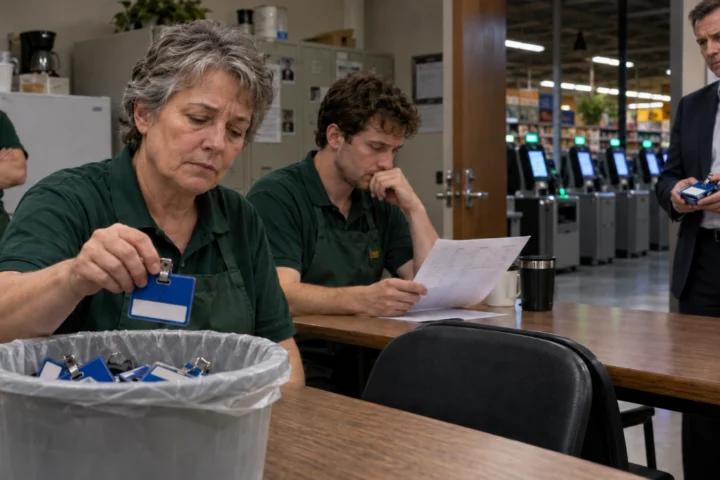
I found my name tag in the trash just before the “new technology training.” The blue plastic still had a scratch through the E in EVELYN. Beneath it were Paula’s, Dev’s, and nearly every other cashier’s badge.
The night before, Mr. Price, the regional manager for Bellwood Grocery, had emailed us to say everyone would have a job after the self checkout lanes were installed. The store was closed for three hours of training this morning. I thought the old badges had been thrown away because we were getting new uniforms. Then I saw next month’s staffing plan on the printer: six self checkout host positions, two at the service desk, and no cashier line for the eighteen people working those jobs now.
I had scanned groceries at Bellwood for nineteen years. I knew Mrs. Chen wanted her eggs placed at the end of the belt and Mr. Harris checked every receipt before leaving. But this month, what I most needed to know was whether I would still work enough hours to keep our insurance. Price’s email gave no hours. The staffing plan had no names.
Dev, who had joined us two years earlier, looked over my shoulder. He was better with computers than I was and hoped for a host position. “If there are only six,” he asked, “what are they training all of us for?”
I folded the page, planning to ask our store manager. The break room door swung open. Price walked in carrying new badges printed with just two words: SERVICE HOST. He looked at the old tag in my hand, then at the staffing plan.
“Where did you get that?” he asked.
I could have told him I had found it in the trash. But Paula stood just behind him, holding her husband’s medication bag and appointment calendar. I asked what we both needed to hear before going into the training room: “How do six positions work for eighteen people?”
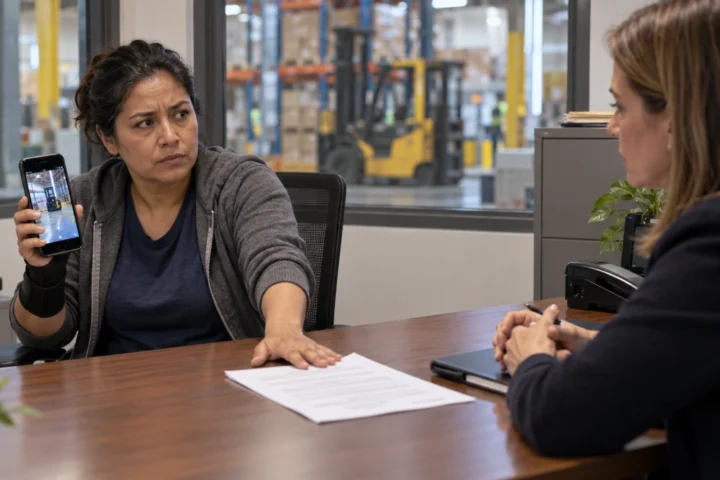
When I walked into Human Resources with a brace on my wrist, my resignation letter was already on the desk. “Marisol Vega” was typed correctly. So was my employee number. Only the signature line was blank.
The day before, a storage rack at our distribution warehouse in Dayton had failed while I was scanning boxes beneath it. Glass jars shattered around my shoes, a metal brace struck my shoulder, and I caught myself on the floor hard enough to hurt my wrist. The doctor told me not to lift anything heavy until a follow-up visit. I thought this meeting was about finding temporary work that fit those restrictions.
Ms. Ford from HR turned the paper toward me. If I “voluntarily separated,” she said, I would receive a three thousand dollar transition payment and keep my insurance through the end of the month. The offer expired at five that afternoon. I asked about my work injury claim. That was a separate process, she said, pointing again to the signature line.
“Why do I have to resign?” I asked.
“We haven’t found a position within your lifting limits,” she said. “And according to the initial report, there was no warning about the rack before the accident.”
My phone buzzed. Aisha, who worked my shift, had sent a photo of an incident log from eight days earlier. Her handwriting, mine, and Ray’s signatures appeared beneath the words: “Third level support bent after forklift impact. Stop using this rack.” At the bottom, our supervisor had written, “Forwarded for action.”
I looked up. Ford was still waiting. In the hall, a forklift sounded its short, repeated backing alarm. If I signed, I could pay next month’s rent. If I didn’t, I would have to prove a warning the company said had never existed.
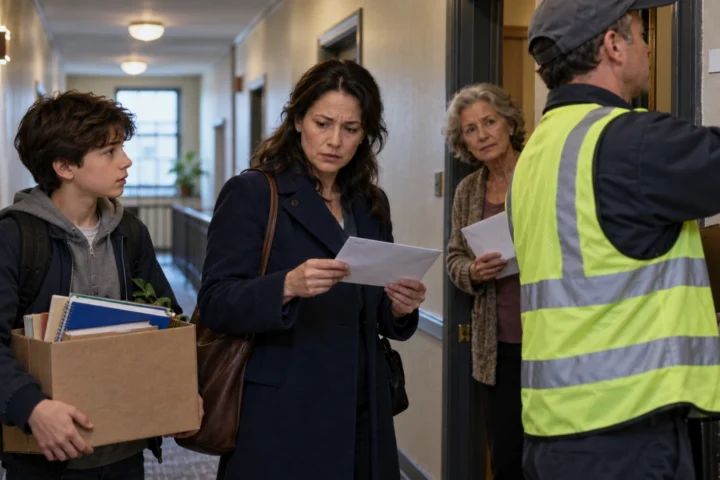
On Monday morning, a man in a reflective vest stuck a label reading 4C on my apartment doorframe. My son, Mateo, thought the building was changing its numbers. The man said he was marking units “ready for delivery” to the new owners. I had never agreed to move.
An envelope from management lay under my door: four thousand dollars if I gave up the apartment in twenty one days. It called the offer voluntary. I looked at the boxes of books Mateo had stacked for a school presentation, then at my night shift schedule. Three weeks was not enough time to find a two bedroom apartment in his school area, save a new deposit, and take days off to move.
Ruth from 4A heard us in the hall. She had received an envelope too, but hers offered twelve thousand dollars and two months. Her apartment was the same size as mine. Both our leases ran into spring.
I went downstairs to ask why the letters were so different. The property manager said every offer was calculated individually and I should sign before mine expired. I asked about the label on my door. She called it a survey crew mistake, then pushed a paper across the counter. “This only confirms you received the notice,” she said.
Under the signature box, in smaller type, the paper said I agreed to terminate my lease and hand over the empty apartment on the twenty eighth. I put down the pen. My phone buzzed with an automated email from the company: “Pre-delivery inspection scheduled.” The inspection was set for Friday.
Mateo stood beside me with a box of books in his arms. “Did you say yes?” he asked. Behind the counter, the manager watched me over her monitor, waiting for me to pick up the pen again.
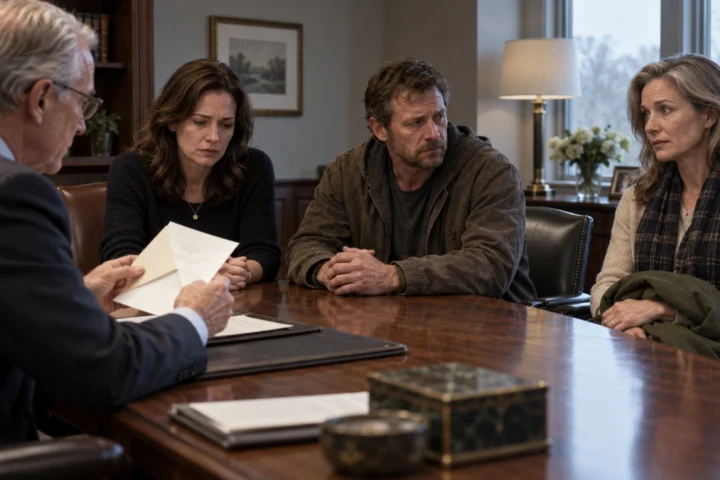
The attorney had barely said “half the house” when my brother laughed. It was the kind of laugh that comes out when there is nothing safe to say. I had spent the last eighteen months sleeping in a folding chair beside our mother’s bed. Dan came by between repairs at his auto shop. Yet half the house on Alder Street was going to a woman neither of us had ever met.
She sat at the far end of the table, a green coat folded across her knees. She didn’t smile when she heard her name. She watched the envelope in the attorney’s hands as though it might contain one more thing she was afraid to learn.
“There’s a mistake,” Dan said. “My mother didn’t know her.”
Mr. Harris took off his glasses. “June Whitcomb signed this will in front of two witnesses after meeting with me alone. She left one quarter of her estate to Daniel, one quarter to Claire, and one half to Maya Ortiz.”
I was about to say that a stranger was not getting a key to Mom’s house. Then Harris opened the letter she had instructed him to read with the will. Its first line made me grip the edge of the table.
“Maya is my first daughter.”
Dan looked at me. I looked at Maya. She had Mom’s gray eyes, but matching eyes could not explain a lifetime of silence. Maya said she had found Mom eleven months earlier through adoption records and a DNA match. She had asked Mom to tell us.
“She promised she’d do it at Christmas,” Maya said. “I waited in my car outside for almost an hour. Then she texted that it wasn’t the right time.”
That Christmas, Mom had sat between Dan and me, opened gifts, and eaten the waffles I made. She had said we must keep the house in the family. Now the woman left waiting in the cold was family too, and each of us held a piece of that promise.
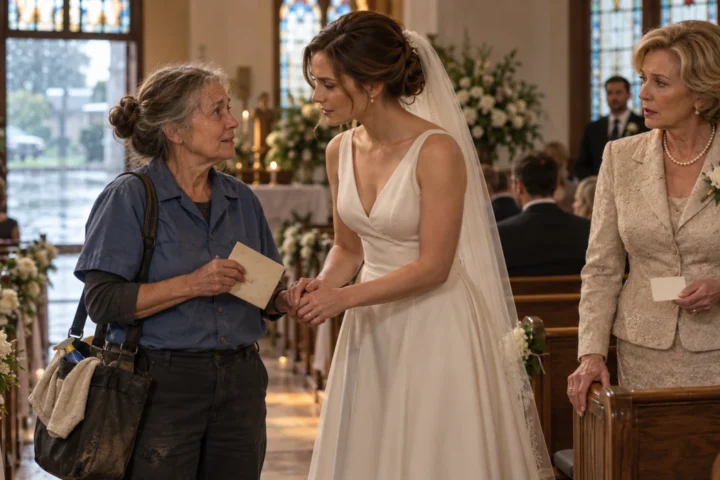
The groom's mother lifted the place card from the front row and pressed it into the hand of a woman wearing a cleaning uniform.
“These seats are for family. Staff use the back entrance.”
I saw it through the door of the bridal room. The organist was still rehearsing. The woman looked down at her blue work shirt, then at the shoes the rain had soaked, and reached for her canvas bag.
Twelve years earlier, those hands had braided my hair before a school audition. She disappeared that afternoon. I was told she had stolen money and run away. I was told to stop waiting for someone who had never really loved me.
That morning, a message arrived: “It's Ruth. I received your invitation.” I pulled a chair close to the aisle. I didn't know what I should call her anymore. I knew she needed a seat.
I stepped out, catching my dress on the hinge. Daniel turned toward me.
“Claire?”
I reached Ruth before she reached the door.
“If she leaves, I leave.”
Daniel's mother looked from me to Ruth. For a moment, her irritation became something else. Recognition.
Ruth took a faded envelope from her bag.
“I didn't come to ruin your wedding,” she said. “But I won't accept money to disappear again.”
Daniel put a hand on the chair. “Mom, do you know her?”
His mother didn't answer. She watched the envelope as Ruth let go of my hand and laid it where the place card had been.
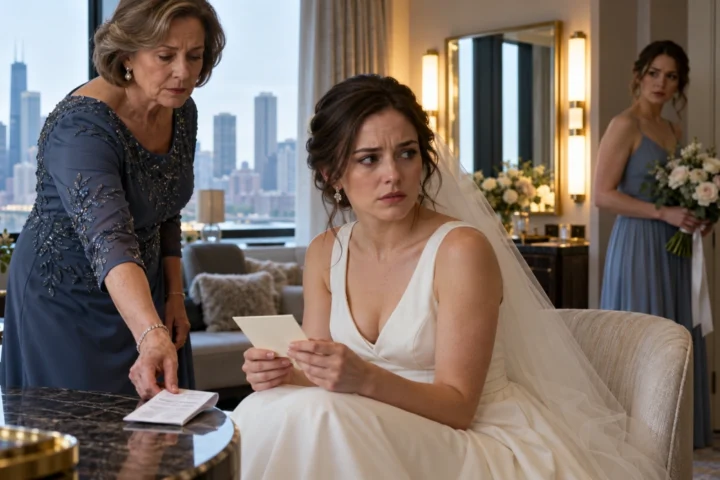
Eight minutes before the wedding, Emily received an unsigned card.
It held only two sentences:
“Ask Daniel about the $1.8 million he owes. He’ll tell you it’s been paid off.”
Emily called her fiancé.
“Do you owe $1.8 million?”
Daniel paused. “Who told you that?”
“Just answer me.”
“It’s from the old company,” he said. “I paid it off.”
Emily looked at the card again. Whoever had sent it knew exactly what he would say.
“Daniel, who paid it?”
A door closed on his end of the call. Daniel lowered his voice.
“Emily, who’s with you?”
“Rachel. And your mother.”
“Don’t ask my mother. I’m coming up.”
He hung up.
Emily looked around the bridal suite. Rachel, the best friend who had urged her to postpone the wedding, stood by the door holding the bouquet. Margaret, Daniel’s mother, was quietly straightening the veil on the dressing table.
“Someone says Daniel owes $1.8 million,” Emily said.
Rachel lowered the flowers. Margaret did not turn around.
“Did you know?” Emily asked her.
Margaret set the veil down. “Have you spoken to Daniel?”
“He says it’s paid off.”
Margaret met Emily’s eyes in the mirror. “Then you asked him the same question I’ve been asking for eleven months.”
Emily’s phone lit up.
Daniel: Don’t make any decisions before I get there.
Downstairs, the musicians began the song Emily had chosen for her walk down the aisle. Margaret reached into her purse, took out a folded sheet of paper and placed it in front of Emily.
It was a receipt for a $16,200 payment made at 9:14 that morning. The sender’s name was Margaret Reed.
“That’s the eleventh payment I’ve made for him,” she said.
Emily stared at the amount. Eleven payments like that were more than Margaret had ever claimed to have in savings. Where had the money come from?
Running footsteps stopped outside. Daniel knocked hard.
“Mom,” he called through the door, “you promised you’d let me tell her myself.”
Margaret looked at Emily before she answered.
“I’ve been waiting eleven months for you to do that.”