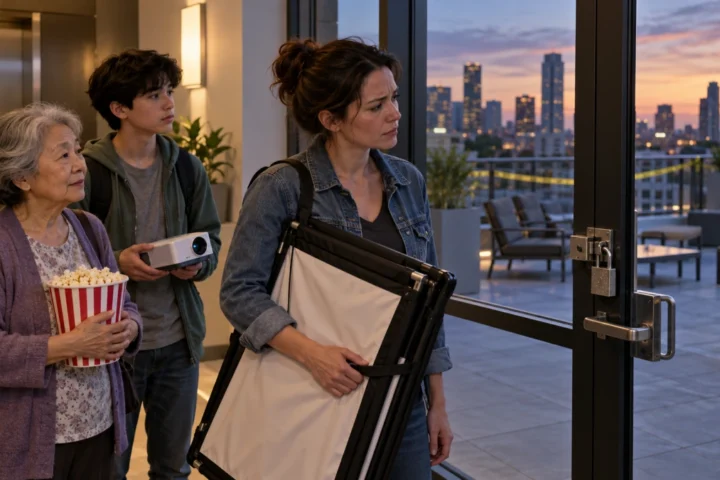
Original fiction The Locked Rooftop The folded movie screen was still under my arm when the elevator opened on the rooftop floor. Someone had put a new padlock on the glass door. A notice taped to it read, “AREA CLOSED DUE TO RESIDENT RULE VIOLATIONS.” Kai held the projector; Mrs. Sato carried popcorn; two children…
My student portal showed a $0 balance when I paid for my final semester. I took a screenshot to tell Mom that the Degree Completion Grant had been applied. Four months later, three days before the graduation application deadline, the same portal displayed a red button: “Cannot continue. Past-due balance: $2,740.”
I'm Nia Torres, a final-year student at Riverbend Community College. I work evenings at a print shop and have been offered full-time hours once I receive my degree. Mom has taken an unpaid day off to attend graduation. The grant award email is still pinned to our refrigerator. It lists exactly the amount that has now appeared as a debt.
At the cashier's window, a clerk pointed to “Aid eligibility adjustment” and said the financial aid office had removed the grant. Financial aid said its system showed me enrolled in only nine credits, below the grant's twelve-credit requirement. I showed them my schedule: four classes totaling twelve credits. The employee said the schedule on my phone was not the data their system used.
I ran to the registrar's office. Ms. Chen printed my unofficial transcript and pointed to Portfolio Lab, a three-credit course with a grade. “You took enough credits,” she said. But the file sent to financial aid still carried the course's old number from when it had been a noncredit class. One change in the catalog had made three of my credits disappear from the grant calculation.
I asked who could fix it before Friday. Ms. Chen called an internal number, listened to it ring, and left a message. I looked at the line outside her door, each student holding a different stack of papers. My phone lit up with a text from Mom: “If we have to, I can put it on my card and we'll figure it out later.”
I typed “Don't pay” but had not sent it when my classmate Mateo came up behind me with his phone raised. He had the same red button. We had taken Portfolio Lab together. Above his balance was the same line: “Aid eligibility adjustment.”
The FOR SALE sign stood in the front yard beneath my old bedroom window. I had just stepped out of my car with a box of roofing tools. My younger brother, Sam, was pulling a ladder from his trunk. We had come to fix the leak above Mom's laundry room. Nobody had told us the house was going on the market.
Mom opened the door before we could ring. She wore a blue shirt and held a roll of tape and three sticky notes. She glanced at the sign, then at us. “I planned to tell you after the roofer looked at the leak,” she said.
“What roofer?” Sam asked. “I brought a ladder.”
“I hired someone insured. He's coming this afternoon.”
Sam set the ladder down harder than he needed to. Dad had been gone six years, and Mom had lived alone in the house outside Columbus ever since.
Mom handed me a sheet of paper. It listed a showing schedule starting the following Saturday, an asking price, and the address of a single-level condo near the downtown library. She had seen it twice. She had not signed to buy it, but she was preparing to list the house. Sam read over my shoulder, his expression changing.
“What about Dad's workshop?” he asked. “My things are still in there.”
“I want you both to choose what to keep,” Mom said. “I texted last month about clearing the attic and shop.”
Sam shook his head. I remembered the message. Mom had asked whether we could help her sort the attic and workshop sometime that month. I had said I would be free after the college admissions rush. Sam had sent a thumbs-up. Neither of us had asked why she wanted to do it now.
A car stopped at the curb. A woman climbed out with a folder, looked at the sign, and asked Mom whether she could take a few photographs of the front yard. Mom said this was Vivian, the real estate agent, due at ten. My watch said 9:57. We were still standing beside the ladder and the leaking roof while an outsider had arrived to begin the move Mom had not finished telling us about.
I saw the check before I saw Dad. It lay beside the household ledger on the kitchen table, made out to Carter Auto for twelve thousand dollars. He had dated it for Monday but left the signature line blank. The account number belonged to the fund we used to pay Mom's in-home aide and build a ramp at the front door.
I had come to take Mom to a final measurement of the front steps. She still made her own decisions, but the three steps had become harder for her since spring. The fund held $17,640. Her aide, who came two afternoons a week, cost $1,760 a month. A $2,900 deposit for the ramp would be due in six weeks. I knew the figures because Dad and I updated the ledger together every Sunday night.
Dad came in and saw the check in my hand. My sister Elise's van had finally died, he said. She needed another one to take a cleaning contract serving six offices. “It's only a loan for a few months,” he said. “She'll pay it back when the client pays her.”
“Has the client signed?” I asked.
He looked out the window. “They said they would.”
Elise appeared in the doorway carrying two bags of groceries for Mom. She had heard the last sentence. “I thought you were lending me your savings,” she told Dad. “You said Mara agreed.”
I laid the check on the table. Nobody had asked me. Dad said he had not signed it, as though that meant nothing had happened. But Elise had arranged to see the van Monday morning and passed up a rental for the following week. If we did not talk now, the decision would arrive as a promise somebody else had already planned around.
Mom stood at the living-room door with one hand on the frame. She had heard enough. Dad hurried to say we were talking about Elise's business and Mom should rest. Mom looked at the check, then at each of us.
“Before anyone decides what to lend,” she said, “show me which part of that money is mine.”
My name appeared in the bottom corner of the presentation, beside the words “Data reviewed by.” On the title slide, beneath Neighborhood Delivery Plan, was my boss's name: Owen Price. I had proposed the route plan, tested it with six stores, and sent Owen the results. But the missing credit was not what made my hands go cold.
Slide four said, “28% fewer late deliveries.” The correct figure was 8%. During two days when the warehouse scanners failed, dispatchers recorded twenty late deliveries in a paper log. The automated report ignored all twenty. I had attached photographs of the log, marked the problem in the spreadsheet, and warned Owen not to use 28% in front of the client.
Owen walked into the conference room and set his coffee beside the projector. “This is final,” he said. “Maple & Main will be here in ten minutes.” The eighteen-store bookstore chain was considering moving its replenishment deliveries to our company. If its managers believed our presentation, they might cut receiving staff on the days we promised to arrive on time.
I pointed to slide four. Owen glanced at it. “It's twenty deliveries. The direction is still right.”
“Those twenty deliveries are the difference between eight and twenty-eight percent.”
He lowered his voice. “Don't ruin the pitch over a footnote. I'll tell them the pilot numbers are still being reviewed.”
I opened the email I had sent on Monday. It contained the complete spreadsheet, Tessa's signature from dispatch, and an unmistakable warning. Owen had replied, “Seen.” I asked if he would fix the slide now. He opened his laptop and changed just one word in the heading: “Projected 28% reduction.”
Greetings sounded in the hall. Marisol Vega, Maple & Main's operations director, approached with two store managers. Owen closed his laptop, handed me the clicker, and smiled as if we had settled everything.
“Leah can answer the data questions,” he told them. “She checked the numbers for my plan.”
At 6:30 every morning, three knocks sounded through my bedroom ceiling. I had usually been asleep for four hours after my late shift. My daughter, Molly, would burrow deeper under her blanket while I stared at the plaster and counted. Ever since we had moved into apartment 2B, the knocks had come at exactly the same time. Sometimes two softer knocks answered them, and then the building went quiet.
I emailed the property manager three times. Dale said the sound came from 3B, where Harold Whitaker, a retired man who lived alone, had an apartment. Dale promised to remind him that quiet hours lasted until seven. When nothing changed, I filed a formal noise complaint. I did not want Harold fined. I wanted forty-five more minutes of sleep before I got Molly to school and returned to work.
Yesterday afternoon, I saw a warning notice beneath Harold's door. I was on the third floor returning a scarf Molly had dropped. Harold stood beside the notice, reading it twice. I walked past without admitting I was the person who had complained.
This morning, 6:30 came without the three knocks. I lay still, waiting to feel relieved. Instead, two sharp taps traveled along the heating pipe. They came again, faster. Footsteps shuffled in the hall, followed by pounding on my door.
Beatrice Bell from 3C stood outside in her robe, clutching an old phone. “Harold isn't answering,” she said. “I sent my signal twice. He has never missed a morning without telling me.”
My clock read 6:34. Beatrice pointed toward the spot on my ceiling where I had wanted the noise to disappear. “Do you have Dale's number? I can't get into Harold's place. The lobby intercom is still broken.”
Molly appeared behind me, barefoot on the cold floor. For the first time, I understood that the three knocks were meant for someone other than the woman trying to sleep below. Now they had stopped, and the three of us had to decide what to do before waiting became its own decision.
The woman holding the real estate sign asked Nathan Vale to move his tomatoes before she photographed the yard.
He had just lowered a seedling into the bed beside Ruth Bell's kitchen window. Dirt darkened the knees of his only decent jeans. Behind him, the garden gate stood open, exactly as Ruth had always left it.
“These aren't mine to move,” he said.
Claire Bell looked at the flat of plants by his feet. “But you're planting them.”
Ruth had been dead for nineteen days. Her daughter had driven down from Toledo with a borrowed trailer, three empty coffee cups, and the belief that clearing a house meant dealing with things inside it.
Nathan had moved into the upstairs apartment next door after his divorce. For most of last summer, Ruth's garden had been the only place where he could spend an evening without hearing his refrigerator switch on.
“She told me to keep it going,” he said.
Claire set the sign against the fence. “She told me she wanted less work.”
Before either could answer, Alma Ruiz appeared at the alley entrance carrying a blue bucket. She stopped when she saw the new tomato plants.
“That's where the marigolds go,” Alma said. “We put them there for Luis every June.”
Across the fence, a boy's voice called, “Did you move my beans?”
Nathan looked down. A row of little sticks lay beside his trowel. He had mistaken them for winter debris.
Claire shut her eyes for a moment. Then she opened the gate wider, not as an invitation but to make room for everyone who seemed to have a claim on her mother's backyard.
“Nobody plants anything else,” she said. “Not until somebody tells me what my mother promised.”
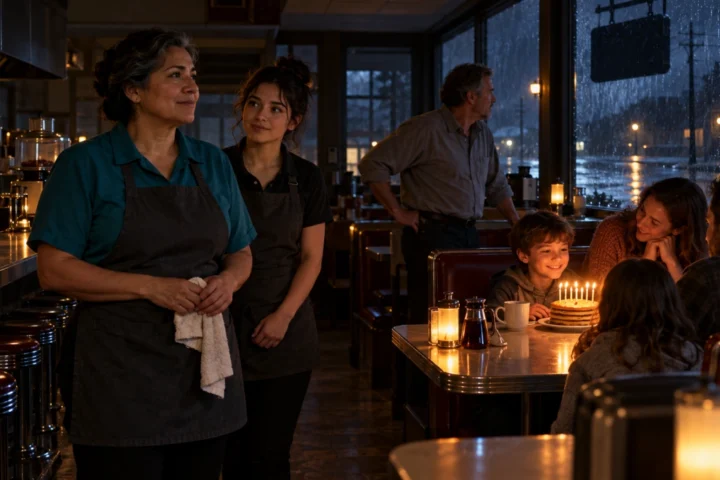
The lights went out while Rosa Medina was showing her replacement where the diner kept its birthday candles.
Across the counter, a little boy inhaled to blow out the seven flames on his pancakes. The exhaust hood stopped. The pie case went dark. Somewhere behind Rosa, a plate shattered.
"Nobody move yet," she said.
She had worked at Cedar Street Diner in Dayton for nineteen years. She knew which stools wobbled, which regulars needed help standing, and how long the emergency lights would last. What she did not know was why the woman she was training had been offered her entire schedule.
That morning, owner Dean Porter had said, "It's coverage, Rosa. You're moving into management. We talked about this."
They had talked about it for three years.
Now the new server, Tessa Ward, stood beside the register with a birthday candle illuminating her frightened face. Through the front windows, rain crossed the parking lot sideways. A dead traffic signal swung above the intersection.
Rosa turned off the coffee warmer and called to Luis in the kitchen. He was already shutting down the cooking line.
"Keep the refrigerator doors closed," she told him. "I'll check the tables."
Dean emerged from his office holding his phone above his head, searching for reception.
"We can still do cash," he said. "Rosa knows how to keep us running."
Tessa looked at her. "He told me you'd be leaving the floor on Monday."
Monday was four days away. Rosa had no new contract, no new pay rate, and no management schedule. At home, her sixteen-year-old son had two tickets to his school concert beneath a magnet on their refrigerator.
Dean moved toward the locked front door.
"Don't turn that sign," he said. "People need somewhere to go."
Rosa put her hand over the switch for the OPEN sign, although it was already dark.
"Then we decide what we're actually offering them," she said.
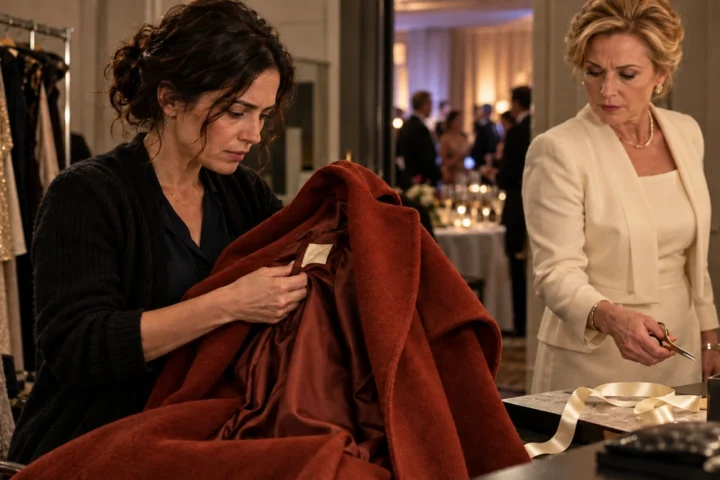
The woman holding Mara Ellis's coat had already cut one stitch from the label when Mara reached across the table and closed the scissors.
"That isn't the washing tag," Mara said.
"I know." Claire Benton kept her voice low. Beyond the dressing room door, volunteers were setting out wineglasses for the Harbor House auction. "We need the lining clean for photographs."
On the hanger beside them waited a cream ribbon printed with the name Bellwether Atelier. Mara had never worked there. She had spent six evenings making this coat at her kitchen table in Cleveland, moving her daughter's homework whenever she needed room for the sleeves.
"Did they design anything?"
"They're lending us their reputation."
The coat was rust red, with a deep inside pocket positioned for a hand that couldn't easily reach across a chest. Mara had developed that pocket for her mother after shoulder surgery. The auction card described the garment as an exclusive Bellwether creation. Under estimated value, somebody had typed twenty-four hundred dollars.
Mara had donated her labor because Harbor House had given her daughter, June, a free place in its summer art program. She had paid a hundred and eighty-six dollars for wool and lining. At home, the refrigerator held a renewal notice for June's bus pass and a gas bill she had turned facedown.
Claire put the scissors down.
"There's private work afterward. Six coats for the committee. Six hundred each. Materials supplied. But they want discretion. No maker tags, no photographs, no discussing clients."
Thirty-six hundred dollars. Mara could hear the radiator knocking in her apartment even here.
"And if I leave my name in this one?"
Claire looked toward the door, where the auctioneer had begun testing his microphone.
"Then I can't promise either opportunity survives."
Mara slid her hand inside the coat and found the loose thread beneath her name.
My husband announced my retirement between the crab cakes and the roast chicken, using a sentence I had never said aloud.
"I want a life that doesn't happen in the spaces my job leaves behind."
Around our anniversary table, eight people lifted their glasses. Martin stood beside me with his reading glasses folded into his shirt pocket. He looked nervous and handsome, the way he had looked twenty-six years earlier when he asked whether I wanted to share an apartment.
Only now he was telling our friends that I was leaving the library.
I was fifty-two. I managed adult programs at a Pittsburgh branch library. I had not given notice, applied for retirement, or agreed to quit. That sentence lived in an unsent email addressed to nobody, written after a particularly exhausting Tuesday.
"No more being the dependable one for strangers," Martin continued. "It's finally Nora's turn."
Another sentence. Same draft.
Our daughter, Wren, put down her glass. Across the table, Martin's sister Beth pressed her hands together, touched by a sacrifice she thought she understood.
Martin set a blue envelope beside my plate. Inside was a printed itinerary for a month driving through New England in September. September was when my branch launched the evening literacy program I had spent a year building.
"I already told people not to expect you back," he said softly, mistaking my stillness for happiness.
The restaurant smelled of browned butter. A server waited behind him with a cake bearing two crooked candles.
I looked at the envelope, then at the man who knew how I took my coffee and apparently believed he knew how I should spend the rest of my life.
"Which people, Martin?"
He lowered his glass.
"And before you answer that," I said, "tell me how you read my email."