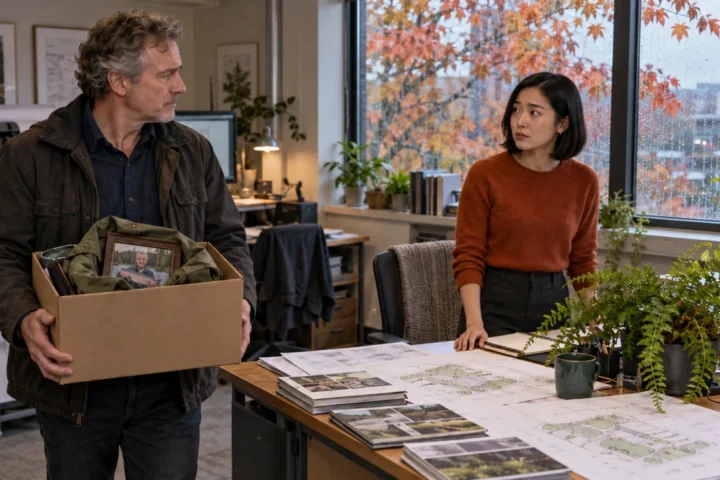
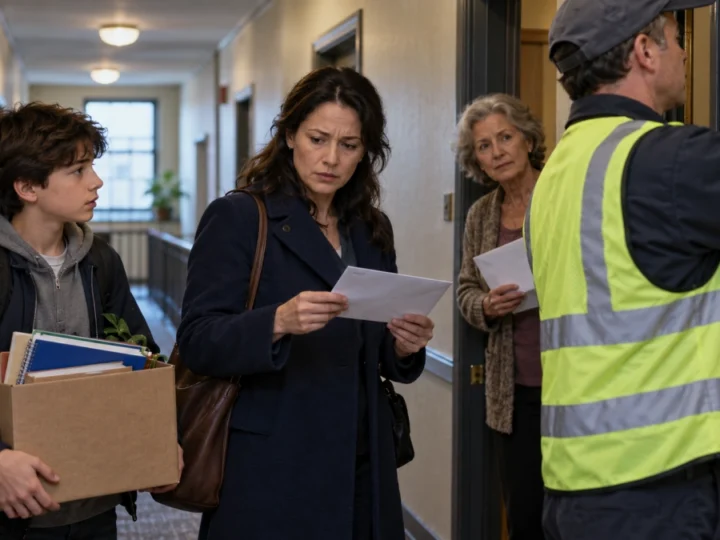
Someone had put a fern where Owen kept the photograph of his father.
It was the first thing he noticed when he returned to the Portland office after eight weeks away. Not the new bid board or the stack of supplier catalogs. A fern, green and extravagantly alive, leaned across the window desk he had occupied for eleven years.
Behind it sat a young woman in a burnt-orange sweater.
"You must be Owen," she said, standing. "I'm Hannah. Paula said you'd be back today."
His father's photograph lay in a cardboard box beneath the coat hooks, wrapped in his old olive overshirt. The picture showed a man holding a salmon he had not caught; Owen had caught it, and his father had insisted on posing. During the last two months, Owen had helped that same man get from bed to bathroom without falling.
"That's my desk," he said.
Hannah looked at the fern, then at him. "Paula told me this was my permanent station."
Through the glass wall, their director lifted one finger to say she was on a call.
Owen stood holding the box. At fifty-two, he had expected returning to feel like stepping back into his own shoes. Instead, a twenty-seven-year-old stranger had her mug beside his window and a plan for the client account he knew best.
"I'm taking the Alder Commons tender through submission," Hannah said. "I was hoping we could review the drainage quantities."
Paula opened her door before he could answer.
"Wonderful. You've met. Owen, you'll be relieved Hannah kept everything moving."
He was not relieved. And the expression that crossed Hannah's face told him she had already understood that much.
The apology had no subject line. Rosa found it between a paper supplier's quote and a message about the church raffle, in the shared project mailbox Evan had asked her to cover while he took his mother to a medical appointment.
Malik, I should have stopped the meeting before they made you carry this.
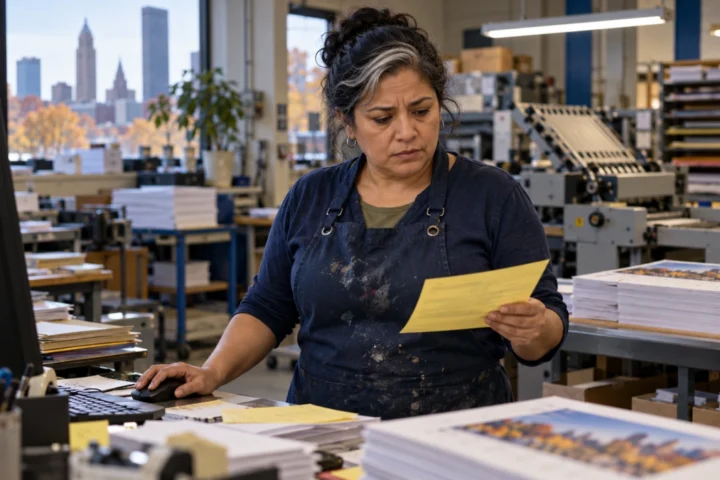
She took her hand off the mouse. Behind her, the folding machine slapped another stack of Cleveland school calendars into neat thirds. It had made that same sound the afternoon Malik cleared out his locker.
Rosa had not gone looking for secrets. The draft sat under the school job number, where a purchase order should have been. She read three lines before she understood what it was, then closed it. But she could not close the sentence in her head.
One month earlier, eight hundred calendars had gone out with the wrong dismissal times. Malik, twenty-eight, had been the last person at the press. Evan had said he ignored the approved file. Rosa had watched Beena, the owner, remove his name from the production board.
And Rosa had remembered a different file arriving after lunch.
She had kept that memory small. An attachment nobody asked her about. A hurried instruction. A thing she could not prove without making trouble for the manager who had recommended her for a bonus.
Now, at forty-six, with silver showing through the dark hair in her bun and ink on her navy apron, Rosa opened the job archive instead of the draft.
The first thing she found was her own handwriting on a yellow routing slip.
Use revised pages. Evan aware.
Brent lifted his glass before the waitress could set the black folder down.
"And to Talia," he said, "for treating us like royalty tonight."
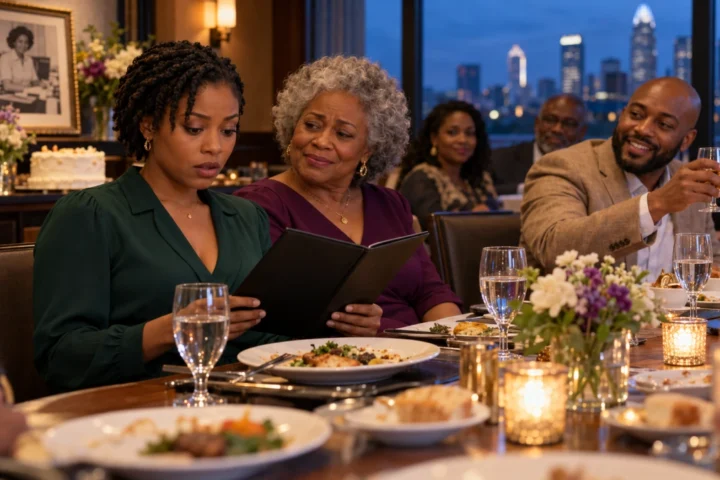
Seventeen people turned toward me. My mother touched her silver curls and smiled from the head of the table. Behind her, the Charlotte evening pressed blue against the restaurant windows.
I had arranged the room. I had chosen the lower priced menu. I had brought the framed photograph of Mom on her first day at the hospital, wearing shoes so white they looked unfinished.
I had not offered to buy dinner.
The waitress placed the folder beside my water glass. Inside was a final total of $1,460. A smaller line showed the $200 deposit I had paid to hold the room. Balance due: $1,260.
Across the table, Brent was already reaching for the last crab cake. He wore the tan blazer he saved for pictures. He had added five people to the reservation three days earlier and told me not to worry about the details.
Mom saw the bill before I closed it. Her smile stayed where it was.
"It's such a beautiful thing you're doing," she said quietly.
I was thirty two, a hotel banquet coordinator with a good blouse and a savings account named COURSE. The certification application closed Monday. Tuition was due at enrollment, and the money in that account was almost exactly what remained on the bill.
The waitress leaned down. "Would you like me to bring the card machine?"
My mother put her hand over mine. For a moment I thought she was going to explain.
"Don't make it awkward," she whispered.
I moved my hand carefully out from under hers.
"Please bring another chair," I told the waitress. "We need to talk about how this is being paid."
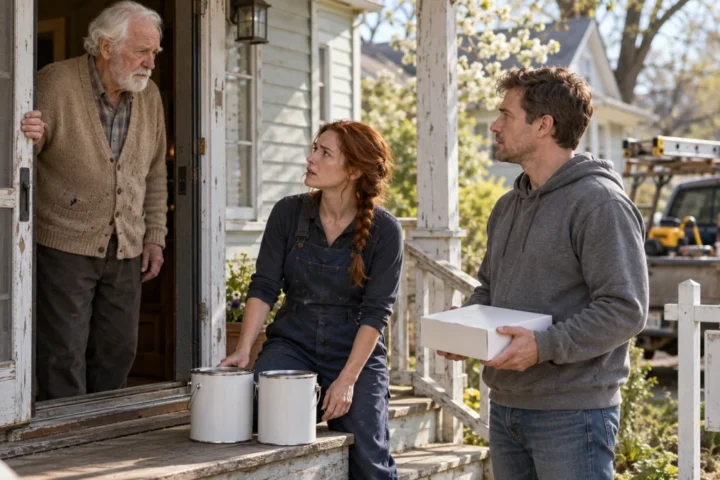
The sale sign was already in the yard when Mae backed her truck against the curb. In the bed lay two gallons of porch paint, a rented sander, and the ladder our father had finally agreed not to climb.
I had brought doughnuts. That was the sort of son I could afford to be that Saturday: generous with twelve dollars, useless with a mortgage.
Mae sat looking through her windshield. Then she got out in her navy overalls and walked past me without taking the box.
Dad opened the screen door. His tan cardigan had a hole near the wrist, and his white beard was damp from shaving.
"I should have called," he said.
"Before or after they put that up?" Mae asked.
Across the street, somebody's sprinkler clicked over wet concrete. I noticed the little red flag on the sign, the cheerful invitation to come inside on Sunday. Strangers would be walking through the room where our mother had died. They would open cupboards, discuss light, and decide whether our lives smelled like old carpet.
"It's my house, Ellis," Dad said, although I hadn't spoken.
That frightened me more than the sign.
In my coat pocket was a message from the man who had lent my restaurant money. He wanted a date, not another explanation. For months I had comforted myself with something Dad said whenever the roof needed work: Your house someday. Both of you.
Mae put the paint on the bottom step.
"Where are you going?" she asked.
Dad reached behind the door for a rental brochure. The picture showed a low brick building with handrails along its paths.
"Somewhere I can get to the bathroom without stairs."
Only then did I notice he was holding the doorframe instead of standing on his own.
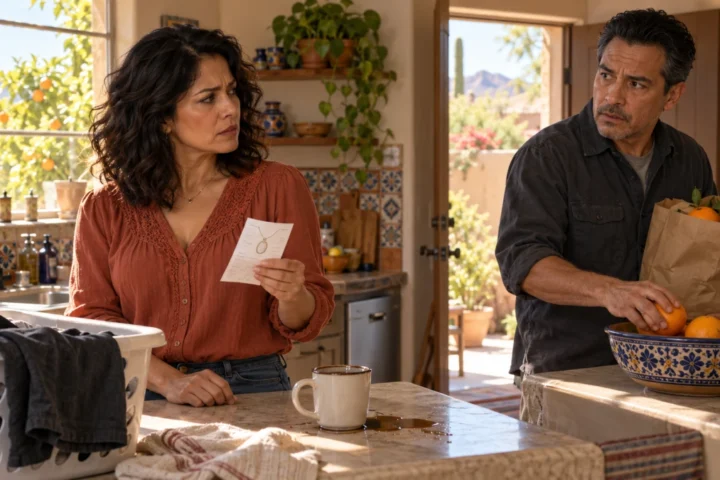
The necklace on the jeweler's receipt wasn't Marisol's. She knew that before she saw the date, before she saw Daniel's name, before the coffee began spilling over the rim of her cup onto the counter.
Twenty years married that morning, and her husband had paid to repair a gold pendant she had never worn.
She found the receipt in his charcoal shirt while sorting laundry in their Tucson kitchen. The drawing was simple: an oval pendant, a small flower pressed into its face, a broken clasp circled in blue. She recognized the flower from a photograph of his mother. That made the discovery worse in a way she couldn't yet explain.
Daniel came through the back door carrying oranges from their neighbor's tree. At forty-five, his black hair had begun to gray at the temples. She usually loved that detail. This morning she noticed how young he looked when he saw the paper in her hand.
"Is this my anniversary present?" she asked.
"No."
One clean answer. Then nothing.
Marisol was forty-three. She had known about Eva since their third date: his daughter from a relationship before their marriage, now twenty-five, living a life Marisol mostly encountered in birthday messages. Last month, when Marisol asked whether he'd heard from her, Daniel had said no.
"Whose is it?"
He set the oranges down one at a time. "Eva's. My mother left it to her. The clasp broke."
That explanation ought to have settled something. Instead, he reached for the receipt, stopped, and said, "She isn't the reason I lied."
Outside, the irrigation timer clicked on. Inside, Marisol put the paper flat between them, smoothing it with both hands so he could no longer pretend it was only a necklace.
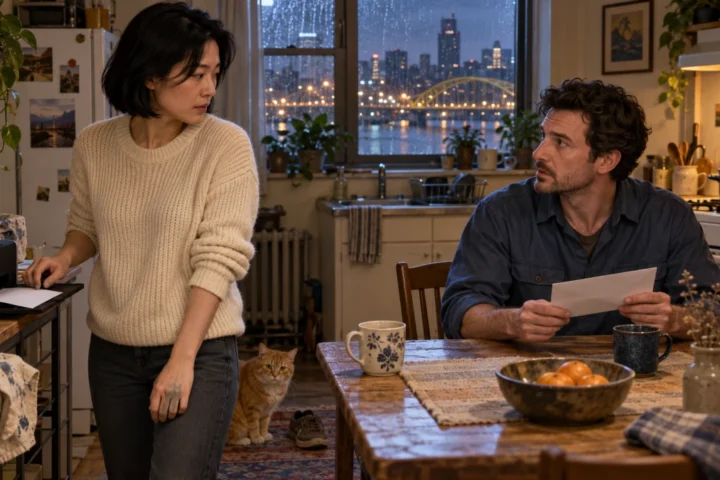
The printer spat out Lena's ticket while Adrian was taking off his shoes. She reached for it too late. Minneapolis lay faceup in the tray between a grocery coupon and the cat's bloodwork, and her husband stood holding an envelope from Baltimore.
For a moment, in their narrow Pittsburgh kitchen, neither of them offered an explanation. The radiator knocked. Clementine, their seventeen-year-old orange cat, put one careful paw on Adrian's abandoned shoe.
"You're going somewhere," he said.
Lena wiped clay from the side of her thumb. She had washed twice at the studio, but the pale crescent beneath her nail remained. "So are you."
He looked down at the envelope as though someone else had brought it home.
They had been married eight years. They knew the sound of each other's car outside, the precise angle of a headache, which drawer contained takeout menus and which contained things they couldn't discuss. They had become remarkably considerate people who no longer asked permission to be unhappy.
"It's six months," Lena said. "A residency. I accepted Friday."
"I signed Tuesday."
She had expected anger, maybe relief. Instead, Adrian set the envelope beside her ticket with the delicate care he used around wet pottery.
His promotion wasn't in Pittsburgh. Her residency wasn't something she could do on weekends. On the refrigerator, beneath a magnet from their honeymoon, their lease renewal waited for both signatures.
"When were you going to tell me?" they asked together.
That almost made her laugh. Then Clementine tried to jump onto a chair, missed, and landed with a small indignant cry. Both of them bent to pick her up. Their hands met under the same frail ribs, and neither knew who should let go.