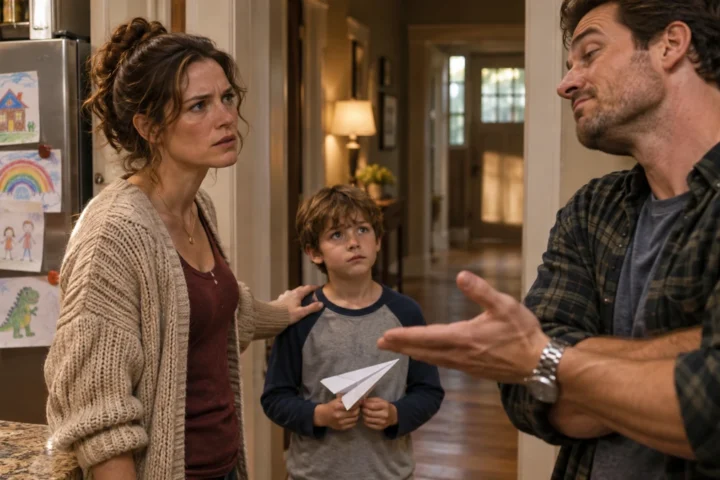
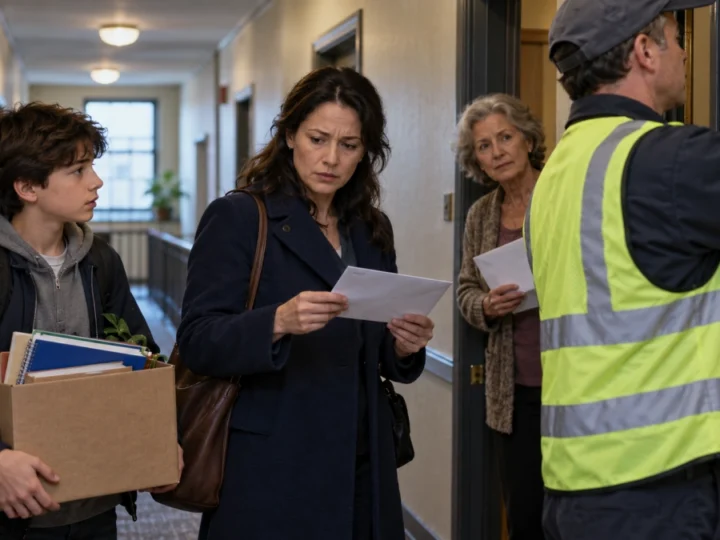
“Could Ben stay with your sister until Sunday?” Eric asked. “My mother needs a quiet first visit.”
My son stood in the hallway holding the paper airplane he wanted to show her.
I watched his hand lower.
“Ben lives here,” I said.
“I'm asking for one weekend, Tessa.”
We were getting married in seven weeks. Eric had moved into my house in May. He paid a fixed share of utilities and groceries. I had kept the mortgage in my name because the house belonged to me before we met, and because Ben had already lost one home after his father's death.
Eric said he understood that better than anyone.
Now he wanted the spare bedroom cleared of Lego bricks because his mother thought children should have a separate play area. He wanted Ben's drawings removed from the refrigerator. And he wanted my seven-year-old sleeping somewhere else.
I took the airplane from Ben and put it on the mantel where nobody could miss it.
“He stays.”
That evening, while printing a wedding seating plan, I found a document in the printer tray. It was an application for a small boarding school two states away. Ben's name was typed at the top.
Under reasons for enrollment, Eric had written: Family transition. Mother supports residential placement.
I sat down before my knees made the decision for me.
The form wasn't signed. There was no need to imagine powers Eric didn't have. He wasn't Ben's guardian and couldn't enroll him. What frightened me was how confidently he had described a future I had never agreed to.
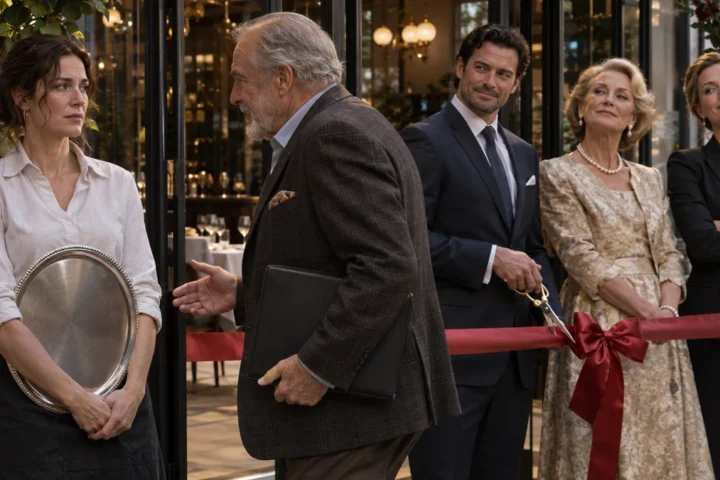
“She's just the wife,” my husband said, laughing as he took the ribbon scissors from my hand. “The business people are over here.”
Twenty guests laughed because they thought they were supposed to. I stepped aside with the silver tray I had borrowed from my mother.
Two years earlier, there had been no restaurant. There had been an empty storefront, a rejected loan application, and my grandmother's small house waiting to be sold. I sold it. I put $72,000 into the restaurant under a written agreement that named me as a partner.
That evening, the framed opening photograph would include my husband, Adrian, his mother, and a woman he introduced as his development director. My chair had been moved behind a column.
I might have stayed there until the landlord arrived.
“Naomi,” Mr. Pierce said, holding a folder. “Before you leave, we need to discuss the new lease request.”
Adrian stopped smiling.
“There is no new request,” I said.
Mr. Pierce looked from me to my husband. “Then who told my office you'd sold your interest?”
The room didn't fall silent. Someone dropped a fork. The pianist continued a song I could no longer recognize.
Adrian took my elbow and tried to steer me toward the kitchen.
“Office error,” he said. “We'll sort it out Monday.”
I pulled my arm free.
“Email me the request,” I told Mr. Pierce. “Please use my address from the original lease.”
For the rest of the evening, I carried food to people who thought I was helping out for fun. Adrian's mother told me not to ruin his moment. The development director, Celia, watched us from beside the new wine display.
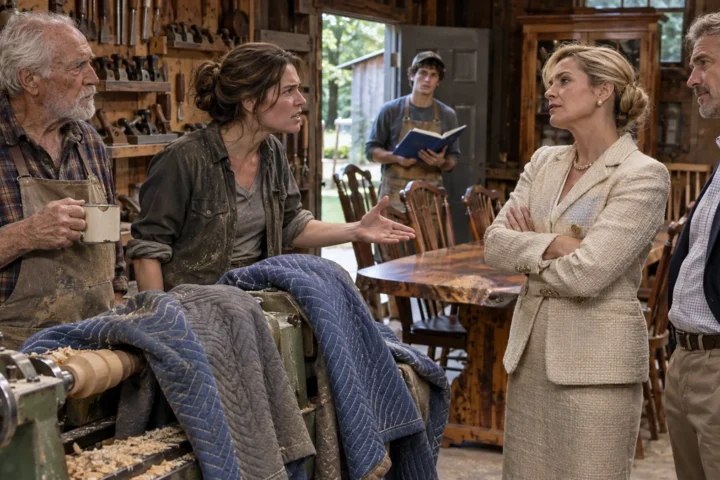
“Dad doesn't need to see this,” my sister said, covering the price on a lathe with her handbag. “It'll only upset him.”
Dad was in the next room, packing his own mugs.
The man beside her had brought a trailer. Two workers waited at the workshop door. On the bench where Dad had taught me to sand a chair rail, someone had placed a stack of moving blankets.
My sister, Vanessa, told me she was selling redundant equipment before Dad moved into his smaller apartment. The sale would help cover his expenses. She had arranged everything while I was away caring for my husband's mother.
“Has he agreed?” I asked.
“He asked me to simplify things.”
Dad appeared with a chipped mug in his hand. At seventy-six, he walked slowly because his knee hurt. There was nothing wrong with his hearing.
“I asked you to sell the spare drill press,” he said.
Vanessa turned toward him with the patient expression she used for difficult customers. “We discussed the whole workshop.”
“No,” he said. “You discussed it. I said I'd think.”
The buyer looked at his workers. One lowered his end of a blanket.
Then a bicycle bell sounded outside. Owen, Dad's former apprentice, came through the gate with a blue order book tucked beneath his jacket.
“I found the copy you wanted,” he said to Dad. “And you should know who's buying your name.”
Vanessa reached for the book before Dad did.
I moved between them.
Three years earlier, Dad had stopped accepting large commissions. Owen took over the rented storefront, with his own equipment and a new business name. Dad kept his home workshop and occasionally made small pieces for old clients. Vanessa managed his invoices because she said paperwork was the one thing he should retire from.
“Your mother's things are outside, Lena. Don't make this embarrassing.”
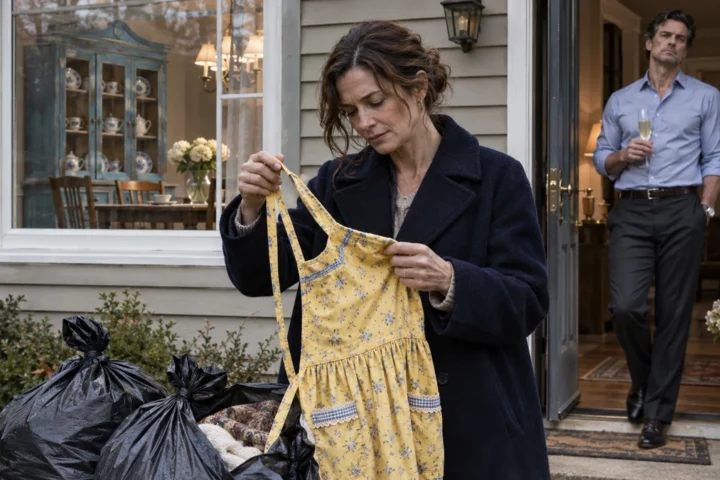
My brother stood in our mother's kitchen holding a champagne flute. Behind him, a woman measured the window for curtains. Mom had been buried seventeen days earlier.
I looked through the back door. Three black bags leaned against the dumpster. The corner of her yellow sewing apron stuck through a split in one of them.
“Those aren't things,” I said. “Those are the things she asked me to keep.”
“Then you should have come sooner.”
I had come every Tuesday during her final year. I changed the sheets, organized the medication list, and drove her to appointments while Paul sent messages about being essential at work. After the funeral, he told me he needed two weeks before anyone touched the house.
Now strangers were drinking in it.
The woman lowered her measuring tape. “We're only here about the furniture.”
Paul put down his glass. “The house has to be cleared before the estate sale.”
I asked who had approved an estate sale. We were both named to handle Mom's belongings together. He said someone had to make decisions while I was busy being emotional.
From the bags, I rescued the apron, two photograph albums, and a dented biscuit tin. The tin held Mom's sewing receipts. Underneath them was a folded delivery slip for a blue cabinet.
The cabinet still stood in her dining room. Paul had placed a red SOLD sticker across its glass.
I photographed the slip before I went back inside.
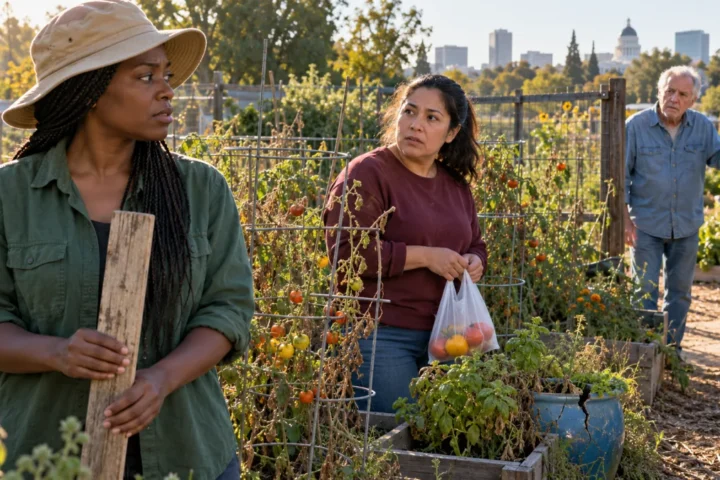
The woman I found picking tomatoes in the abandoned plot knew exactly which ones were ripe, and the man who supposedly owned it had never received my warning.
I learned the second part after I had already promised his garden to somebody else.
It was seven on a September morning in Sacramento. I had come to pull the little wooden marker from Plot Eighteen before the waiting family arrived. My spreadsheet called it inactive. The weeds along its edges agreed.
But a woman in a burgundy sweatshirt stood between the leaning cages, putting tomatoes into a grocery bag. She held one up when she saw me, as if I had come to help.
“The yellow ones split if you leave them another day.”
“Are you Walter Price?” I asked, although she plainly wasn't a seventy-four-year-old man.
She lowered the tomato.
My name was Amara Okafor. I was thirty-seven, three months into coordinating the garden, and determined to make its waiting list mean something. One family had waited an entire year. Meanwhile this plot had missed the spring workday, the summer cleanup, and every message I had sent.
“I'm Elena,” the woman said. “Ruth told me I could take what I needed.”
“Ruth Price died in January.”
“I know.”
Behind her, a tomato rolled from the bag and stopped against my shoe. I picked it up, feeling its sunless morning weight.
“Permission doesn't transfer the plot,” I said.
Elena looked toward the gate. A man with white hair and a faded denim shirt had stopped there, holding the fence instead of opening it.
“Nobody told me,” he said.
I still had the new family's name written on the back of Walter's marker.
The dog came into the laundry room carrying somebody else's sock, and by morning two strangers had thanked me for finding him.
Both knew the crescent of white fur under his chin. Both knew he hated the garbage truck and would eat a green bean only if you pretended it was yours. Both said the little terrier in my photograph belonged at home with them.
Arthur called him Scout. Vivian called him Pip.
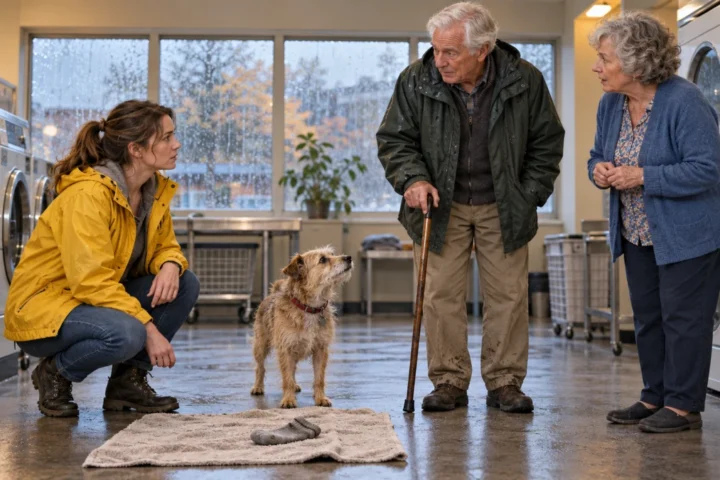
I was thirty-one, the maintenance worker at a Spokane apartment building with unreliable gutters, not a person qualified to divide a living thing between two lonely people. But the rain was coming sideways that Thursday night, and the dog had followed me through the service entrance before I could shut it.
His red collar had no tag. His white muzzle smelled faintly of peanut butter. When I crouched to read the worn buckle, he put the stolen sock in my lap.
I posted a photograph in the neighborhood group and gave him water in a clean paint tray. By seven the next morning, Arthur had sent me a picture of the same dog asleep against a woman's blue slippers. Vivian sent a veterinary receipt dated three weeks earlier.
Then Arthur arrived with a cane and a dark green jacket darkened further by rain. A woman in a blue cardigan came through the other entrance carrying a familiar red leash.
The dog scrambled off his towel. He ran to Arthur, sneezed against his knee, then turned and pressed himself against Vivian's ankles.
Neither person looked relieved anymore.
“Your son said you didn't want him back,” Vivian said.
Arthur closed his hand around the handle of his cane.
“He told me you wouldn't answer,” he said.