The unfamiliar name appeared between Owen's father's number and the box for special instructions.
Leah Mercer. Authorized pickup.
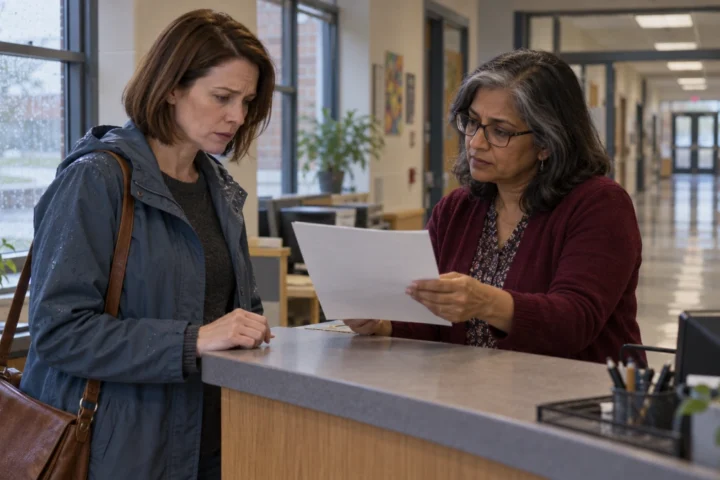
Claire Bennett read it twice while rain ran down the school office window. She had come to collect her eight-year-old for a dentist appointment, not discover a stranger on his emergency form.
"Who added her?"
Ms. Patel turned the paper so she could check the entry. "His father submitted the update. Let me look at the notes before we make assumptions."
"Has she picked him up?"
"No. Owen is with his teacher. You're the person collecting him today."
The administrator's calm helped Claire keep her own voice low. She loosened the strap of her brown shoulder bag and asked for a copy of the form. Beneath her slate-blue raincoat, her sweater felt suddenly too warm.
Daniel had mentioned no new girlfriend. Their divorce agreement had not made them experts at telling each other things, but they usually managed schedules, shoes, and school notices without surprises.
Claire called him from the empty stretch of counter.
"Who's Leah Mercer?"
For a moment she heard only the indicator clicking in his car.
"I meant to explain."
"Explain now."
"She won't pick Owen up without us talking. I told her that."
"Then why put her on the form?"
He stopped the indicator. Somewhere behind Claire, a copier started feeding paper.
"Because she asked if she could help sometime. Because I thought it would make things simpler."
"What things?"
His next answer arrived quietly enough that she had to press the phone closer.
"She's my daughter."
Claire looked at the unfamiliar name again. Daniel had been her husband for eleven years. Owen knew every cousin on his father's side, every dog the family had owned, every version of the story about the broken canoe.
He had never been told he had a sister.
Walter Reed knew the feel of a bad lock. For thirty years he had repaired doors in factories, apartment buildings, and nursing homes, and he knew when a cylinder needed graphite and when somebody had installed a different one.
This one was different.
He stood on his Dayton porch with rain dripping from his navy work jacket and tried his key once more. Beside his boot, the brown canvas duffel sagged like something equally tired of traveling. Inside the house, his daughter switched on the hall light.
Nora opened the door only as far as the chain allowed. Her dark hair was tied back, and she wore the olive cardigan he had bought her last Christmas.
"Dad. You said tomorrow."
"Job finished early."
She looked at his key. He looked past her at the empty rectangle beside the stairs, where his mother's walnut cabinet had stood since before Nora was born.
"You changed my lock."
"I have a key for you."
She closed the door to release the chain. That small necessary movement hurt more than he wanted to admit. He had spent eleven nights sleeping beside an interstate so he could keep this house, and now his own daughter was making him wait outside it.
When she reopened the door, she held a plain envelope.
"Before you call Uncle Glenn," she said, "please let me explain."
Walter had not mentioned his brother.
From the kitchen came the steady clicking of the dishwasher. On the hall table lay a receipt from a locksmith and a photograph of the missing cabinet, its drawers standing open in somebody else's garage.
"Where is it?" he asked.
Nora did not offer the envelope again.
"That's what I was trying to find out when he used your spare key yesterday."
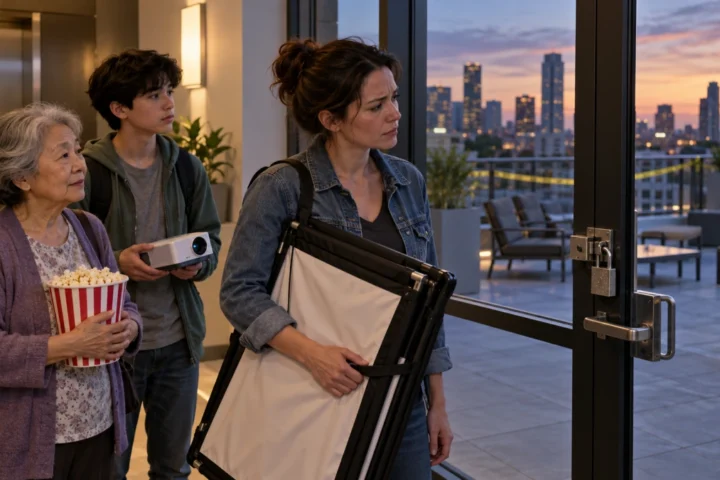
Original fiction The Locked Rooftop The folded movie screen was still under my arm when the elevator opened on the rooftop floor. Someone had put a new padlock on the glass door. A notice taped to it read, “AREA CLOSED DUE TO RESIDENT RULE VIOLATIONS.” Kai held the projector; Mrs. Sato carried popcorn; two children…
My student portal showed a $0 balance when I paid for my final semester. I took a screenshot to tell Mom that the Degree Completion Grant had been applied. Four months later, three days before the graduation application deadline, the same portal displayed a red button: “Cannot continue. Past-due balance: $2,740.”
I'm Nia Torres, a final-year student at Riverbend Community College. I work evenings at a print shop and have been offered full-time hours once I receive my degree. Mom has taken an unpaid day off to attend graduation. The grant award email is still pinned to our refrigerator. It lists exactly the amount that has now appeared as a debt.
At the cashier's window, a clerk pointed to “Aid eligibility adjustment” and said the financial aid office had removed the grant. Financial aid said its system showed me enrolled in only nine credits, below the grant's twelve-credit requirement. I showed them my schedule: four classes totaling twelve credits. The employee said the schedule on my phone was not the data their system used.
I ran to the registrar's office. Ms. Chen printed my unofficial transcript and pointed to Portfolio Lab, a three-credit course with a grade. “You took enough credits,” she said. But the file sent to financial aid still carried the course's old number from when it had been a noncredit class. One change in the catalog had made three of my credits disappear from the grant calculation.
I asked who could fix it before Friday. Ms. Chen called an internal number, listened to it ring, and left a message. I looked at the line outside her door, each student holding a different stack of papers. My phone lit up with a text from Mom: “If we have to, I can put it on my card and we'll figure it out later.”
I typed “Don't pay” but had not sent it when my classmate Mateo came up behind me with his phone raised. He had the same red button. We had taken Portfolio Lab together. Above his balance was the same line: “Aid eligibility adjustment.”
The FOR SALE sign stood in the front yard beneath my old bedroom window. I had just stepped out of my car with a box of roofing tools. My younger brother, Sam, was pulling a ladder from his trunk. We had come to fix the leak above Mom's laundry room. Nobody had told us the house was going on the market.
Mom opened the door before we could ring. She wore a blue shirt and held a roll of tape and three sticky notes. She glanced at the sign, then at us. “I planned to tell you after the roofer looked at the leak,” she said.
“What roofer?” Sam asked. “I brought a ladder.”
“I hired someone insured. He's coming this afternoon.”
Sam set the ladder down harder than he needed to. Dad had been gone six years, and Mom had lived alone in the house outside Columbus ever since.
Mom handed me a sheet of paper. It listed a showing schedule starting the following Saturday, an asking price, and the address of a single-level condo near the downtown library. She had seen it twice. She had not signed to buy it, but she was preparing to list the house. Sam read over my shoulder, his expression changing.
“What about Dad's workshop?” he asked. “My things are still in there.”
“I want you both to choose what to keep,” Mom said. “I texted last month about clearing the attic and shop.”
Sam shook his head. I remembered the message. Mom had asked whether we could help her sort the attic and workshop sometime that month. I had said I would be free after the college admissions rush. Sam had sent a thumbs-up. Neither of us had asked why she wanted to do it now.
A car stopped at the curb. A woman climbed out with a folder, looked at the sign, and asked Mom whether she could take a few photographs of the front yard. Mom said this was Vivian, the real estate agent, due at ten. My watch said 9:57. We were still standing beside the ladder and the leaking roof while an outsider had arrived to begin the move Mom had not finished telling us about.
I saw the check before I saw Dad. It lay beside the household ledger on the kitchen table, made out to Carter Auto for twelve thousand dollars. He had dated it for Monday but left the signature line blank. The account number belonged to the fund we used to pay Mom's in-home aide and build a ramp at the front door.
I had come to take Mom to a final measurement of the front steps. She still made her own decisions, but the three steps had become harder for her since spring. The fund held $17,640. Her aide, who came two afternoons a week, cost $1,760 a month. A $2,900 deposit for the ramp would be due in six weeks. I knew the figures because Dad and I updated the ledger together every Sunday night.
Dad came in and saw the check in my hand. My sister Elise's van had finally died, he said. She needed another one to take a cleaning contract serving six offices. “It's only a loan for a few months,” he said. “She'll pay it back when the client pays her.”
“Has the client signed?” I asked.
He looked out the window. “They said they would.”
Elise appeared in the doorway carrying two bags of groceries for Mom. She had heard the last sentence. “I thought you were lending me your savings,” she told Dad. “You said Mara agreed.”
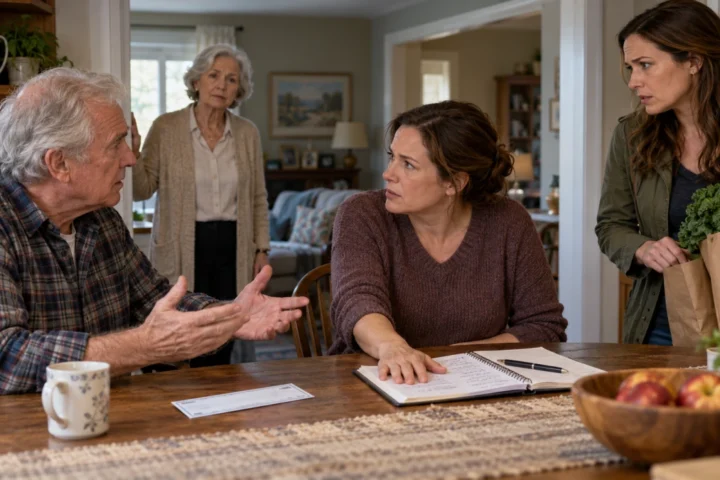
I laid the check on the table. Nobody had asked me. Dad said he had not signed it, as though that meant nothing had happened. But Elise had arranged to see the van Monday morning and passed up a rental for the following week. If we did not talk now, the decision would arrive as a promise somebody else had already planned around.
Mom stood at the living-room door with one hand on the frame. She had heard enough. Dad hurried to say we were talking about Elise's business and Mom should rest. Mom looked at the check, then at each of us.
“Before anyone decides what to lend,” she said, “show me which part of that money is mine.”