The woman my mother said had abandoned us was standing beside her in a graduation photograph, holding her shoes.
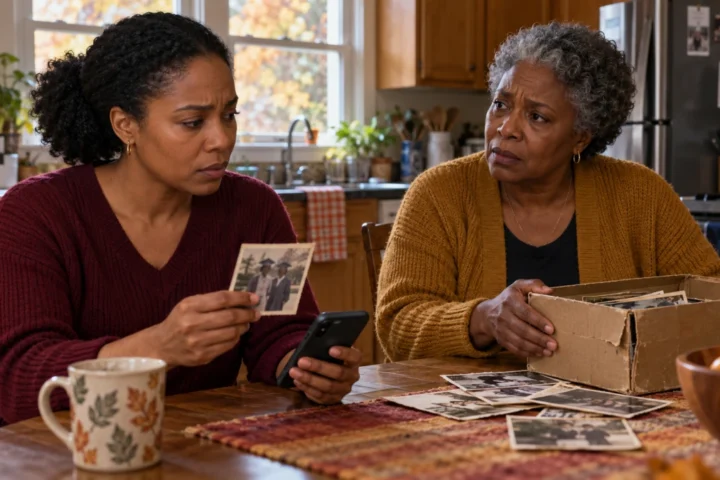
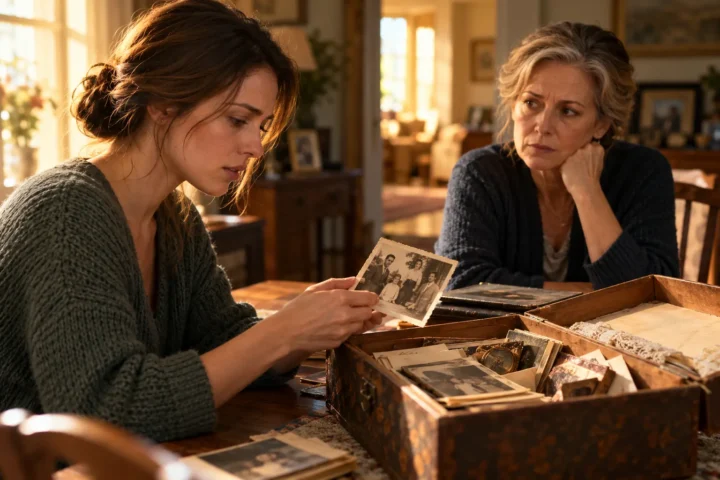
I found the picture in a bent envelope while collecting material for our school's alumni display. Mom had graduated from the same Richmond high school where I now worked as a counselor. In the photograph she was eighteen, her gown lifting in the wind. Beside her stood my aunt June, sixteen, barefoot on the grass, carrying two pairs of heels and laughing at something outside the frame.
On the back, in Mom's handwriting, were four words: Couldn't do it alone.
I was thirty five. I had not seen June since I was two, and I knew exactly one story about her: when my mother needed her most, she left.
Then my phone lit up.
"Camille, thank you for the invitation. I'll come if you still want me. But does Denise know you asked?"
June's message sat beneath the cheerful email I had sent the night before. I had found her through an alumni contact and invited her to stand beside Mom at the opening. I had even described the display as a chance to bring our family together.
Mom came into the kitchen carrying a box of photographs. At sixty one, she still looked at school projects as something we should finish before dinner.
"Who are you writing?"
I turned the phone toward her.
She put the box down so hard that a corner split.
"You asked her without asking me?"
"I thought after all this time—"
"You thought you'd give me an audience."
I looked from her face to the two laughing girls in the picture. For the first time, the story I knew did not explain what I was holding.
The storage manager handed Nora Bennett a pair of bolt cutters and asked whether she wanted to keep the wedding dress.
"What wedding dress?"
He checked the number on his clipboard. "Your father said the family was clearing everything today."
Nora looked at Russell. Her father stood beside the loading door with both hands buried in his brown jacket, although the Toledo morning was already warm. For eleven years, he had told her that unit forty-six held her brother's woodworking tools. For eleven years, she had pictured a table saw, the unfinished maple chair, the things Adam had left behind when a driver ran a red light.
She had come to help her father stop paying a hundred and eighteen dollars every month to keep grieving behind a padlock.
"We aren't cutting anything," Russell said.
The manager looked between them, set down the cutters, and went back inside.
Nora held out her hand. "You asked me to clear it today."
Her father took the key from his pocket.
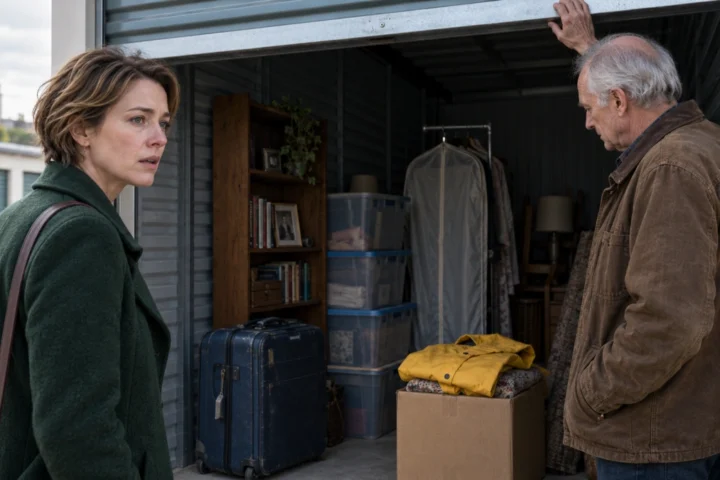
When the door rattled upward, the first thing she saw was a blue suitcase. Not a saw. Not a chair. Behind it stood a narrow bookcase, three plastic tubs, and a dress bag hanging from a garment rack. A woman's yellow raincoat lay folded on top of a cardboard box.
Nora knew that coat. She had given it to Tess the Christmas before Tess left Adam.
"Why do you have her things?"
Russell kept his hand against the door as if the whole mechanism might fall.
"Because your brother wouldn't give them back."
Nora turned toward him. There was no confusion in his face, no mistake she could help him correct.
"You let us say she abandoned everything."
Her father looked into the narrow room.
"Yes," he said. "I did."
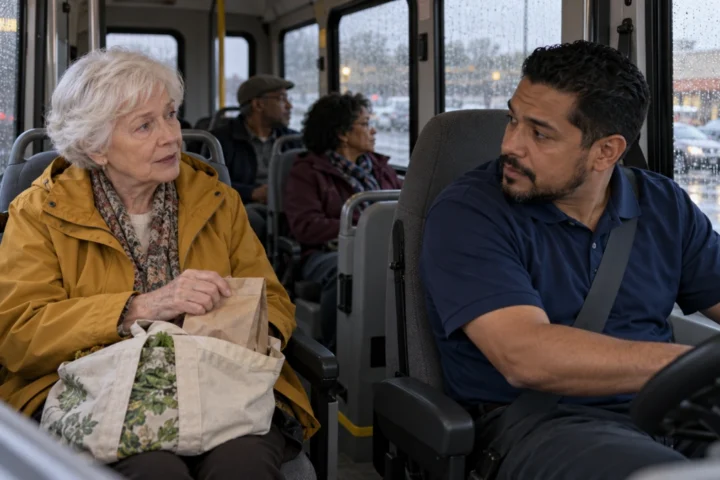
Irene Webb kept her paper bag as I closed the shuttle door.
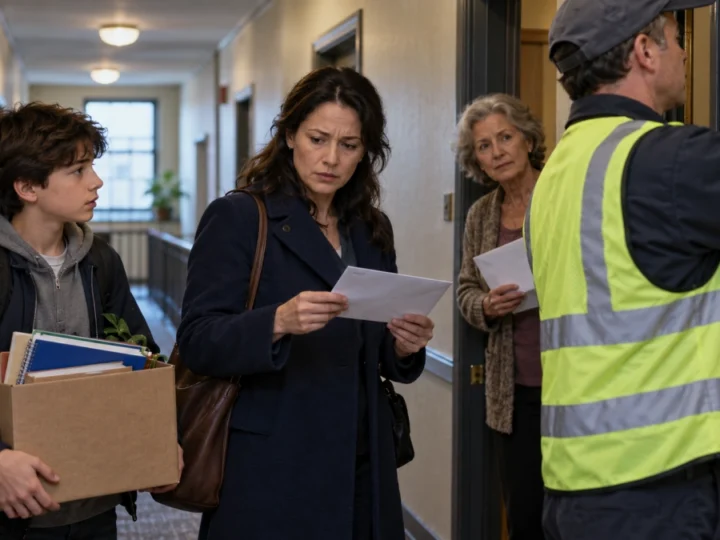
Her grocery bags were zipped shut. Her cane was upright beside her knee. She had checked her receipt, tucked it into her wallet, and fastened every button on her ochre raincoat. There was nothing confused about the way she looked at me.
"We still have one stop," she said.
Behind her, Mr. Bell shifted the insulated bag containing his groceries. Across the aisle, Ruth pressed the button on her watch to check the time. I had three passengers left, a return sheet clipped beside the steering wheel, and a daughter who expected me at school at four.
"We're heading home now," I told Irene.
"After the cemetery."
The rain ticked against the windshield. We were parked outside the grocery store in Dayton, finishing the Tuesday shopping route. I was thirty-nine, a part-time community shuttle driver, and very good at noticing when a trip was about to become something that wasn't on my sheet.
Irene lifted a small paper bag off her lap. "I asked last week. I wrote it on the form."
"Did dispatch confirm it?"
"Nobody said no."
My name is Mateo Santos. There are things that sound easy until you're the person behind the wheel. One extra stop. Five little minutes. A road you've driven a hundred times.
Then Irene told me Tuesday would have been her wedding anniversary. Victor had died eighteen months earlier. She had brought a smooth stone from their garden, wrapped in a clean handkerchief.
I looked at the route again. No cemetery. No time set aside for a visit. No way to make the promise she thought we'd already made without breaking promises to people still sitting behind her.
The first woman who called to tell me Arthur Kemp was dead asked whether I had eaten anything.
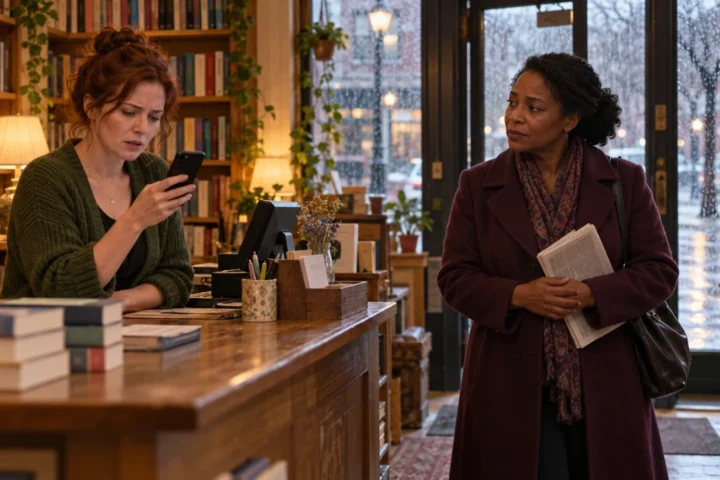
I was standing behind the register at the bookstore, trying to persuade a roll of receipt paper to fit. Rain slid down the front window. My coffee had gone cold beside a stack of used atlases.
"I'm sorry," I said. "Who are you trying to reach?"
She gave me a name I didn't know, then read my number back without my asking. I told her she had the wrong person. She apologized, but before hanging up she said, "Grief does that. You forget the smallest things."
By noon, six strangers had offered me food.
By three, a man wanted to know where to send flowers.
My name is Nell Foster. I was forty-one, I sold books in St. Paul, and the only Arthur I knew was a cat who belonged to the woman upstairs. I had not lost a father that morning. I had lost the ability to hear my phone without bracing myself.
Then someone sent me a photograph of an obituary.
Arthur Kemp had repaired school boilers, loved cribbage, and left behind a daughter named Beatrice. Near the bottom, beneath the memorial information, was my phone number.
I called the funeral organizer. His voicemail was full.
For the next caller, an older man who sounded frightened, I explained the error and read out the public memorial time. It seemed like the smallest decent thing to do.
An hour later, he called back.
"Wallace says you're handling everything now. Flowers, contributions. The family must be so grateful."
I looked at the obituary again. Somehow, without ever meeting the dead man, I had acquired a job in his funeral.
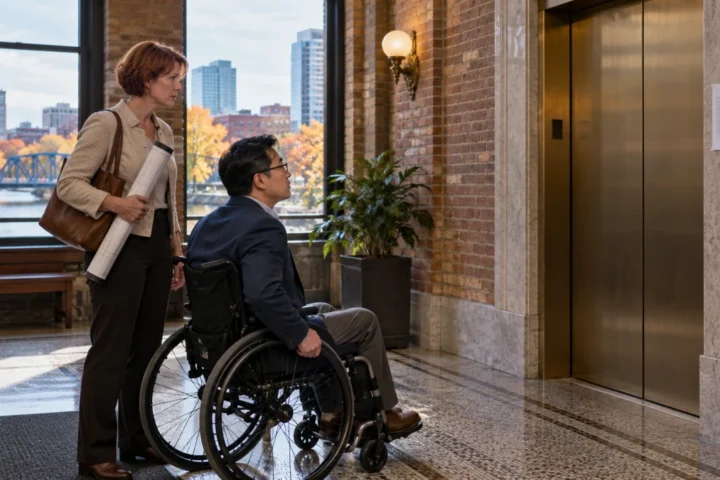
The elevator doors stayed closed while Beth Rowe explained that Miles Chen could still be part of the presentation from the bottom of the stairs.
“I'll put you on speaker,” she said. “You know I know the drawings.”
Miles looked from the small service notice to the presentation tube under her arm. Inside were the market forecourt plans he had spent three weeks revising. His name was on the drainage study. His measurements determined whether delivery trucks could turn without blocking the pedestrian route.
He had arrived twenty minutes early. Now there were twelve minutes before the Thursday pitch, and the meeting was three floors above him in an older Grand Rapids commercial building with one broken elevator.
“Where would I put the drawings?” he asked.
Beth glanced toward the narrow space beside the stairwell. She had not thought that far.
A building employee offered to find two strong people. Miles said no before the man finished. He would not be carried upstairs, and nobody would improvise a lifting arrangement with his wheelchair. The employee apologized and went to answer the desk phone.
Beth lowered her voice. “We can't lose this meeting.”
“Then we need a place where I can do it.”
His phone lit up with a message from Omar Velez, the client coordinating the proposal review. Were they in the building?
Miles typed yes, then paused. Beth was already reaching for the tube as though taking the drawings upstairs might save the morning.
He held it against his wheel.
“Don't take the work up without me,” he said.
Then he called Omar, not to ask permission to exist in the meeting, but to explain why the meeting needed to move.
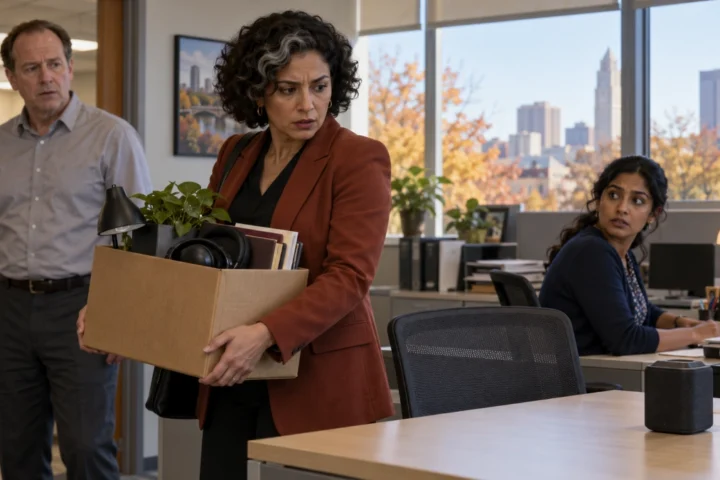
Farah Haddad was returning her headset when she heard herself offer to help a customer from the desk where she no longer worked.
Her cardboard box held a laptop, a charging cable, and the blue ceramic mug she had accidentally packed with company equipment. The mug was hers. Everything else had a yellow inventory sticker. After twelve years at the Columbus office, the distinction seemed almost funny.
Then the speaker said, in her voice, “Let's take this one step at a time.”
Farah stopped beside the empty desk. The little upward catch on “time” was hers too, a habit she had spent years trying to soften in recordings. Nobody was sitting behind the monitor.
Scott Avery came through the doorway carrying the equipment receipt. His pale gray shirt had a coffee stain near the pocket. He saw her looking at the speaker and stopped walking.
“That's the new assistant,” he said.
“I can hear that.”
Across the aisle, Priya Nair lowered her headset. Farah recognized the expression on her former coworker's face: the careful stillness people wore when they were being asked, without words, not to become witnesses.
Scott explained that the vendor had used the training library. Farah had recorded those examples herself. He had understood that the old recording permission covered the new system.
The assistant spoke again, describing a refund policy Farah had never read aloud.
She set the box down slowly. Her position had been eliminated on Friday. It was Tuesday morning, and apparently part of her had been given a new position without being asked.
“Turn that off while we talk,” she said.
Scott reached toward the speaker, then hesitated.
“I mean my voice,” Farah said. “Not just this speaker.”