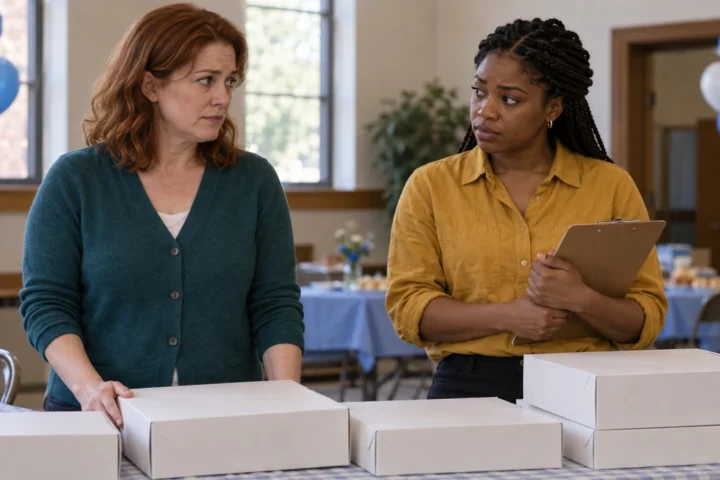
Bethany Wells was cutting the first cake when Zoe Fletcher asked why her name was on the announcement.
Not the cake boxes. Those were plain white, stacked on a folding table beneath the community center's basketball scoreboard. The name was in the fundraiser post everyone had been sharing since breakfast: Homemade cakes by Bethany Wells.
Bethany looked at the phone Zoe held above her plain clipboard. In the screen's reflection, her auburn hair seemed redder than usual, her teal cardigan almost gray.
"I didn't write that," she said.
"I know. I asked Martin to change it. He said you were fine with it."
Across the Milwaukee gym, Martin was arranging raffle baskets. Bethany had told him she was coordinating the cakes. She had also seen the draft announcement yesterday and postponed correcting it because the real explanation was difficult.
Now someone behind Zoe said, "Maybe ask her where the recipes came from."
The speaker was a volunteer named Paula. She had found a handwritten recipe card beside the cash envelope and decided that Zoe, who had brought neither cakes nor recipes, was selling somebody else's work under a false name. By noon, the story had grown a missing donation.
Zoe's braided hair shifted as she turned. Her mustard shirt had a streak of flour from helping plate slices.
"You need to say what you're accusing me of," she said.
Bethany set down the knife. She knew who had baked the cakes. She knew why that woman had asked not to be named. She also knew that silence was beginning to look like agreement with a lie.
Her phone buzzed inside her pocket. A message from the baker read: Please tell me you haven't put my name anywhere.
Bethany wiped her hands before answering. For the first time that morning, she stopped trying to make the problem disappear politely.
The blue bicycle caught Celia Moss by the grocery bag before anyone admitted it was in the way.
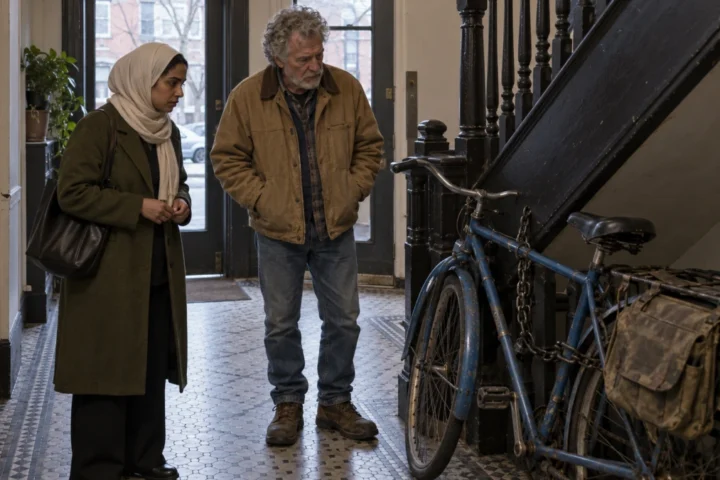
Amira Hassan heard glass strike the apartment hall tiles and turned from the mailboxes. A jar of peaches rolled beneath the radiator. Celia stood behind her walker, one hand shaking against its rubber grip, while the bicycle's brake lever held the torn handle of her bag.
Gus Mercer came out of the basement carrying a coffee cup. At sixty-seven, he still wore the tan work jacket he had worn fixing Richmond buses, although retirement had softened its shoulders. His gray curls were damp from the rain.
"I can tuck that farther back," he said.
"You tucked it back yesterday," Celia answered.
Amira set down her own bag. Her olive coat brushed the wheel as she reached for the peaches. Beneath the stairs, the bicycle was chained to a railing, its battered tool pannier bulging into the passage. She had walked around it for months without considering what walking around meant for somebody who could not turn sideways.
"It needs to come out," she said.
Gus looked at her as though she had slapped his cup away.
From the upstairs landing, a young man called, "That's the bike he uses to get to work on ours."
Another door opened. Someone mentioned a stroller. Someone else said Gus had saved her two weeks of bus fares. Celia remained in the middle of the hall with peaches dripping through a split paper sack.
Amira pulled a dish towel from her shopping bag and wrapped the broken jar.
"He can be helping people," she said, looking up at the gathered neighbors, "and this can still be blocking Celia."
Gus put his coffee on the bottom stair.
"Then help me unchain it," he said. "But don't tell me there's somewhere else until you've actually found somewhere."
I had come back for my socket set, not to hear my father become somebody else's father.
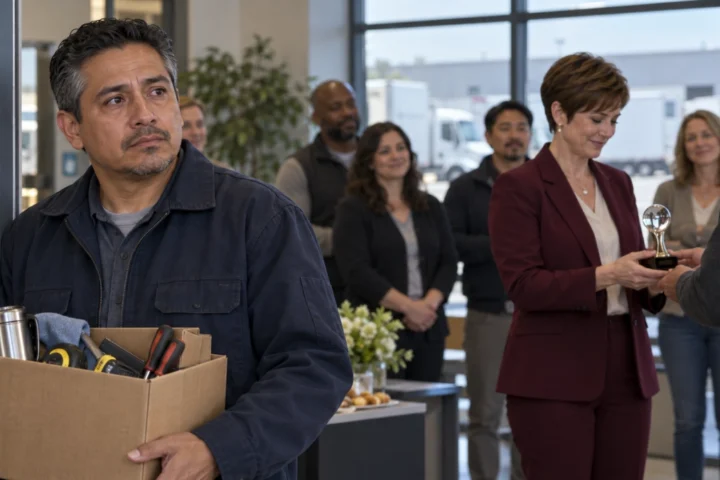
The security desk had already checked my name against the collection appointment. I stood at the edge of the lobby in my navy work jacket, holding a small cardboard box, while my former manager accepted a trophy beside the elevators.
Celeste Wynn's chestnut pixie cut caught the light. Her burgundy suit was the one she wore when visiting executives arrived. The trophy had no writing I could see, just a silver curve rising from a plain base.
“The idea came to me while caring for my father,” she said. “When someone you love can't tell you what they need, you learn to create a better signal.”
I knew the sentence because I had said it to her in a private meeting eight months earlier. My father could tell people what he needed. After his stroke, the words sometimes arrived late. That distinction had mattered when I explained why I wanted a predictable departure time.
Celeste had taken the sentence, removed the difficulty that made it true, and fitted it to her own mouth.
Behind her, Keiko Sato stopped clapping. Leon Ward looked down at his hands. They knew the dock readiness system on the display was not something Celeste had dreamed up alone. Keiko had tested the timing. Leon had found the flaw that could leave a driver waiting beside the wrong door.
My name appeared nowhere that I could see.
Then a communications employee lifted her phone to record the closing remarks. Celeste smiled toward the lens and began another sentence about the man who had raised her.
I put my box down before I could drop it.
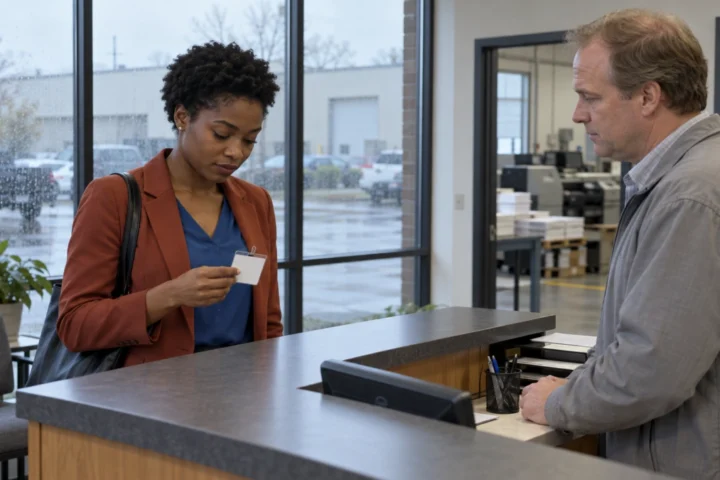
The badge Brent Keller handed me said visitor, although the job offer in my bag said employee.
There was no name on the little white rectangle. I stood at the plain reception counter in my rust blazer and blue blouse, rain cooling the back of my neck, and turned it over as if the other side might explain something.
“Everybody starts with one,” Brent said. His light gray jacket still had a store crease along the sleeve. “Agnes will get you settled.”
I had ironed that blouse at midnight. I had stopped applying for other jobs on Friday, after accepting his written offer for nineteen dollars an hour. At twenty nine, after four months without steady work, I had wanted one morning when I didn't have to introduce myself as available.
Behind the counter, Agnes Porter slid her green reading glasses down her nose. Her silver braid rested against a cardigan with a missing button.
“Did you bring lunch?” she asked.
It sounded like kindness. Later I would understand it was also a warning.
By noon I had corrected two delivery lists, answered calls, and arranged a replacement shipment for a customer whose funeral programs had gone to the wrong church. Brent stood beside my desk while I explained the mistake to a driver.
“That's the initiative we're looking for,” he said when I hung up.
Then he pushed a form toward me. Three trial days. No wages. No guarantee of employment.
I looked at the clock. Six hours since I had arrived. My sandwich was untouched.
“I already accepted the job,” I said.
Brent glanced toward Agnes, who had stopped sorting the mail.
“You accepted consideration,” he said. “Let's not get ahead of ourselves.”
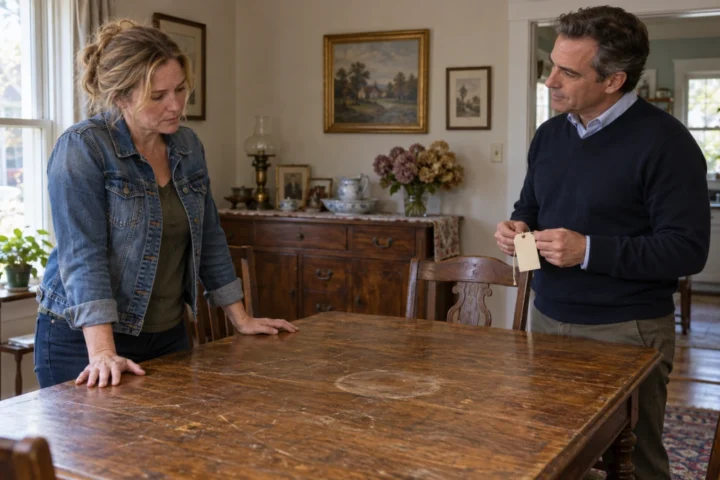
The man buying my mother's table brought a blank tag and a moving blanket. I kept both hands on the oak while he checked whether the legs would come off.
"One eighty, like we agreed," Adrian Shaw said.
I nodded. My car needed a six hundred forty dollar repair. I had four hundred sixty set aside, and the arithmetic was easier than looking at the empty dining room would be.
At forty six, I was old enough to know a scratched table wasn't my mother. Still, I could feel the pale ring where she had put a hot pan during the ice storm, feeding neighbors by candlelight. My dark blond hair kept falling across my face as I bent to undo the leaf catches. Adrian waited in his navy sweater, his dark hair gray at the temples, polite enough not to offer comfort I hadn't requested.
He paid. We carried the table out. I swept the rectangle of dust it had left behind.
Four days later, my brother sent me a photograph of the same table in Adrian's shop window. The asking price was twenty four hundred dollars.
That wasn't what made me sit down.
The sales listing called it a cherished piece from the private dining room of a prominent Louisville family. It described my mother's candlelit suppers as gatherings of civic leaders. Beneath that were photographs of Mom, my brother, and me, cropped to hide the paper plates and the broken screen door.
I had given Adrian those pictures to explain how the table came apart. Not to sell our childhood beside it.
Then I saw the surname he had attached to us.
It wasn't ours.
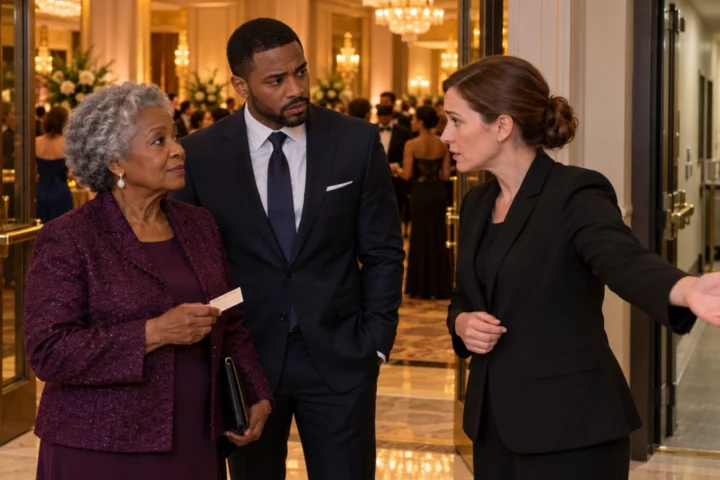
The woman in the black blazer looked at my mother's plum jacket, then pointed past the coat check toward a door marked for deliveries.
"Service check in is around the back. They'll give you an apron there."
My mother held out the ticket I had bought her. She did not laugh to make the woman comfortable. At sixty two, Harriet Cole had retired from a school cafeteria after thirty one years of feeding children who sometimes thanked her and sometimes dropped their trays without looking up. Tonight her silver natural hair caught the light from the ballroom chandeliers. She had asked me twice whether her jacket was dressy enough.
"I'm here with my son," she said.
I was standing right beside her in the dark suit she had helped me choose. On my lapel was a ribbon identifying me as an honoree. Beyond the open ballroom doors, our nonprofit's largest donor was waving me toward a photographer.
The staff woman glanced at my ribbon. "Of course. Let me find somewhere she can wait while we sort this out."
Somewhere. Not a chair at the table listed on her ticket. Not the reception where everyone else was being handed glasses of sparkling water.
My mother lowered her hand. That was the movement I noticed: the ticket disappearing against her side, as though she had brought an embarrassing document into the wrong office.
"Check both tickets," I said. "We'll wait here."
The donor, Vivian Beck, had stopped waving. My director was already crossing the foyer with the tight smile she used when a conversation might cost money.
My mother touched my wrist.
"Before you decide anything," she said, "ask me what I want."