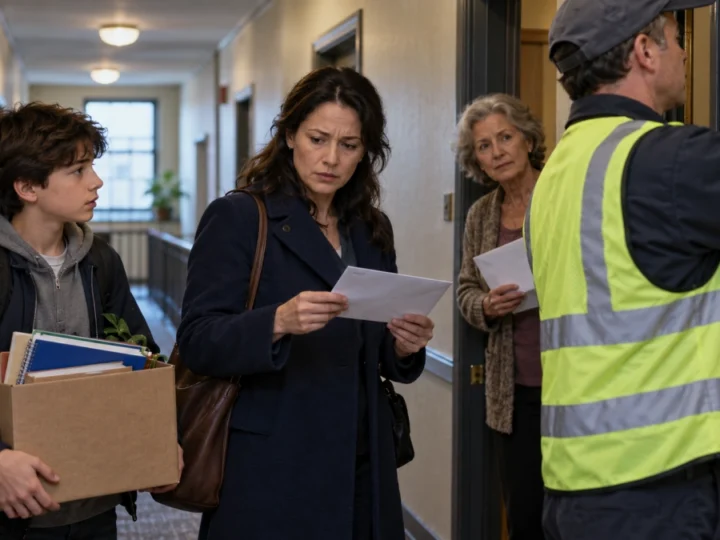
The invitation to my divorce party arrived while I was waiting for my husband to come home with dish soap.
It appeared between a grocery receipt and a reminder from the dentist: Saturday, seven o'clock, a celebration of Evan's fresh start. Under the cheerful artwork was a line inviting me to join if I felt comfortable.
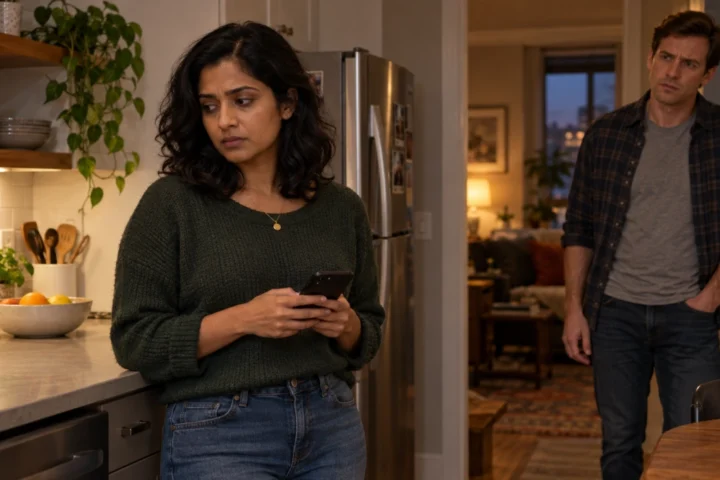
I stood beside our empty kitchen counter in Minneapolis and read it three times. We had argued about our marriage. We had discussed counseling. We had never agreed to separate, never divided our bills, never decided who would leave this apartment. No divorce had been finalized.
The host was Jules, our friend who always brought too many folding chairs. I could already imagine her arranging snacks, believing she was helping somebody survive a hard season.
Evan came through the doorway with brown hair flattened by his hat. He was thirty seven and suddenly looked younger, like someone hoping a broken window would be blamed on the wind.
"What's wrong?" he asked.
I held my phone with its screen facing me.
"Apparently we're having a party."
He set down the shopping bag. Something glass clinked inside it.
"Jules shouldn't have sent that to you."
Not: What party? Not: There has been a terrible mistake.
My wavy black hair had fallen across my face. I tucked it behind my ear so he would have to look directly at me.
"What did you tell her?"
He glanced toward the living room, where his shoes were still under the couch and his half finished puzzle covered our coffee table.
"That we're moving on."
"Who is we?"
The woman who called before sunrise said my husband's wedding ring was at the hotel reception desk.
I was standing in our Baltimore kitchen, holding the coffee Miles had promised to drink with me before another early meeting. His cup was still upside down on the rack.
"He asked me to call his emergency contact," the woman said. "His phone isn't working. He said you could collect it on your way to work, if that's convenient."
She didn't offer a room number. I didn't ask for one. For three weeks, my husband had been leaving after dinner and coming home with explanations that seemed prepared while I was still forming questions. Inventory trouble. A client in another time zone. A meeting that couldn't wait.
Last Thursday, a charge from this same hotel had appeared on our shared card. When I asked, he said it was parking near the office.
I put on my navy coat without finishing the coffee.
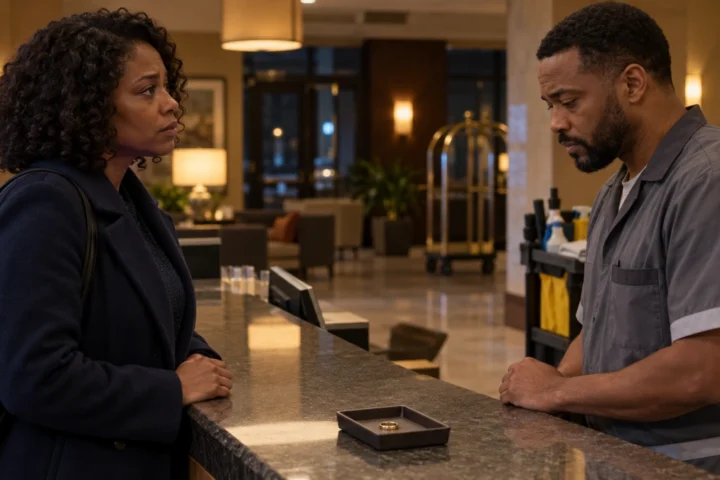
At reception, a small plain tray sat beside a stack of blank envelopes. His ring lay in it, the shallow scratch from our honeymoon catching the light. Then Miles came through a door behind the counter.
He wasn't wearing the charcoal suit he'd carried out of our bedroom the previous evening. He wore a gray housekeeping uniform. His close cropped hair was damp at the temples, and his short beard couldn't hide how tired he looked.
"Rowan," he said. "I thought you'd come later."
I looked from his uniform to the ring.
"Later than what?"
He reached toward the tray, stopped, and folded his hands.
"I need to tell you where I've been working."
My mother told my brother to move out of the family picture.
Not to the back row. Not beside the cousins who had arrived late. Out.
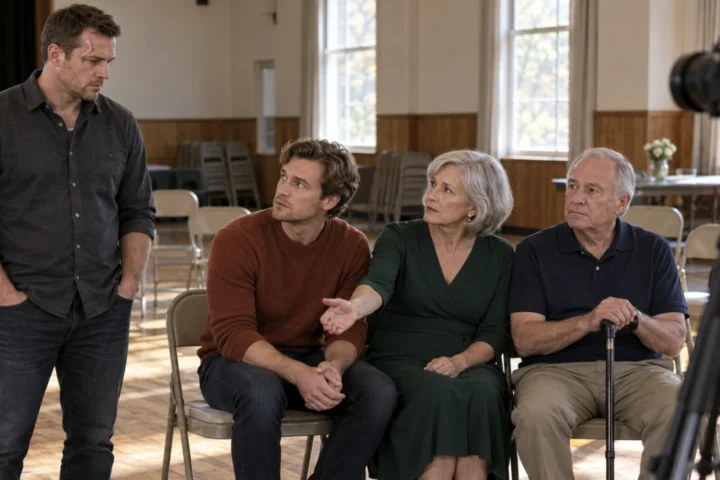
“Just until we do the main one, Aaron,” she said, waving toward the beige folding chairs along the community hall wall.
I had driven into Ohio the night before, and I still wore the rust sweater I had pulled from my bag. Beside me, my father sat with his cane between his knees. My mother, Vera, smoothed the waist of her green dress as if that were what had gone wrong.
Aaron stood at the edge of the group in a plain charcoal shirt. At thirty-nine, he had the same broad shoulders I remembered, the same pale scar beside his left eyebrow. He looked at the space she had pointed to, then took one step toward it.
“Wait,” I said. “Why is he moving?”
The photographer lowered her camera. A cousin laughed because he thought I was making a joke.
“We've already explained he's away,” Mom said quietly.
I looked at Aaron. “Away where?”
A woman near the refreshment table answered before he could. “Overseas, isn't it? Your mother says the work keeps him traveling.”
Aaron worked at a warehouse twenty minutes from our parents' house. I knew that. I knew he had left school at seventeen after Dad's fall, when I was eleven. I knew more of what he had paid for than he liked me to mention.
What I did not know was that my family had found a way to make him absent while he stood in the room.
Mom touched my sleeve. “Caleb, please. Not in front of everyone.”
Aaron reached the chairs, picked up his jacket, and stopped waiting for anyone to tell him where to stand.
My father pushed the envelope back across the kitchen table without opening it.
“You already told me this,” he said.
I had not. That was the point.
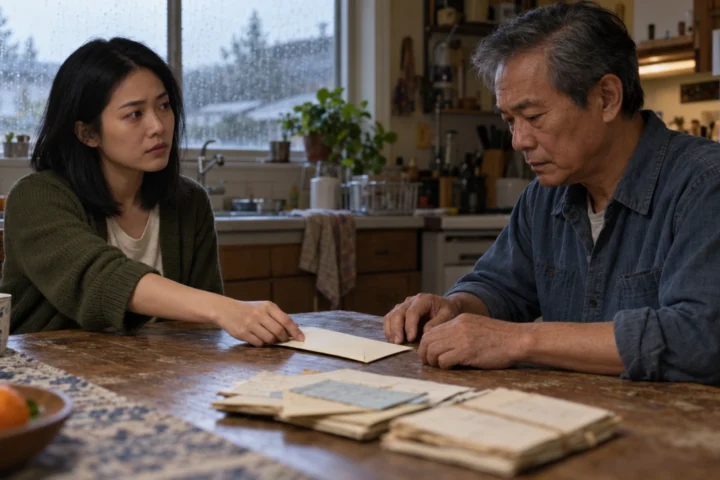
Outside his Tacoma window, rain trembled on the bare branches. I was thirty-two, still wearing my olive cardigan from work, and the cream envelope between us had traveled through three apartments before coming home to him. Inside was a letter I had written at twenty-four, asking whether he would come to a small concert where I was going to sing alone for the first time.
He had never come. He had never mentioned the invitation.
“Tell me what I said, then.”
Dad rubbed a pale thread from the cuff of his faded blue work shirt. His salt-and-pepper hair was flattened on one side, as though he had slept in his shop again. He could make a ruined chair look loved instead of new. He could hear a loose spring under three layers of fabric. But that afternoon, he would not look at a sheet of paper.
I had found eleven of my letters in a tin under his bed while helping him search for a spare house key. Their envelopes were open. Their pages were folded with care.
“Read this one,” I said. “Just the first part.”
“Linh.”
“You told Aunt Mai I stopped writing. You said I got busy.”
He reached for his glasses, put them on, and took them off again.
My mother had been dead for six years. Until that moment, I had thought the silence belonged to grief, or stubbornness, or something wrong with me.
Dad laid both hands flat on the table.
“If I read it,” he said, “you will know something I should have told you before you ever sent it.”
The video began with Nina Park carrying a library book toward her car. It did not show the cart beside the dumpster, the rain starting, or the handwritten sentence that had made her stop.
By breakfast, a man she had never met was calling her a thief beneath a photograph of her volunteer badge.
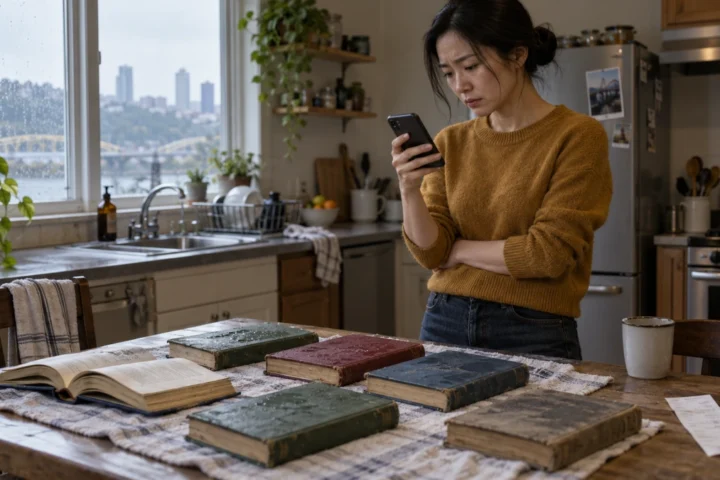
Nina watched the clip standing in her kitchen in the same ochre sweater she had worn the previous evening. Her black hair was still in its low bun. On the table lay six books, their faded cloth covers drying beside a grocery receipt.
Inside one, a dead man had written, Beth called. Did not answer. Must do better tomorrow.
She had not meant to take that sentence home. She had been looking for his descriptions of the neighborhood before the steel mill closed, the little observations he penciled beside whatever he happened to be reading. She had imagined saving a voice.
Now that voice was open on her table, saying something its owner's daughter might never have been meant to see.
Her phone rang. Gloria Hayes, the library manager, did not waste time asking whether Nina had seen the video.
"Bring everything back before we open. Don't post anything."
"They were withdrawn books."
"I know what they were. That isn't the same as permission to take them."
Nina looked at the six volumes. One had a warped spine. Another carried a red pencil line under the words forgive yourself.
"Can I explain when I get there?"
"Yes," Gloria said. "But bring the books first."
At the bottom of the screen, a new message appeared from Beth Voss.
Those are my father's. Please tell me you have not photographed the pages.
The letter asking Dana Reeves to turn off her father's porch light arrived inside a sympathy card.
Someone had crossed out the printed message and written, I am sorry about Walter. I am also still awake at three in the morning.
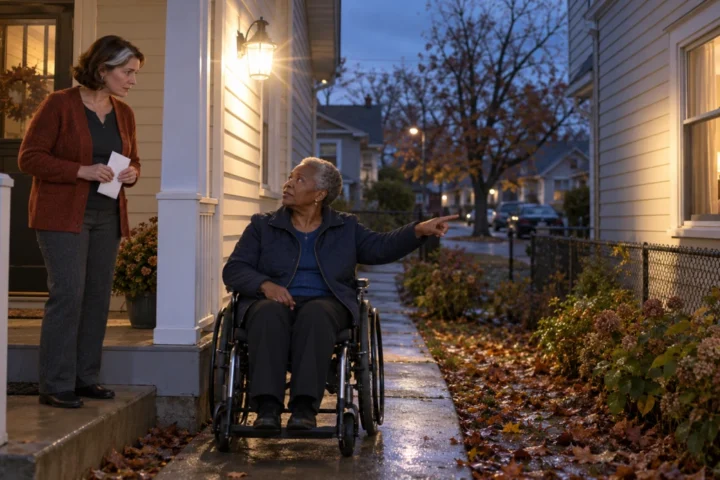
Dana stood beneath the clear glass fixture in her rust cardigan, holding the card by its corners. Across the narrow side yard, Ruth Bell waited on the concrete path in her wheelchair. Her navy jacket was zipped to her chin. She pointed toward the white rectangle burning across her bedroom curtains.
"I asked him twice," Ruth said. "He meant to fix it."
At forty-three, Dana had returned to Dayton with a divorce, a temporary bookkeeping contract, and the keys to a house full of things her father had meant to fix. The porch lamp seemed like one problem she could solve without a probate folder or a screwdriver.
She reached inside the door and flipped the switch.
Ruth's window went dark. So did the porch, the cracked flowerpot, and the empty wooden chair facing the street.
"Thank you," Ruth said, without triumph.
Four hours later, someone knocked hard enough to rattle the brass mail slot.
A man in a reflective vest stood outside. Behind him, a woman with a strawberry-blond braid hugged a green work jacket around herself. A city bus was already pulling away from its regular stop at the corner.
"I'm Eddie," the man said. "I drive the late route. Did something happen to Walter's light?"
Dana tightened her hand around the door.
"Walter died."
His expression changed. "I'm sorry. I didn't know."
The woman behind him glanced at the empty chair.
"My ride isn't coming," she said. "And I thought this was still where we could wait."