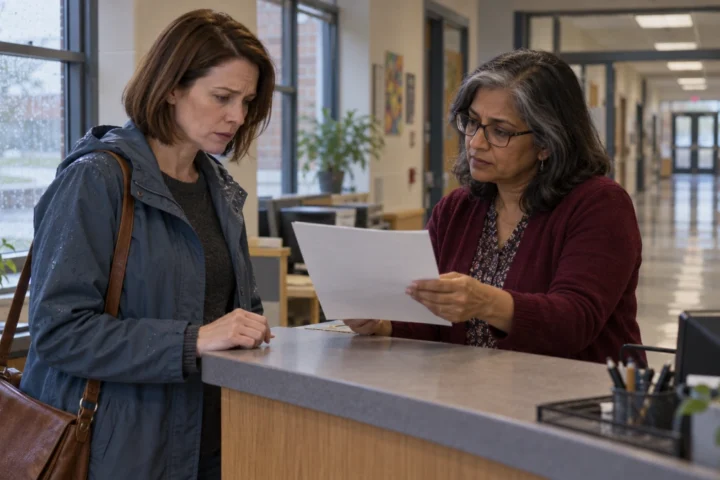
The video began with Nina Park carrying a library book toward her car. It did not show the cart beside the dumpster, the rain starting, or the handwritten sentence that had made her stop.
By breakfast, a man she had never met was calling her a thief beneath a photograph of her volunteer badge.
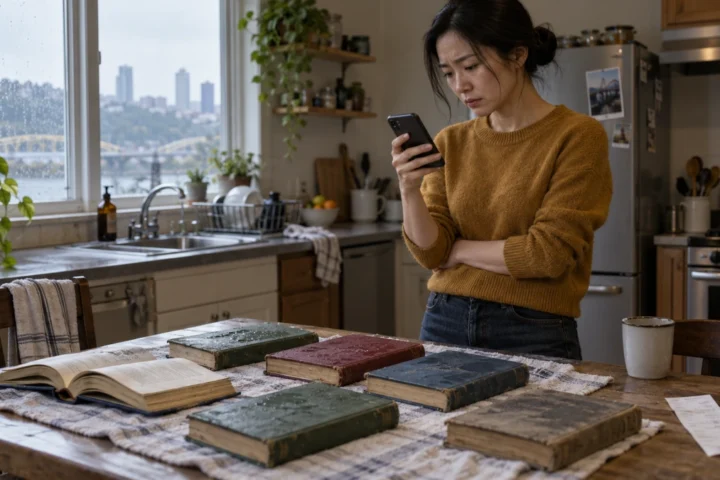
Nina watched the clip standing in her kitchen in the same ochre sweater she had worn the previous evening. Her black hair was still in its low bun. On the table lay six books, their faded cloth covers drying beside a grocery receipt.
Inside one, a dead man had written, Beth called. Did not answer. Must do better tomorrow.
She had not meant to take that sentence home. She had been looking for his descriptions of the neighborhood before the steel mill closed, the little observations he penciled beside whatever he happened to be reading. She had imagined saving a voice.
Now that voice was open on her table, saying something its owner's daughter might never have been meant to see.
Her phone rang. Gloria Hayes, the library manager, did not waste time asking whether Nina had seen the video.
"Bring everything back before we open. Don't post anything."
"They were withdrawn books."
"I know what they were. That isn't the same as permission to take them."
Nina looked at the six volumes. One had a warped spine. Another carried a red pencil line under the words forgive yourself.
"Can I explain when I get there?"
"Yes," Gloria said. "But bring the books first."
At the bottom of the screen, a new message appeared from Beth Voss.
Those are my father's. Please tell me you have not photographed the pages.
The letter asking Dana Reeves to turn off her father's porch light arrived inside a sympathy card.
Someone had crossed out the printed message and written, I am sorry about Walter. I am also still awake at three in the morning.
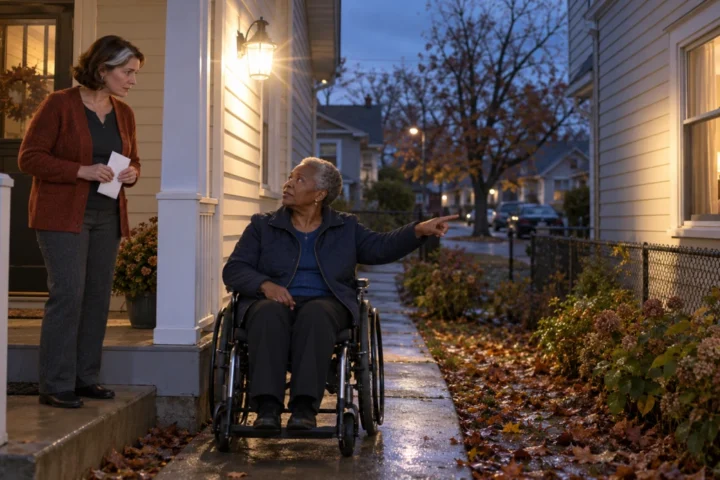
Dana stood beneath the clear glass fixture in her rust cardigan, holding the card by its corners. Across the narrow side yard, Ruth Bell waited on the concrete path in her wheelchair. Her navy jacket was zipped to her chin. She pointed toward the white rectangle burning across her bedroom curtains.
"I asked him twice," Ruth said. "He meant to fix it."
At forty-three, Dana had returned to Dayton with a divorce, a temporary bookkeeping contract, and the keys to a house full of things her father had meant to fix. The porch lamp seemed like one problem she could solve without a probate folder or a screwdriver.
She reached inside the door and flipped the switch.
Ruth's window went dark. So did the porch, the cracked flowerpot, and the empty wooden chair facing the street.
"Thank you," Ruth said, without triumph.
Four hours later, someone knocked hard enough to rattle the brass mail slot.
A man in a reflective vest stood outside. Behind him, a woman with a strawberry-blond braid hugged a green work jacket around herself. A city bus was already pulling away from its regular stop at the corner.
"I'm Eddie," the man said. "I drive the late route. Did something happen to Walter's light?"
Dana tightened her hand around the door.
"Walter died."
His expression changed. "I'm sorry. I didn't know."
The woman behind him glanced at the empty chair.
"My ride isn't coming," she said. "And I thought this was still where we could wait."
The envelope was already inside Lena Ortiz's locker when she arrived for the early shift, resting between her spare gloves and the photograph of a dog she no longer owned.
It was cream, unsealed, and thick enough to lift the gloves at one corner. A folded edge of currency showed through its mouth. On the front, someone had written only her first name.
Lena stopped with her hand against the locker door.
At the Dayton maintenance shop, people left things for one another all the time: borrowed sockets, grocery coupons, a sandwich someone had forgotten in the refrigerator. They did not leave money. Especially not the week the contractor's internal auditors were coming to ask why the records for city vehicles looked cleaner than the vehicles themselves.
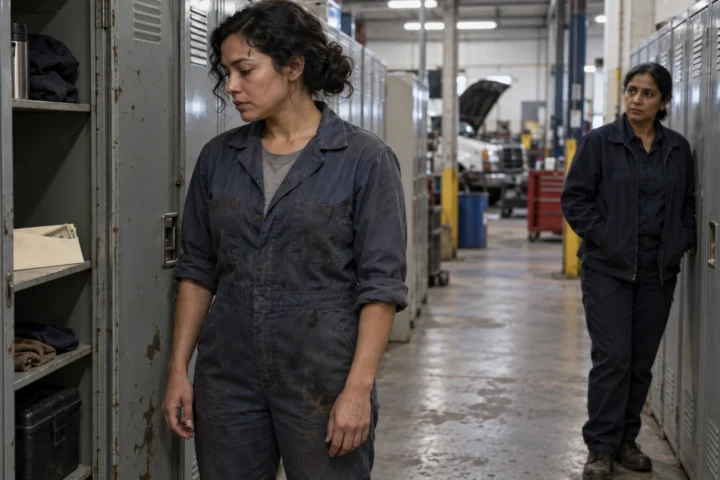
Behind her, an air compressor started. She could feel the vibration through her scuffed brown boots. Her slate-blue coveralls smelled faintly of yesterday's work, and one dark curl had escaped the low bun at her neck.
She had seen an invoice on Tuesday for a cooling-system repair that, as far as she knew, had never happened. Her supervisor, Frank Danner, had called it an administrative delay. Her mentor, Walt Mercer, had told her to give him a day.
Now there was cash beside her gloves.
Lena withdrew her hand and called Priya Shah from the parts desk. She asked her to come to the lockers, without touching anything on the way.
Priya stopped at the end of the empty aisle in her navy work jacket. She looked from Lena's face to the shelf.
"Do you know where it came from?"
"No."
"Then let's keep it that way until someone records it."
Before Lena could answer, Walt appeared beyond the doorway.
He saw the open locker, the envelope, and Priya standing there.
"Don't make a big thing of this," he said.
At five forty on Friday morning, Tessa Brooks found her own name printed across the day she had already been promised off.
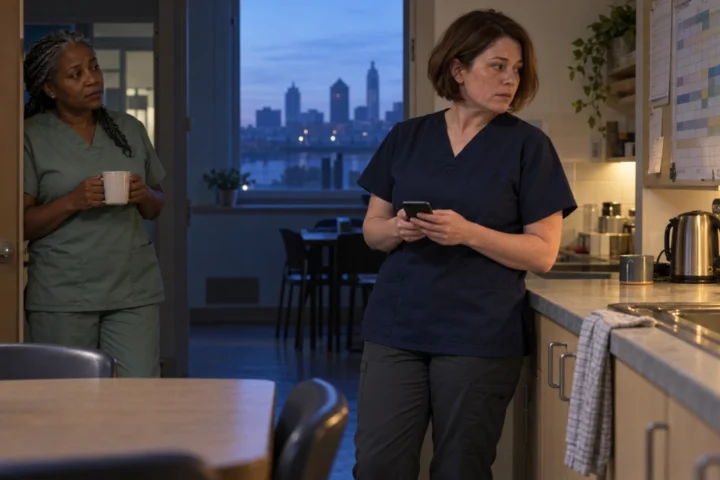
The schedule hung beside the kettle in Linden House's staff kitchenette. Someone had circled the seven o'clock shift in red, hard enough to tear the paper. Outside the small window, Columbus was still blue with darkness. Tessa stood under the amber cupboard light in her navy scrubs, phone in one hand, the leave approval open on its screen.
She had come early to collect the thermos she had forgotten after Thursday's shift. At eight, movers would arrive at her mother's apartment. Ruth Brooks had waited nineteen months for a place without stairs. The elevator reservation, the truck deposit, the friend driving over from Newark: none could simply be moved to Saturday.
From the doorway, Celia Price watched her without drinking from her mug. Silver showed through the braids tied behind her head.
"Please tell me that's an old copy," Celia said.
Tessa touched the date. It was tomorrow's date crossed out, today's written above it. The names underneath were unchanged.
Her manager answered on the fourth call.
"You need to arrange your coverage," Denise said, before Tessa finished explaining.
"You approved this three weeks ago. I reminded you Tuesday."
"And you're physically there now. Let's not turn this into a refusal to work."
Across the hall, a radio played softly behind the closed office door. Celia had been awake all night. The residents were safe, but the next shift needed two people, and only one was coming.
Tessa looked at the forgotten thermos beside the sink. She had never felt so trapped by something she had not agreed to do.
Then Denise added, "If you walk out, I'll have to record what happened."
Tessa put the call on speaker and asked Celia to stay.
Grant Bell waited until Elena Ruiz had locked her car before telling her it could not stay behind the restaurant.
"We're trying to present a different image," he said.
Elena looked at her faded blue sedan, then at the grease barrels beside the service door. The passenger door was silver because a matching replacement had cost more than she could spare. The engine ran. The lights worked. Nothing leaked onto the cracked Richmond pavement.
"It's behind the building," she said.
"Guests can see it from the patio entrance."
She held her keys between two fingers. Through the rear window she could see her mother's brown sewing case. Rosa had asked for a ride after finishing a curtain repair nearby. Elena would collect her after the dinner shift; until then, the tools were safer locked inside than carried through a crowded kitchen.
Grant, clean shaven in a pale blue shirt and dark apron, gestured toward the alley. "Use the overflow lot tomorrow. Tonight we're already late."
Elena went inside. The staff board still showed the parking instruction she had followed for nineteen months: rear spaces after four, leave the loading area clear. Her car occupied the farthest marked space, nowhere near a delivery door.
At ten seventeen, a dishwasher came looking for her. He had seen a truck pulling a blue car out of the lot.
Grant reached for a folder instead of his phone. "The rule changed this afternoon. There was a notice."
"You just told me tomorrow."
"I meant the overflow arrangement."
Elena walked outside. The empty space seemed smaller without her car in it. A new sign stood near the gate, turned toward arriving drivers, where she would not have passed it on her way into work.
Her mother called then. Elena answered before Rosa could ask where she was.
"Don't leave the library steps," she said. "I'm finding out where they took your tools."
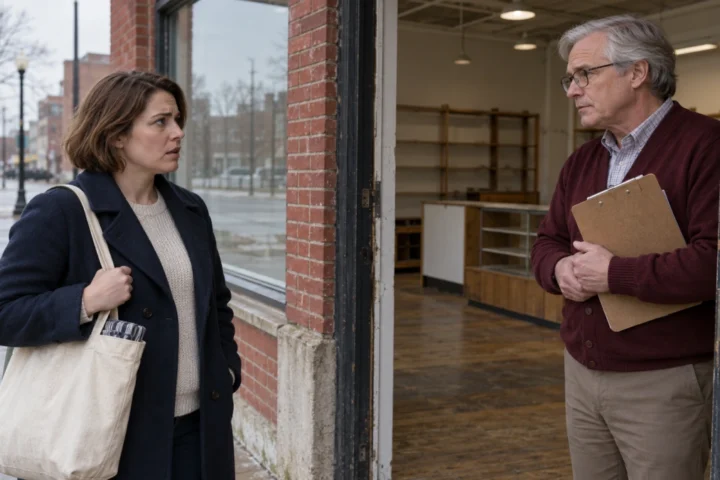
Nora Ellis arrived with a folded apron in her canvas tote and a loaf of bread for the man who was supposed to hand her the keys. Outside the empty brick shop, the October wind pushed a receipt along the Dayton sidewalk. Martin Voss opened the door only far enough to keep the warmth inside.
"I thought Leah called you," he said.
Nora smiled because she did not yet know what else to do. She had spent three years baking before her warehouse shift, saving tips from weekend markets in a separate account. Eight thousand dollars had finally purchased something more substantial than permission to dream.
Martin held his clipboard against his burgundy cardigan. "The reservation was reassigned. You're not taking this unit."
"I paid for this unit."
"Your representative submitted a change."
Leah Moreno was more than a representative. She had held Nora's hair during a stomach virus, helped bury her father, and remembered which market customers needed bread without sesame. She also handled administrative work for small businesses. Nora had paid her to review the shop paperwork because friendship did not make someone's labor free.
Martin turned a page. Nora saw her own last name beside a different address.
Ellis Sandwich Company.
Her brother's company.
Owen had called the previous evening to say that things were finally working out. Nora had congratulated him while scrubbing flour from the seams of her kitchen table. She remembered the relief in his voice now, and the way he had asked whether she had spoken to Leah.
"Don't print anything new," Nora said. "Show me exactly what you already have."
Martin hesitated, then stepped aside. Nora carried the bread inside with her. She had imagined crossing this threshold as a tenant. Instead, she sat at a bare counter and asked to see the record of who had spent her future.
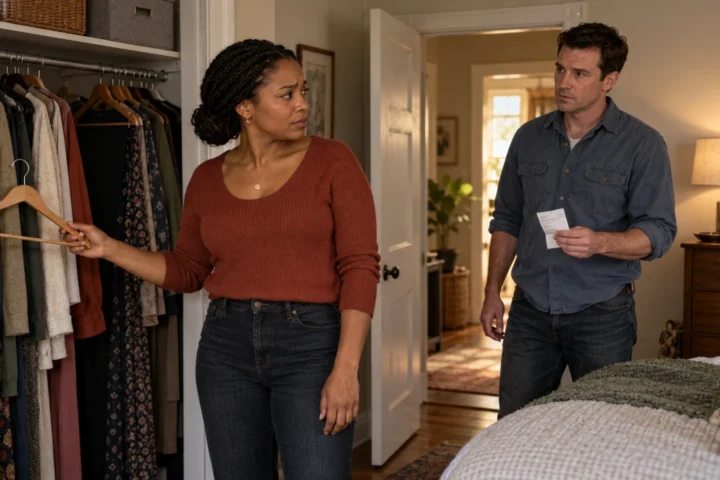
Leah found the empty hanger before she found the receipt.
The dress had hung between her winter coat and the blouse with the loose cuff button, dark teal, sleeves long enough for an overcooled conference room. She had left its tags on because her payroll training did not begin until Monday. Buying something specifically for the first morning had felt extravagant, even after she checked their budget twice.
Now the hanger knocked against the closet rail in her hand.
Owen stood in the bedroom doorway wearing his faded blue work shirt. He looked at the hanger, then at her rust-colored sweater, as if either object might suggest a better beginning.
"I returned it," he said.
Their Columbus apartment was quiet except for the neighbor's vacuum cleaner coming through the wall.
"You went into my closet?"
"It still had the tags. You hadn't worn it."
"I hadn't gone to the training yet."
He took a folded receipt from his pocket. Leah reached for it, expecting the amount she already knew: eighty-nine dollars and tax. Instead she noticed the last four digits beside the refund. They belonged to neither the household card nor the account where she kept her small personal allowance.
"Whose card is this?"
Owen rubbed his thumb along the doorframe.
"Mine."
"I paid with our card."
"I know. They let me put the refund there because I didn't bring it."
She looked at him until he stopped studying the floor.
"There's a balance," he said. "I needed to get it down."
Leah set the hanger on the bed.
"How much?"
He gave her a number. Then, before she could speak, he added, "And I canceled Monday. We couldn't afford you being gone."
The reservation said three guests. Mara checked it twice before she asked Ben who else was coming to their anniversary dinner.
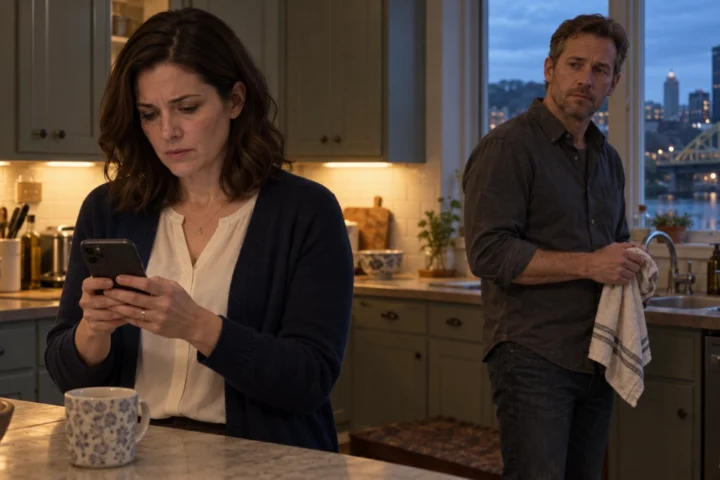
He stood beside the kitchen sink with a dish towel twisted between his hands. Outside their Pittsburgh duplex, October rain darkened the brick steps. Mara was still wearing her navy cardigan over the ivory blouse she had worn to work, and she had been deciding whether it was too ordinary for twelve years of marriage.
Now the blouse seemed like the least important decision in the room.
"Elise Ward," he said.
Mara knew the name. Six years earlier, Elise had worked with Ben at the distribution company that offered him a promotion in Cleveland. Mara had never met her, but she had heard her voice once, on speakerphone, confirming that the company had withdrawn the offer after Ben requested more time.
For six years, Ben had referred to Cleveland whenever their life disappointed him. When the furnace failed. When his younger brother bought a house. When Mara accepted a Saturday shift at the neighborhood arts center instead of visiting another open house.
I could have been somewhere else, he would say. We made our choice.
Mara had believed the choice was hers. Her mother had been recovering from an accident then, and she had asked whether they could wait until summer to move.
"Why would she come to our anniversary?"
Ben set down the towel with such care that Mara stopped looking at the reservation.
"Because she won't keep saying what I asked her to say."
The phone went dark in Mara's hand.
"Then cancel the restaurant," she said. "Whatever this is, you don't get to put a waiter beside it."
The unfamiliar name appeared between Owen's father's number and the box for special instructions.
Leah Mercer. Authorized pickup.
Claire Bennett read it twice while rain ran down the school office window. She had come to collect her eight-year-old for a dentist appointment, not discover a stranger on his emergency form.
"Who added her?"
Ms. Patel turned the paper so she could check the entry. "His father submitted the update. Let me look at the notes before we make assumptions."
"Has she picked him up?"
"No. Owen is with his teacher. You're the person collecting him today."
The administrator's calm helped Claire keep her own voice low. She loosened the strap of her brown shoulder bag and asked for a copy of the form. Beneath her slate-blue raincoat, her sweater felt suddenly too warm.
Daniel had mentioned no new girlfriend. Their divorce agreement had not made them experts at telling each other things, but they usually managed schedules, shoes, and school notices without surprises.
Claire called him from the empty stretch of counter.
"Who's Leah Mercer?"
For a moment she heard only the indicator clicking in his car.
"I meant to explain."
"Explain now."
"She won't pick Owen up without us talking. I told her that."
"Then why put her on the form?"
He stopped the indicator. Somewhere behind Claire, a copier started feeding paper.
"Because she asked if she could help sometime. Because I thought it would make things simpler."
"What things?"
His next answer arrived quietly enough that she had to press the phone closer.
"She's my daughter."
Claire looked at the unfamiliar name again. Daniel had been her husband for eleven years. Owen knew every cousin on his father's side, every dog the family had owned, every version of the story about the broken canoe.
He had never been told he had a sister.
Walter Reed knew the feel of a bad lock. For thirty years he had repaired doors in factories, apartment buildings, and nursing homes, and he knew when a cylinder needed graphite and when somebody had installed a different one.
This one was different.
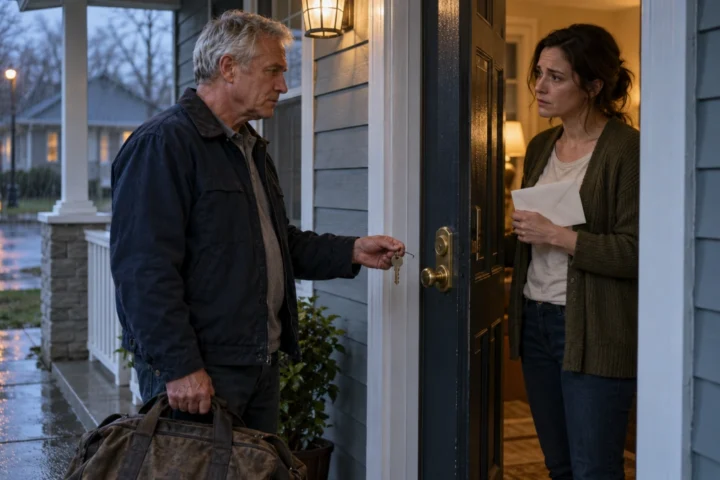
He stood on his Dayton porch with rain dripping from his navy work jacket and tried his key once more. Beside his boot, the brown canvas duffel sagged like something equally tired of traveling. Inside the house, his daughter switched on the hall light.
Nora opened the door only as far as the chain allowed. Her dark hair was tied back, and she wore the olive cardigan he had bought her last Christmas.
"Dad. You said tomorrow."
"Job finished early."
She looked at his key. He looked past her at the empty rectangle beside the stairs, where his mother's walnut cabinet had stood since before Nora was born.
"You changed my lock."
"I have a key for you."
She closed the door to release the chain. That small necessary movement hurt more than he wanted to admit. He had spent eleven nights sleeping beside an interstate so he could keep this house, and now his own daughter was making him wait outside it.
When she reopened the door, she held a plain envelope.
"Before you call Uncle Glenn," she said, "please let me explain."
Walter had not mentioned his brother.
From the kitchen came the steady clicking of the dishwasher. On the hall table lay a receipt from a locksmith and a photograph of the missing cabinet, its drawers standing open in somebody else's garage.
"Where is it?" he asked.
Nora did not offer the envelope again.
"That's what I was trying to find out when he used your spare key yesterday."