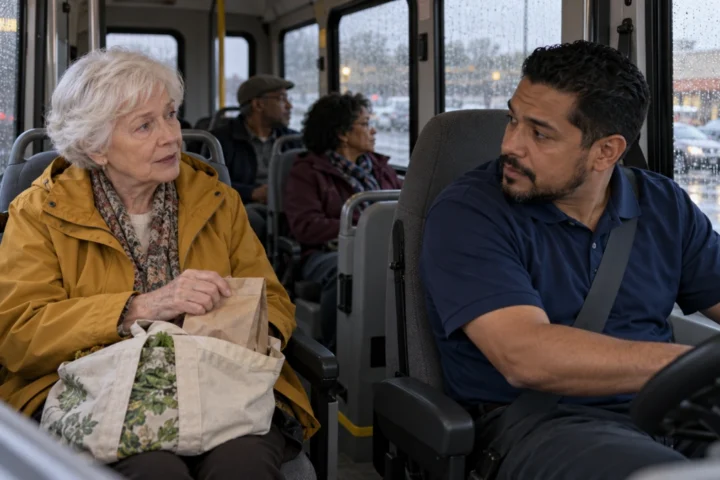
Irene Webb kept her paper bag as I closed the shuttle door.
Her grocery bags were zipped shut. Her cane was upright beside her knee. She had checked her receipt, tucked it into her wallet, and fastened every button on her ochre raincoat. There was nothing confused about the way she looked at me.
"We still have one stop," she said.
Behind her, Mr. Bell shifted the insulated bag containing his groceries. Across the aisle, Ruth pressed the button on her watch to check the time. I had three passengers left, a return sheet clipped beside the steering wheel, and a daughter who expected me at school at four.
"We're heading home now," I told Irene.
"After the cemetery."
The rain ticked against the windshield. We were parked outside the grocery store in Dayton, finishing the Tuesday shopping route. I was thirty-nine, a part-time community shuttle driver, and very good at noticing when a trip was about to become something that wasn't on my sheet.
Irene lifted a small paper bag off her lap. "I asked last week. I wrote it on the form."
"Did dispatch confirm it?"
"Nobody said no."
My name is Mateo Santos. There are things that sound easy until you're the person behind the wheel. One extra stop. Five little minutes. A road you've driven a hundred times.
Then Irene told me Tuesday would have been her wedding anniversary. Victor had died eighteen months earlier. She had brought a smooth stone from their garden, wrapped in a clean handkerchief.
I looked at the route again. No cemetery. No time set aside for a visit. No way to make the promise she thought we'd already made without breaking promises to people still sitting behind her.
The first woman who called to tell me Arthur Kemp was dead asked whether I had eaten anything.
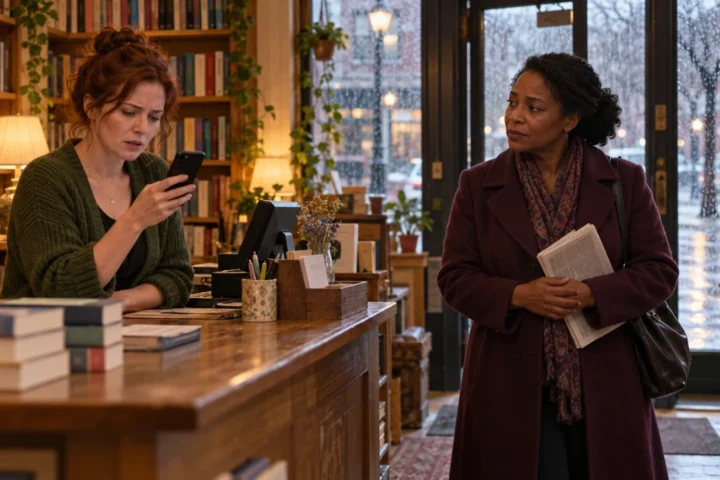
I was standing behind the register at the bookstore, trying to persuade a roll of receipt paper to fit. Rain slid down the front window. My coffee had gone cold beside a stack of used atlases.
"I'm sorry," I said. "Who are you trying to reach?"
She gave me a name I didn't know, then read my number back without my asking. I told her she had the wrong person. She apologized, but before hanging up she said, "Grief does that. You forget the smallest things."
By noon, six strangers had offered me food.
By three, a man wanted to know where to send flowers.
My name is Nell Foster. I was forty-one, I sold books in St. Paul, and the only Arthur I knew was a cat who belonged to the woman upstairs. I had not lost a father that morning. I had lost the ability to hear my phone without bracing myself.
Then someone sent me a photograph of an obituary.
Arthur Kemp had repaired school boilers, loved cribbage, and left behind a daughter named Beatrice. Near the bottom, beneath the memorial information, was my phone number.
I called the funeral organizer. His voicemail was full.
For the next caller, an older man who sounded frightened, I explained the error and read out the public memorial time. It seemed like the smallest decent thing to do.
An hour later, he called back.
"Wallace says you're handling everything now. Flowers, contributions. The family must be so grateful."
I looked at the obituary again. Somehow, without ever meeting the dead man, I had acquired a job in his funeral.
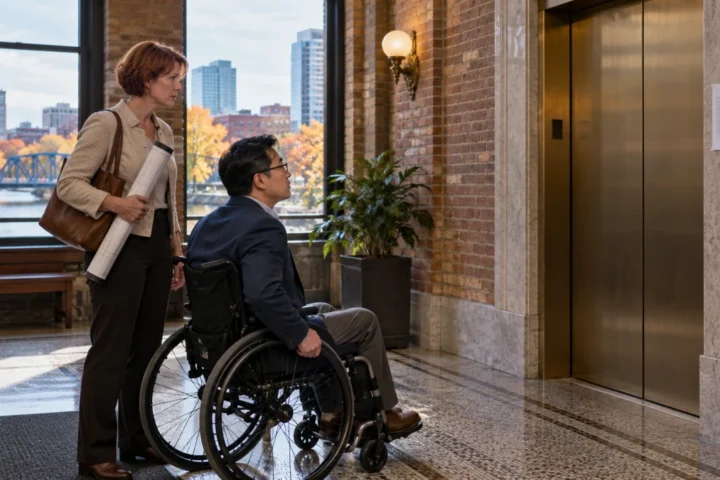
The elevator doors stayed closed while Beth Rowe explained that Miles Chen could still be part of the presentation from the bottom of the stairs.
“I'll put you on speaker,” she said. “You know I know the drawings.”
Miles looked from the small service notice to the presentation tube under her arm. Inside were the market forecourt plans he had spent three weeks revising. His name was on the drainage study. His measurements determined whether delivery trucks could turn without blocking the pedestrian route.
He had arrived twenty minutes early. Now there were twelve minutes before the Thursday pitch, and the meeting was three floors above him in an older Grand Rapids commercial building with one broken elevator.
“Where would I put the drawings?” he asked.
Beth glanced toward the narrow space beside the stairwell. She had not thought that far.
A building employee offered to find two strong people. Miles said no before the man finished. He would not be carried upstairs, and nobody would improvise a lifting arrangement with his wheelchair. The employee apologized and went to answer the desk phone.
Beth lowered her voice. “We can't lose this meeting.”
“Then we need a place where I can do it.”
His phone lit up with a message from Omar Velez, the client coordinating the proposal review. Were they in the building?
Miles typed yes, then paused. Beth was already reaching for the tube as though taking the drawings upstairs might save the morning.
He held it against his wheel.
“Don't take the work up without me,” he said.
Then he called Omar, not to ask permission to exist in the meeting, but to explain why the meeting needed to move.
Farah Haddad was returning her headset when she heard herself offer to help a customer from the desk where she no longer worked.
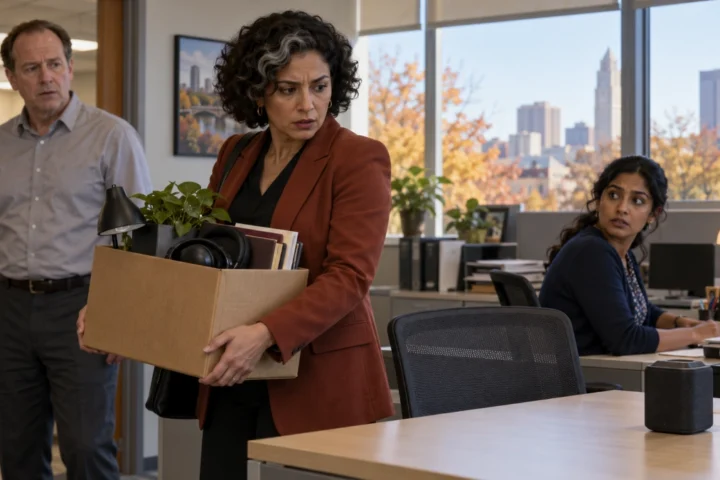
Her cardboard box held a laptop, a charging cable, and the blue ceramic mug she had accidentally packed with company equipment. The mug was hers. Everything else had a yellow inventory sticker. After twelve years at the Columbus office, the distinction seemed almost funny.
Then the speaker said, in her voice, “Let's take this one step at a time.”
Farah stopped beside the empty desk. The little upward catch on “time” was hers too, a habit she had spent years trying to soften in recordings. Nobody was sitting behind the monitor.
Scott Avery came through the doorway carrying the equipment receipt. His pale gray shirt had a coffee stain near the pocket. He saw her looking at the speaker and stopped walking.
“That's the new assistant,” he said.
“I can hear that.”
Across the aisle, Priya Nair lowered her headset. Farah recognized the expression on her former coworker's face: the careful stillness people wore when they were being asked, without words, not to become witnesses.
Scott explained that the vendor had used the training library. Farah had recorded those examples herself. He had understood that the old recording permission covered the new system.
The assistant spoke again, describing a refund policy Farah had never read aloud.
She set the box down slowly. Her position had been eliminated on Friday. It was Tuesday morning, and apparently part of her had been given a new position without being asked.
“Turn that off while we talk,” she said.
Scott reached toward the speaker, then hesitated.
“I mean my voice,” Farah said. “Not just this speaker.”
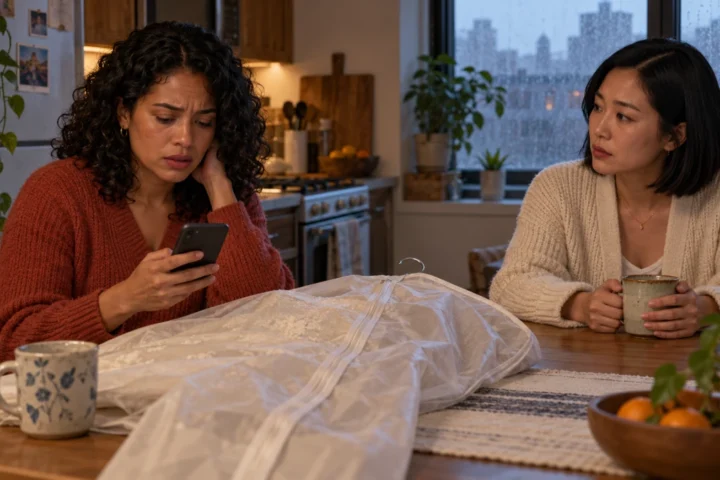
Lucia Moreno found out she was no longer in the bridesmaid photograph while standing in her own kitchen, holding a dress she had already paid for.
The dress had cost one hundred sixty dollars. The message on her phone cost nothing to send.
Celia had posted the new picture plan in the wedding group: four women beside the bride, arranged by height. Lucia's name was gone. Under the list was a note about keeping the morning simple for the girls who had committed to everything.
Everything had changed three days earlier, when a two-night trip outside Des Moines appeared in the chat. Shared lodging, activities, food, and travel would add six hundred eighty dollars. Lucia had privately told Celia she could not go.
She had not asked anyone to cancel. She had not mentioned rent, her aging car, or the small balance she kept between herself and trouble. She had said she could still afford their original agreement: the dress and ninety dollars in local wedding expenses.
Now she set the garment bag over a chair and read the word committed again.
Across the table, Nadine Cho put down her tea. Her cream cardigan sleeve brushed the saucer.
"Maybe she forgot to copy your name," Nadine said, without sounding convinced.
Lucia scrolled. Someone had replied with four heart emojis. Celia had answered, Perfect, finally settled.
She was thirty years old. She could manage her money, turn down a trip, and survive not being in a photograph. What she could not figure out was how a private limit had become a public measure of how much she loved her friend.
She typed a question, deleted the part explaining her checking account, and sent what remained.
"Celia, am I still a bridesmaid?"
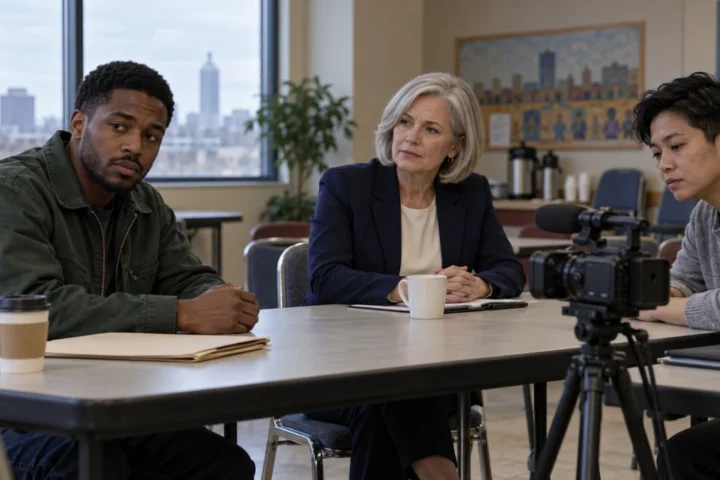
The camera was already pointed at Darius Bell's chair when he arrived for the scholarship interview. Beside the lens, someone had taped a sheet headed MY WAY OUT.
He recognized his name in the first sentence. Nothing after it belonged to him.
At twenty-eight, Darius had survived abandonment, hunger, and a family that never believed in education.
His mother had driven him to his placement test. His younger sister had bought him a calculator with grocery-store overtime. On Tuesday his uncle had spent two hours helping him understand fractions, admitting cheerfully that neither of them remembered enough.
There had been hard months. That did not make this their story.
"We can make it sound natural," said Ingrid Sloan, the scholarship committee chair, smoothing the sleeve of her navy blazer. "It's just a starting point."
Darius kept his dark green work jacket on. He had come to ask for eighteen hundred dollars toward electrical courses and tools, not to explain his family to strangers with donation buttons.
Behind the camera, Robin Tate stopped adjusting a cable. Their gray sweater had a tiny burn near one cuff.
"Before we start," Darius said, "is doing this part of being considered?"
Ingrid glanced at the empty chairs reserved for two other interviewers. "Our supporters like to meet the people they help."
That was not an answer. His parking meter had forty minutes left. Another candidate waited outside with a folder as carefully organized as his.
He could smile, replace a few sentences, and hope nobody noticed what he had traded. Or he could ask again and risk leaving with nothing except the bus schedule he had folded into his application.
Robin reached for the power switch, then waited.
Darius put the prepared sheet facedown on the table.
"I can tell you why I want to be an electrician," he said. "I won't say those things about my family."
I recognized the wrong note before I recognized my own voice.
At my husband's cousin's engagement party in Nashville, somebody turned up a small speaker beside the courtyard door. Under the string lights, Elsie lifted her glass. Her auburn bob brushed the shoulder of her green dress.
"Graham made us something," she said.
My husband smiled in his tan jacket. I was reaching for a napkin when the piano began.
Four notes climbing. A pause I hadn't decided how to fill. Then the low E I had struck by accident because my hand was shaking that night.
It was my unfinished recording.
Not a song I had played for friends. Not something from my teaching website. A private file I had left on our household laptop after my own computer stopped working.
I turned toward Graham. He gave me a little nod, as though we were sharing a wonderful secret.
Then my voice came through the speaker.
"For Leena. I still don't know how to finish—"
I reached the table before the sentence ended and pressed the power button.
The courtyard fell quiet. Someone's ice shifted in a glass.
My sister had been dead five years. I had recorded those words alone, after midnight, believing that an unfinished thing could stay unfinished until I was ready.
Elsie's fiancé, Oscar, stepped away from the speaker immediately.
"Is something wrong with the file?"
Graham's hand settled between my shoulders. "Anika's emotional about this one."
I moved out from under it.
"Who did you send it to?"
He blinked. "It's just a gift."
"Who has it, Graham?"
Across the courtyard, a phone was still pointed toward the silent speaker. Elsie lowered her glass and went to ask its owner to stop recording.
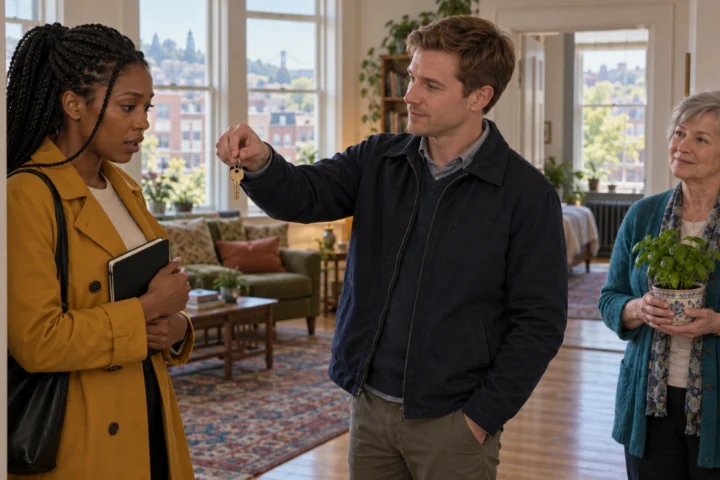
The leasing agent handed Wesley a key before she asked my name.
"Your mother already put a plant outside 2A," she said. "It makes this floor feel like home."
I looked at my fiancé. We had come to see an apartment in Cincinnati, not collect one. In my purse was a notebook containing twelve questions, including whether the second bedroom could hold my sewing table and whether the rent included water.
Wesley tucked the key into his navy jacket.
"I wanted you to see it first," he said.
"Before what?"
The agent stopped smiling. Behind her, an empty room smelled of fresh paint and somebody else's decision.
We were supposed to tour a first-floor apartment overlooking the courtyard. This one was upstairs. Across the hall, a door opened, and Adele Pike appeared in a teal cardigan with a basil plant cradled against her chest.
"Keira! Did he tell you about the Saturday market?"
He had not told me his mother lived here.
Adele was sixty-three, worked three afternoons a week doing alterations, and had recently sold the house where Wesley grew up. She needed fewer stairs, less yard, and somewhere to put a dining table that nobody wanted. None of that explained why her son's key was already warm in his pocket.
"Whose name is on the lease?" I asked.
"Mine," Wesley said. "We can add yours."
The agent quietly stepped toward the kitchen.
I had signed nothing. Paid nothing. Given notice nowhere.
Then Adele said, "I'm glad we can work out those evening errands together. I told him Tuesdays wouldn't suit me."
Wesley looked from his mother to me, still expecting this to become a happy surprise.
I closed my notebook.
"What evenings," I asked, "did you promise her?"
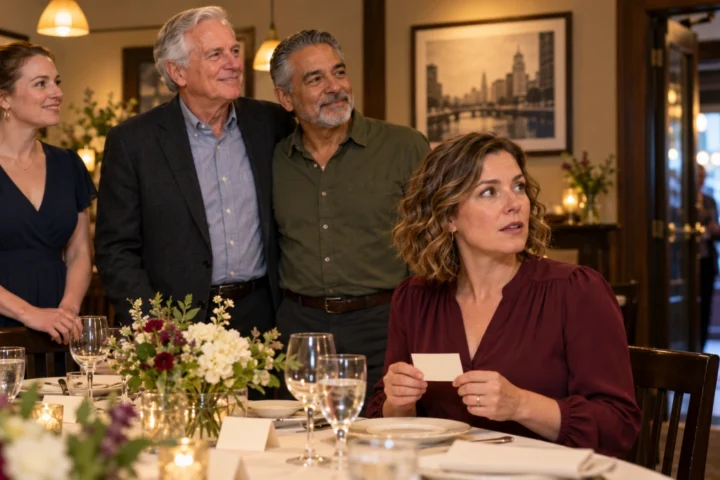
I was moving the last place card when my father walked into his retirement dinner holding a man's hand.
Not helping him through the doorway. Not greeting an old friend. Their hands rested together until they saw me, and then Dad let go.
That small retreat hurt before I understood why.
"Morgan," he said. "This is Rafael."
I looked down at the card I'd written that afternoon: CALVIN'S GUEST. At forty, I had organized enough dinners to know you asked for a guest's name. Somehow, when Dad said he was bringing someone, I had pictured a woman from his walking group and stopped listening.
Rafael had a neatly trimmed gray beard and an olive shirt beneath his coat. He extended his hand.
"It's good to meet you."
Behind me, my younger sister Paige said his name with the ease of someone greeting a person she'd met before.
I turned. "You know each other?"
Her silence answered first.
We were in a small restaurant room in Milwaukee, waiting for eight other guests to arrive. Dad's charcoal jacket still had a loose thread at the cuff. I'd meant to cut it off before the photographs. Twelve years after Mom died, I was still managing details as though enough careful work could keep our family in its familiar shape.
"We should have talked before tonight," Dad said.
"About what, exactly?"
He glanced at Rafael, who didn't rescue him.
"About the fact that Rafael is my partner."
Outside the door, a server laughed with somebody at the bar. I heard the restaurant continue being ordinary while the place card bent between my fingers.
Then Rafael looked at it.
"My name will fit," he said quietly.
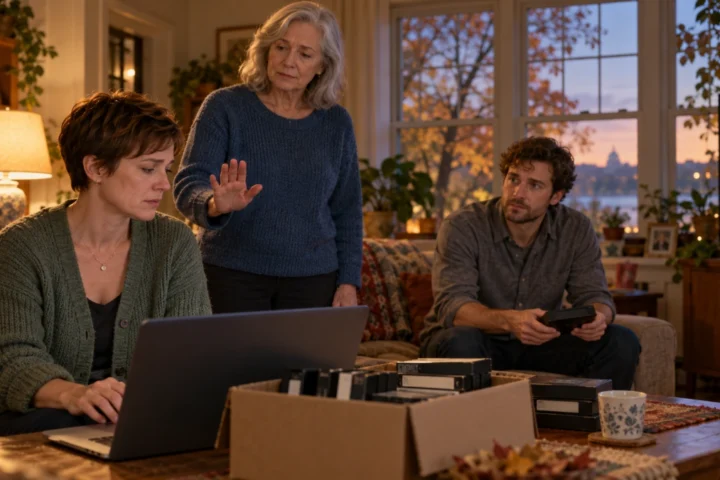
Mom asked me to stop the video before the cake hit the floor.
I had already reached for the volume. On the television, my father was laughing, alive again in our Madison kitchen, and for a second I wanted nothing except to hear him finish.
"Not this one," Mom said.
My brother Jonah leaned forward on the sofa. "It's the birthday cake. Everybody loves this one."
Everybody had included me. There I was on the screen, seventeen, laughing so hard that the camera shook. Behind Dad stood our mother, holding a platter with both hands. The cake leaned toward the edge like a house on a collapsing bluff.
In our living room, twenty years later, Mom gripped the back of a chair.
"Sadie. Stop it."
I paused. Her mouth remained open on the television. Dad's hand hovered near the platter. A blue plastic candle lay sideways in the frosting.
We were planning a home-movie evening for the first anniversary of his death. I was thirty-seven, old enough to know memory wasn't neutral, but apparently not old enough to stop treating my family's favorite joke as proof that we had been happy.
Jonah lifted the tape case. "We can't erase family history because it's embarrassing."
Mom looked at him, then at me in my sage cardigan, with my careful folders and invitation list.
"I'm not embarrassed about a cake."
The refrigerator started humming in the next room. Without the soundtrack, I noticed a kitchen towel tucked into the waistband of her younger self's skirt. I remembered that towel. I remembered none of the work around it.
Mom walked over and closed my laptop without slamming it.
"Before you show anyone," she said, "watch what comes before."